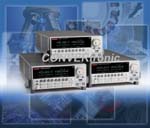
 Keithley has added three 2-channel SMUs to its 2600B series, designed for researchers, educators, R&D engineers, and those working with tighter instrumentation budgets. The new 2604B, 2614B, and 2634B models are optimized for benchtop applications, product development, student labs, and other scenarios where accuracy and high performance are important, but automation or integration with other instruments is not required. With these models tailored to these users, Keithley further strengthens its leadership in SMU instruments. Their pricing is designed to fit easily within researchers' budgets.
New Features that Boost Productivity:
The 2600B series offers 1- and 2-channel models that combine the features of a precision power supply, real current source, 6-digit multimeter, arbitrary waveform generator, pulse generator, and electronic load into a single, all-in-one instrument. The result is a solution for a multitude of applications, from benchtop IV characterization to automated production testing.
- 6.5-digit measurement resolution. They provide industry-leading resolution (up to 0.1 fA for models 2635B and 2636B), which is 100 times better than the closest competitor. This level of resolution allows users to discern smaller changes
in their measurements, enabling more comprehensive characterization.
- Software emulation for the SMU 2400. The 2600B Series is compatible with test codes developed for the Keithley SourceMeter SMU 2400 instrument, which has been widely used in the industry for over 15 years. This facilitates the upgrade of test systems based on the 2400 model to the 2600B Series, potentially improving test times by up to 80%. It also provides an easy path for migrating from SCPI programming to Keithley's advanced TSP technology. For legacy test systems, this emulator also supports the test command sequencer for managing the 2400's Source-Measure memory.
- USB communication for external control. The rear USB 2.0 connector expands the available interface options for communicating with a PC. The new 2600B series gives users the widest range of communication buses: USB, LAN/LXI, GPIB, and RS232. The addition of the USB connector offers the ease, versatility, and low cost of using this type of connection.
- Embedded IV characterization software. The 2600B instruments are the only SMUs on the market with embedded Java-based test software for plug-and-play IV characterization via any web browser from any PC, even from anywhere in the world. This built-in software increases productivity in a multitude of applications, including R&D, student labs, failure and quality analysis, and many others. Users can easily connect to their 2600B via the web using the supplied LAN cable and by entering the instrument's IP address, and begin characterizing materials or components immediately. Results can be downloaded to a spreadsheet for analysis or imported into a document or presentation.
High-Speed Test Automation Tools:
The 2600B series contains the same features and functions as its predecessor, the 2600A, with which it is fully compatible. Key features include the internal Test Script Processor (TSP®), which allows test programs to run from its non-volatile memory to provide the highest speed, eliminating the problems associated with GPIB traffic common in PC-dependent systems.
For multi-channel applications, the TSP-Link® communication and expansion bus is incorporated, working in conjunction with the TSP processor to enable high-speed, pin-by-pin SMU parallel testing. Because the channels of each 2600B instrument are completely isolated and do not require a mainframe, they can be easily reconfigured and used as new applications develop. A Digital Input/Output port is also included for controlling external equipment such as controllers or other devices, along with the internal Contact-Check option to detect faulty connections between the instrument and the sample being characterized before testing. These features are not available on the new 2-channel 2604B, 2614B, and 2634B models, which are designed to offer lower-cost solutions for tighter budgets in non-automated benchtop applications.