
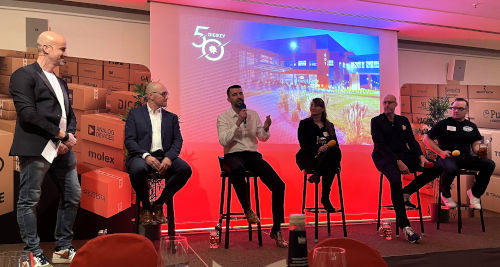
• Stefanie Kolbl, Business Unit Director, TQ Embedded
• Karsten Bier, Managing Director, RECOM
• Ian Wallace, Vice President for EMEA, DigiKey
• Hermann Reiter, Senior Director, DigiKey
• Kevin Walseth, DigiKey Manufacturer
The round table reviewed DigiKey's 50-year history, the evolution of the company and the sector, current industry trends, and the future of the integrated product community.
The panel began by discussing what has made DigiKey successful over the years and allowed it to compete in this global market. "It's about the culture, a positive attitude, helping each other get those 1,000 little things right every day," said Ian Wallace, DigiKey's Vice President for EMEA. "Being open to change and innovation. " This "can-do" attitude has made it a welcoming place to pitch ideas and try new things, an important characteristic for the success of a technology company.
Karsten Bier, CEO of RECOM, which develops standard and custom power converters and platform architectures, spoke about how DigiKey opened doors for him and his company. RECOM had been successful in Europe, but wasn't gaining traction in the United States due to a lack of brand recognition. That was until DigiKey showed a willingness to talk.
DigiKey's forward-thinking approach and ability to recognize what RECOM had to offer allowed them to enter the US market. Now they are successful in every state.
"I would say it's the American dream come true. And that's not an exaggeration," Bier added.
the digital transformation,
noting that while many things are being automated and digital transformation is ubiquitous, service and a personal touch remain important. Regardless of where a customer falls on the analog-digital spectrum, strong relationships between suppliers and manufacturers will continue to be critical. DigiKey works to find that balance with every customer.
"I don't think everyone is ready for pure digital. Everyone knows it has its advantages and its effectiveness, but you have to be prepared and in the right place," Wallace says.
Wallace also shared an anecdote about visiting a former DigiKey client last year. DigiKey had recently launched a tool that automates budgeting. While most of the team was thrilled that digitization would free up more time to focus on strategic work, some key team members weren't so sure. They felt automation eliminated personal interaction and was actually creating more work for their clients by requiring them to generate their own budgets. All this to say, you have to meet people where they are.
"Trust is very important, and everyone has their favorite partners," says Hermann Reiter, CEO of DigiKey. "You have to build trust with your supplier base and your customer base, and that's what helps digital transformation."
Current Challenges in the Sector:
Like any industry, electronics companies face challenges that are often beyond the control of any single company. The panelists discussed some of the challenges the sector is currently facing and how they are working to minimize their impact.
• Production Diversification: Before the pandemic, there was a huge reliance on APAC for products. Everyone was comfortable with the status quo and didn't recognize the need to diversify manufacturing. Now that people realize that something like a global pandemic could happen again, companies are working to ensure there isn't total dependence on one geographic area.
• Avoiding Bottlenecks: While sometimes unavoidable, bottlenecks exacerbate problems. Companies, like DigiKey, that have a long-term perspective and strategy are better positioned to mitigate supply chain issues by focusing on inventory allocation and having additional materials in stock.
• Communication is key: For the entire ecosystem to function properly, collaboration between the manufacturer, the customer, and the distributor is essential, even in an unstable market. This collaboration and real-time, interactive communication help to level the playing field in the market. "During this crisis, we, as customers, have learned who a true partner is, not just a supplier," shared Stefanie Kolbl, business unit director at TQ Embedded. "We need flexibility, and we've established strong partnerships with DigiKey."
• An opportunity for innovation: Smaller companies had large stockpiles when Covid hit. This allowed them to make a name for themselves by innovating with new and exciting initiatives. "If there's a silver lining to the chip shortage, especially for manufacturers, it's that it has allowed many companies with large stockpiles, inventory, and availability to create new chips," says Kevin Walseth, a manufacturer at DigiKey. "They came from nowhere and were able to help many customers who couldn't get their favorite chip or whatever it was."
The next generation of engineers, designers and makers
Back in 1972, DigiKey's founder was a hobbyist and engineer, now commonly called a "maker".
The roundtable discussion highlighted how, 50 years ago, being a manufacturer wasn't as common as it is now. Currently, the barrier to entry and the availability of supplies are lower than ever, opening the door for many young people to enter the sector.
"Educators and students are creating the next generation of products," Walseth says. "Students are going to take what they've learned in electronics and apply it to their careers, whether they're engineers or in technology, and they're going to take DigiKey with them. We want to support and grow with students; they are the next generation."
The roundtable concluded with a discussion about the successes of the past 50 years and the excitement for what lies ahead. Companies that can be flexible, evolve, and continue building relationships, even with the shift to a more digital environment, will thrive in this constantly evolving industry. "DigiKey is a really good provider," says Kolbl. "We're looking forward to the next 50 years and moving forward together into the future."