




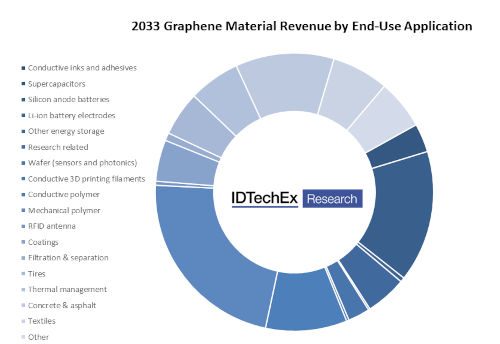
Graphene has been proposed and used for numerous functions in energy storage applications, from lead-acid batteries to supercapacitors, but the real target is lithium-ion batteries. This market is booming; IDTechEx forecasts that the lithium-ion battery market will exceed $430 billion by 2033, so even a small slice of this pie is significant. The market has various applications, from power tools to residential installations, but, of course, the majority will be used in the automotive sector. Graphene's role within the battery has once again become diverse; companies have proposed using it as a coating for a current collector or as a conductive network enabling alternative solutions such as lithium-sulfur. However, the predominant area is the role it can play in enabling silicon anodes or improving the performance of current-generation lithium-ion electrodes.
In February 2023, Evonik announced an investment in the China-based graphene manufacturer SuperC. This investment comes from its Technology Fund for Sustainability, launched in 2022, which has a total investment volume of €150 million. The press release states that SuperC's technology can "improve the range, robustness, charging speed, and lifespan of lithium-ion batteries." It adds that "the addition of graphene increases the electrical and thermal conductivity of the batteries for faster charging and better overall performance. Furthermore, the batteries are less sensitive to temperature.".
SuperC has long been a strong advocate for graphene, and at a time when other early adopters have withdrawn, it provides a welcome boost to the industry. Founded in 2011 (also known as Hefei Haizhou New Material Co.) in Dongguan, China, the company has always focused on energy storage. They produce thin-layer graphene (FLG) and have reportedly established a 10,000 tpa capacity for graphene electrode pastes for batteries. The press release also notes that the company will be establishing a new production facility in Hefei.
Location is also important, both for the graphene supply chain and for customers. Chinese research institutes and trading companies have excelled in the field of graphene, holding a significant share of global capacity and a dominant number of registered patents. A key market for graphene is its use as a heat sink in smartphones, led by Chinese manufacturers who supply the consumer electronics industry locally. Similarly, China, and Hefei in particular, is a major battery production hub, providing a key strategic advantage for SuperC. Evonik, for its part, has become increasingly active in the battery sector, with several product launches.
This isn't the only headline about graphene batteries. In 2022, VoltaXplore (a 50/50 joint venture between NanoXplore and Martinrea) commissioned a demonstration facility, and more recently, Nanotech Energy announced in 2023 plans for a £1 billion gigafactory in the UK. Both are noteworthy, but the combination of a large chemical company with a leading graphene manufacturer, in a key geographic location, and with proven capabilities and relationships in the lithium-ion battery sector, could have a major impact.
IDTechEx points out that, despite all the hype, graphene is just one solution. It is in a relatively early stage of adoption, unlike its older sibling, MWCNT, which is experiencing significant commercial expansions, such as the recent announcement that CATL will use Toyocolor's dispersed CNT product and LG Chem's expansions (see report). There is substantial know-how in both dispersion and optimization of the charge and corresponding properties in combination with other conductive additives. The price of graphene will, of course, be a major factor, but unlike other markets that graphene is targeting (e.g., recycled plastic), the added value and corresponding margins in the energy storage space are more attractive. Regarding the next generation of batteries, there are many exceptionally well-funded viable solutions for both silicon anodes and, further down the line, solid-state batteries. Competition is fierce, given the size of the prize for the winner.













