
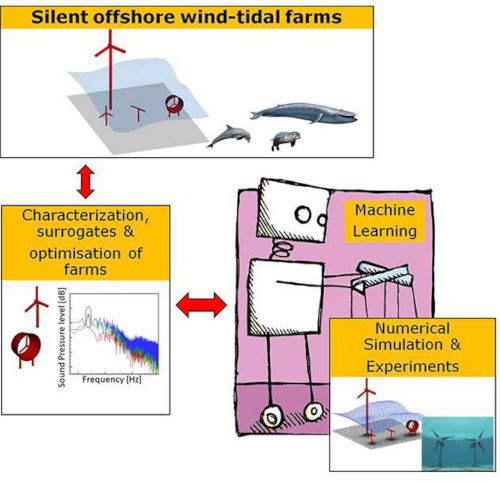
Esteban Ferrer, a professor at the Higher Technical School of Aeronautical and Space Engineering at the Polytechnic University of Madrid, has been working for over 20 years on the impact of noise generated by wind farms. The reward for this long journey has come with the awarding of a Consolidator Grant in the latest call for proposals from the European Research Council (ERC) in 2022 for his OFF-COUSTICS project, which aims to predict the acoustics of offshore wind and tidal power plants.
The environmental and socioeconomic challenges of the project are significant. The government is finalizing the map of areas that can host offshore wind farms and has set 2023 as the date to launch the first offshore wind energy auction in Spain. All of this will lead to a surge in offshore wind farms, which, in Ferrer's opinion, must be approached with caution. “Acoustics at sea is a hot topic, not only because of the turbines themselves, but also because of maritime traffic. The difference is that the turbines will be installed for thirty years and will not generate energy continuously.”
The CoG grant will allow them to hire five researchers, both PhDs and non-PhDs, to, on the one hand, run simulations using a highly precise tool developed by Ferrer's group that will allow them to study flows and acoustics, and on the other hand, conduct experiments involving controlled tests in wind tunnels and wave tanks to observe the acoustic transmission from the turbine to the water. This will provide simplified models of the turbines, enabling them to optimize the wind farm and minimize noise while maintaining energy generation.
Esteban Ferrer's project proposal doesn't involve changing the geometry of the existing windmills, but rather attempting to make minimal changes to their operating conditions to reduce noise. "I propose conducting a fundamental study, analyzing noise direction maps to see how far it propagates, and then controlling it."