
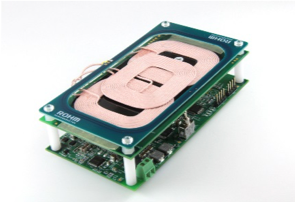
 ROHM recently announced the development of a wireless charging solution for the automotive industry with integrated NFC communication. This solution combines ROHM's automotive-grade (AEC-Q100 rated) wireless power transfer control IC (BD57121MUF-M) with STMicroelectronics' NFC reader IC (ST25R3914) and 8-bit microcontroller (STM8A Series).
In addition to meeting the WPC Qi standard and supporting EPP (Extended Power Profile), which allows the charger to deliver up to 15W of power, the multi-coil design provides a wide charging area, offering greater spatial flexibility for in-vehicle applications (2.7 times the charging range compared to single-coil configurations). This means consumers don't need to worry about precisely aligning their smartphones with the provided charging zone to charge them wirelessly.
Wireless charging technology, commonly used in portable devices like smartphones to improve the safety and water and dust resistance of connectors, is increasingly being adopted in infrastructure applications, including vehicles, hotels, airports, cafes, and similar public spaces. Currently, Qi, the most popular standard, has already been adopted by the European Automotive Standards Group (CE4A) as the standard for in-vehicle charging, and it is projected that by 2025 most cars will be equipped with Qi-based wireless chargers.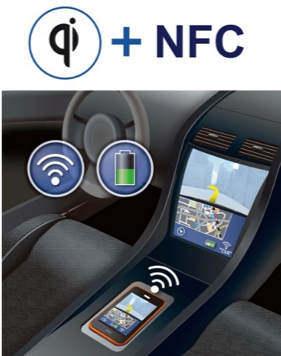
Meanwhile, NFC communication provides user authentication to enable Bluetooth/WiFi communication with the infotainment system, lock and unlock the doors, and start the engine. NFC communication also allows for the customization of vehicle settings for multiple drivers, such as seat and mirror positioning, infotainment presets, and navigation destination presets.
A reference board incorporating this solution will be showcased at the 11th International Automotive Electronics Technology Show at Tokyo Big Sight from January 16-19, 2019. ROHM plans to release a sample reference board in the future that will allow users to easily configure a Qi-compatible (EPP) wireless automotive charger when combined with our existing Qi-certified receiver board (BD57015GWL-EVK-002).
ROHM is committed to developing solutions that enable greater convenience and performance for a rapidly expanding wireless charging market.
Availability: February (reference plate), April (BD57121MUF-M)
Key Features
1. Foreign Object Detection (Detects NFC Cards in Smart Cases)
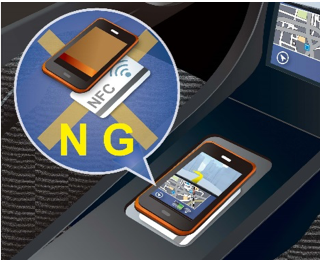
Using the Qi standard, a foreign object detection function is included to detect metallic objects and prevent deformation or damage due to excessive heat generation if a metallic object is placed between the transmitter and receiver. This time, however, the designers faced the challenge of ensuring that the NFC antenna detection does not damage the NFC card due to the magnetic field. This has been achieved by integrating an NFC communication function that allows the NFC card to be detected even when it is inserted into a smartphone case or similar item.
2. NFC Enables Seamless Infotainment Operation Through Device Authentication
. Previously, connecting smartphones to infotainment systems required manual pairing for each device. However, by combining Qi wireless charging with NFC communication, ROHM has made it possible not only to charge mobile devices such as smartphones, but also to simultaneously pair via Bluetooth or Wi-Fi using NFC authentication. To use it, simply place a smartphone on the charging pad to automatically initiate screen sharing with the infotainment and navigation system.
3. It allows system sharing through personal authentication via NFC.
In the future, it is expected that all vehicles will use the NFC protocol to connect smart devices with the on-board system in order to provide shared functionality that does not depend on traditional keys or dedicated cards.
 ROHM Wireless Charging Technology.
As a regular member of the WPC, ROHM actively participates in working groups from the early stages of specification development for the increasingly popular Qi wireless power standard and has diligently developed 15W class control ICs and reference designs that meet market needs.
In 2016, it began selling the industry's first Qi-certified 15W class transmit (BD57020MWV-EVK-001) and receive (BD57015GWL-EVK-001) reference boards. These boards were launched to promote the deployment of wireless charging solutions. The latest board, the BD57121MUF-M (transmit), complies with the AEC-Q100 standard to support automotive applications.
STMicroelectronics'
Automotive-Grade NFC Reader ICs: The ST25R3914/3915 NFC reader ICs are compliant with ISO14443A/B, ISO15693, FeliCa™, and ISO18092 (NFCIP-1) Active P2P, and feature a high-performance analog front end with best-in-class receiver sensitivity, delivering reliable foreign object detection performance in vehicle center consoles.
The ST25R3914 includes ST's patented automatic antenna tuning feature, which adapts to environmental changes to minimize the effects of nearby metallic objects, such as keys or coins placed in the center console. Additionally, MISRA-C:2012 compliant RF intermediate software is available to enable customers to reduce their software development effort.
STMicroelectronics' 8-bit MCUs for the Automotive Sector:
The STM8A series of high-performance 8-bit MCUs for the automotive sector is available in a variety of packages and memory sizes. Furthermore, the pin-to-pin compatible product line allows users to select the product that best suits their required functions and performance. Devices with embedded data EEPROMs are also available, including CAN-equipped models that offer a wide guaranteed operating temperature range up to 150°C, making them ideal for a variety of automotive applications.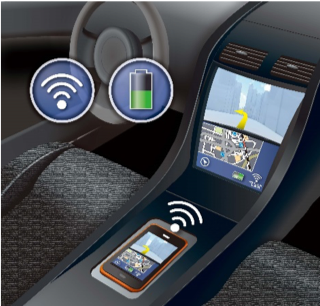
NFC
(Near Field Communication) is a well-established technology that facilitates the introduction of innovative applications by enabling contactless wireless communication at 13.56 MHz. The unique characteristics of NFC are expected to have a significant impact on a wide variety of areas, including smart homes, industrial equipment, and wearable devices. STMicroelectronics, a leading provider of NFC technologies, offers a comprehensive portfolio that enables users to develop the most efficient and secure solutions for a wide range of applications.
AEC-Q100 is a failure mechanism-based stress test established by the Automotive Electronics Council, an organization comprised of the leading U.S. automotive and electronics component manufacturers responsible for setting reliability standards for the automotive electronics industry.
The Wireless Power Consortium (WPC) is a standards organization established to formulate and promote the international Qi standard for wireless charging. WPC is currently the largest international standards organization for wireless charging, with over 638 member companies as of November 2018.
CE4A (Consumer Electronics for Automotive) is an organization that promotes the standardization of interfaces between portable devices (i.e., mobile phones, compact audio players, beacons) and automotive ECUs (electronic control units).