
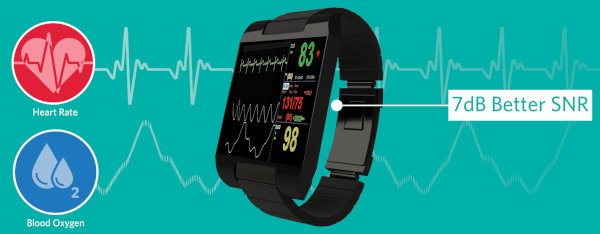
Traditional low-quiet-current regulators, preferred in wearable applications, have advantages and disadvantages that degrade signal-to-noise ratio (SNR) at the wrist, such as high-amplitude ripple, low-frequency ripple, and long settling times. Some designers have even turned to high-quiet-current alternatives to overcome these drawbacks, but these come at the cost of increased power consumption, reducing battery life or requiring a larger battery. The MAX20345 features a one-of-a-kind buck-boost regulator based on an innovative architecture optimized for highly accurate heart rate, blood oxygen (SpO2), and other optical measurements. This regulator delivers the desired low-quiet-current performance without the SNR-degrading drawbacks and, as a result, can increase performance by up to 7 dB (depending on measurement conditions).
The MAX20345 is also the latest in a range of ultra-low-power PMICs for small wearable and IoT devices that help increase efficiency without sacrificing battery runtime. To meet these needs, the MAX20345 integrates a lithium-ion battery charger; six voltage regulators, each with ultra-low quiescent current; three nanoPower bucks (900nA typical); and three LDO regulators with ultra-low quiescent current (as low as 550nA typical). Two load switches allow peripherals to be disconnected from the system to minimize battery drain. Both the speed boost and the bucks support dynamic voltage scaling (DVS), providing additional power-saving opportunities when lower voltages can be implemented under favorable conditions. The MAX20345 is available in a wafer-like package (WLP) of 56 bumps, 0.4 mm pitch and 3.37 mm x 3.05 mm.
Key Benefits
Superior performance for optical systems: The integrated buck-boost regulator provides low ripple at high frequencies that will not interfere with optical measurements. These short setup times are compatible with measurements from highly sensitive optical sensors in wearable devices.
Extended battery life: Regulators with nanoPower quiescent current reduce standby and reserve power, which in turn extends battery runtime and allows for a smaller battery size. High-efficiency regulators conserve battery power during active states.
Small footprint: By eliminating multiple discrete components, the MAX20345 provides a sophisticated power architecture for space-constrained IoT and wearable device designs.