
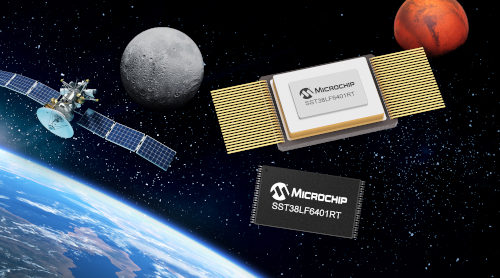
Microchip Technology Inc. has announced a SuperFlash memory device incorporating a radiation-tolerant 64 Mbit parallel interface and featuring a Total Ionizing Dose (TID) that offers maximum reliability and robustness in the high-radiation environment of space missions. It is an ideal complement to Microchip's space-ready microcontrollers, microprocessors, and FPGAs (Field Programmable Gate Arrays), providing the building blocks for this scalable development model.
“The SST38LF6401RT SuperFlash device further enhances our scalable approach to developing comprehensive solutions for space systems, utilizing our radiation-tolerant or radiation-resistant microprocessors and FPGAs,” said Bob Vampola, associate vice president of Microchip’s aerospace and defense business unit. “It provides the vital protection these space systems need for the most reliable digital processing when additional Flash memory is required to store critical software code or the bitstream that powers the entire system.”.
The SST38LF6401RT device, which tolerates up to 50 kilorads (krad) of TID radiation while the Flash remains polarized and operational, enables systems to work in a wide range of space applications where losing any code execution that could cause serious system defects and losses is unacceptable. It is an ideal complement to Microchip's SAMRH71 radiation-resistant SoC based on the Arm® Cortex®-M7 and can also be used with PolarFire® RT FPGAs for in-flight system reconfiguration.
The pinout of the device is compatible with its industrial version to facilitate the transition to the plastic or ceramic versions approved for space applications with respect to the printed circuit board. The SST38LF6401RT operates at 3.0 to 3.6 V. Development Tools and Availability: The SST38LF6401RT SuperFlash device is currently being sampled in a ceramic version and is supported by an evaluation board and demo software, available upon request. A reference board for FPGA flight programming, which combines the SuperFlash device, an FPGA, and a SAMRH71 processor with supporting software, is also available
Microchip's Process: From Conventional to Radiation-Tolerant Devices.
Selecting the right devices from its family of approved automotive and industrial products, along with improvements to the silicon process, allows Microchip to increase its level of protection, making them more immune to spot blockages in highly ionized environments. The radiation response of the slightly modified devices is fully characterized, and a radiation report is available for each functional block. The devices are used in applications ranging from launch vehicles and satellite constellations to space stations. Designers can begin implementing the system with readily available conventional devices before replacing them with their space-approved equivalents, which feature compatible pins and are supplied in highly reliable plastic and ceramic packages.