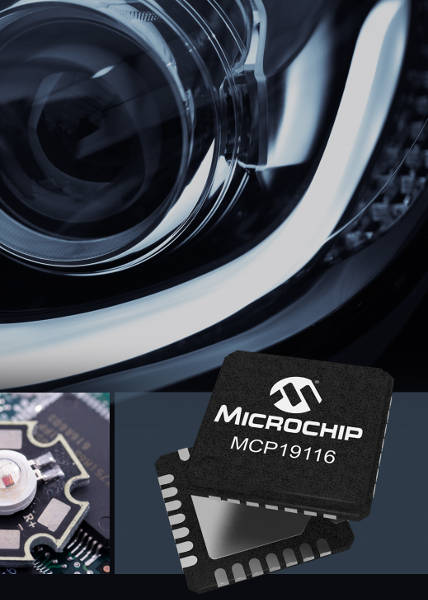
The MCP19116 and MCP19117 models increase the accuracy of LED lighting and allow users to carefully control LED light levels without sacrificing color or light quality for reliable applications with a long operating life.
Efficiency and longevity have driven the adoption of LEDs. However, light quality remains one of the most important aspects to consider in the system; color, brightness, and controllability are key to a successful lighting product. Combining the power and performance of an analog-based controller with the flexibility of a digital interface, the MCP19116/7 is an intelligent pulse-width modulation (PWM) controller with a fully integrated PIC® microcontroller core that offers cost savings while still providing the highest levels of reliability, efficiency, and light quality. The digital interface also enables communication and configuration, allowing a subsystem to report its status or be controlled remotely. This functionality is essential for adding lighting to numerous applications, especially in high-reliability automotive environments and in remotely accessible Internet of Things (IoT) devices.
The LED lighting industry continues to grow in market share and reach. A 2015 report by Big Market Research indicated strong market growth for LED lighting, anticipating that the sector would grow by 45 percent annually until 2020. The market is expected to exceed $63 billion by 2020. These forecasts align with those presented by other industry analysts.
Microchip also announced the MCP19117 (ADM00663) evaluation board, priced at $49.99 and available now. This evaluation board features a flyback design for constant current loads up to 50V, ideal for controlling a medium-voltage LED string.
The MCP19116 and MCP19117 models also feature Microchip's full suite of development tools, including the MPLAB® X integrated development environment. A special MPLAB X module for digitally enhanced analog power controllers is also available.
The MCP19116 is supplied in a 4 x 4 QFN package, and the MCP19117 in a 5 x 5 QFN package. Both devices are now available for sampling and volume production.