




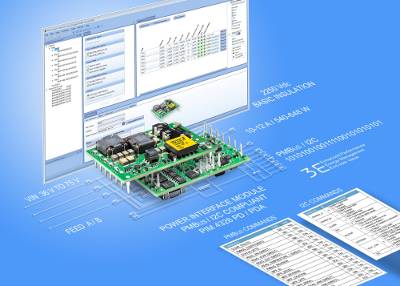
 The PIM4328PD and PIM4328PDA modules, which conform to the de facto standard 300W format and offer I2C and PMBus serial bus communications, simplify the monitoring of the board's power supply and operational functionality without the need to add external components, thus shortening the time to market and reducing development costs.
Thanks to the company's own high-efficiency PIM4328P analog platform, the addition of bus communication to the modules increases the flexibility offered by digital monitoring, including voltage/current input parameters. This allows system architects to evaluate power consumption at the board level, an important parameter for accurately monitoring efficiency and also helps ensure system compliance with energy efficiency legislation where required.
While initially designed for Advanced Telecom Computing Architecture (ATCA) applications due to the advantages of a standalone module in terms of board space and time to market, the Information and Communications Technology (ICT) sector is rapidly adopting PIM technology, which is becoming an increasingly important component for system designers implementing new platforms. However, the new PIMs are also well-suited for industrial, telecommunications, and data communications applications using distributed power architectures.
Communication Functions:
The PIM4328PD incorporates an embedded standard I2C/PMBus digital interface that allows users to monitor input and hold voltages, output current, and device temperature. The product can be used with any standard two-wire I2C or SMBus host device. The PMBus version of the module is compatible with PMBus version 1.2 and can operate with clock frequencies between 10 and 400 kHz.
Through the PMBus interface, the module can monitor various parameters and status/fault indicators in addition to continuous monitoring: Supply A voltage, Supply B voltage, output current, holding voltage, internal junction temperature, and status/fault indicators such as supply undervoltage, Output 1 undervoltage, and hot swap. Through the I2C interface, the PIM4328PDA can monitor six status bits and five analog measurements, including holding capacitor voltage, Output 1 current, Supply A input voltage, Supply B input voltage, and module temperature.
Electrical performance
The PIM4328PD and PIM4328PDA, which offer a typical efficiency of 99% for an output of 300W, maintain the high levels of dynamic and load variation performance required by ATCA equipment, while limiting power losses in the filtering unit to a very low level.
The modules operate on an input range of 36V to 75V and can maintain a continuous output current of 10A without forced airflow up to +70°C and up to +90°C with an airflow of only 2.0 m/s (400 LFM). The output power is 390W with a 39V input (minimum) and up to 540W with a 54V input (minimum). Thanks to the excellent thermal design and high-performance components, when used in conjunction with a power supply at the input stage, the output current can be increased to 12A. This results in a total output power of 648W, providing ample headroom for upgrading motherboards with newer processors or more memory.
Protection and Other Functions:
The dual-supply 2250 VDC management output voltages with isolated I/O are 3.3V/3.6A and 5V/0.15A. Other functions of the PIM4328PD and PIM4328PDA include protection against input transients, reverse polarity, over-temperature, overcurrent, input undervoltage, and inrush current. The modules are RoHS compliant, feature full-function swap functionality, and retain charge and discharge management. Inputs include two power supply channels with ORing functionality and "on" signaling. The modules have an MTBF of 1.5 million hours (Telcordia SR-332 Edition 2, Method 1) and meet the safety requirements defined in IEC/EN/UL 60950-1.








