It is fundamental for FHE to mount an integrated circuit (IC), fabricated separately using photolithography, on a flexible substrate and connect it to the printed interconnects. This presents some technological challenges: firstly, silicon dies are rigid and therefore have a form factor and coefficient of thermal expansion completely different from the underlying flexible substrate; secondly, alternative semiconductors to silicon, such as metal oxides and organic semiconductors, have much lower mobilities and are difficult to fabricate with sufficiently high yields.
Encapsulated ICs: A temporary solution
One interim strategy involves soldering a conventional encapsulated rigid IC to a flexible (usually rigid) substrate. Such circuits are generally called flexible printed circuit boards (FPCBs) despite having etched interconnects. Unfortunately, mounting an encapsulated IC substantially limits flexibility and eliminates the possibility of R2R fabrication.
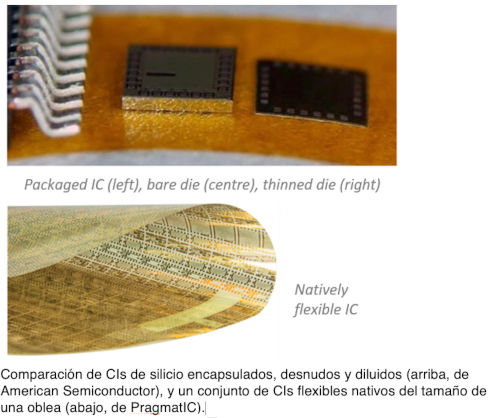
One solution is to use bare dies, a strategy that has been employed for years in RFID tags. These have a very small integrated circuit (< 1 mm²) attached at two points using a conductive adhesive to an antenna. However, this application avoids two of the difficulties associated with incorporating larger, more functional ICs. First, the integrated circuits are so small that their flexibility is almost irrelevant at any realistic bend radius. Second, large dies are feasible since only two electronic connections are needed.
However, as integrated circuits become more functional (for example, those incorporating Bluetooth or memory) and therefore larger, difficulties begin to arise. First, their lack of flexibility becomes a problem for FHE applications, as they cannot be tailored to the underlying substrate.
Flexible ICs of dilute Si
As such, flexible ICs are beginning to emerge, with the technological approach following two divergent paths. The first is to reduce the size of existing silicon chips by milling them down to just above the first junction. The fragile, thin die, with thicknesses as low as 10 µm, is encapsulated in a thin layer of polyimide to add protection against fractures and make it easier to handle.
This methodology is applicable in principle to many semiconductor chips, with flexible ICs already available in small volumes for prototyping. This includes a module with an analog-to-digital converter and UHF RFID measuring 2.2 mm x 2.3 mm x 25 µm. The current limitation to flexibility is not the die itself, but the fixing method, which we have identified as a key area for innovation.
 Native metal oxide flexible ICs
The other alternative is native flexible integrated circuits, which are currently only available for relatively simple applications such as RFID tags and sensor reading. While printed ICs have been tried and largely failed, the application of long-established photolithographic techniques to sequentially deposit films of metal, insulator, and metal oxide onto a polyamide substrate has enabled the creation of natively flexible ICs, allowing chips to cost as little as $0.01.
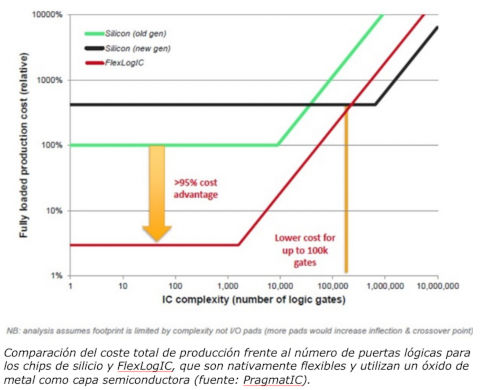
As can be seen in the table below, native flexible ICs are cheaper to produce than Si-based ICs if there are fewer than 100,000 logic gates, with the cost of RFID chips around $0.01. This cost-complexity characteristic is ideal for applications such as smart packaging, where low cost rather than processing capacity is the limiting factor.
Adoption of Flexible ICs 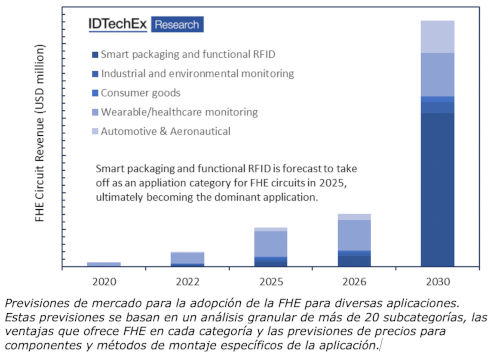
In summary, FHE inherently requires alternatives to the rigid packaged ICs used in conventional rigid PCBs and FPCBs. Dilute silicon dies, made more robust by polyimide encapsulation, are likely to find acceptance in applications with more complex processing requirements, such as replacing conventional PCBs. Standard bare dies can also be used, but require very careful handling to preserve yields. Natively flexible metal-oxide-based integrated circuits, currently only capable of HF RFID communication and relatively simple sensor data processing, will initially be used in RFID tags and smart packaging applications. Their capabilities, and therefore the range of suitable applications, are likely to expand as the technology develops.