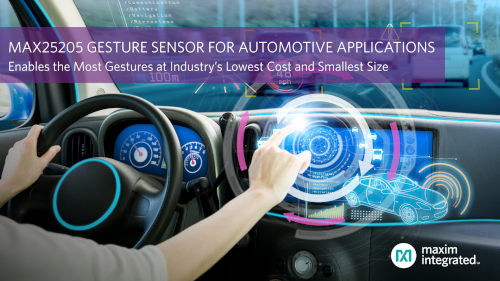
Automakers predict that driver safety will improve when gesture and proximity detection replaces knobs and touchscreens for infotainment, phone, side mirror, climate, trunk, sunroof, and reading light controls. Most current automotive gesture detection systems rely on Time-of-Flight (ToF) cameras, which are also costly and complex—features many manufacturers want to avoid.
Maxim Integrated's optically based MAX25205 enables most hand gestures at a solution cost up to 10 times lower than ToF camera-based systems. Furthermore, the gesture and proximity sensor features a high level of integration and comes in a small 4mm x 4mm chip size, which is up to 75 percent smaller than ToF camera-based solutions. This gesture solution offers a great complement to voice command, as there are scenarios where voice command is ineffective. Another benefit of a gesture solution is that car displays don't become covered in fingerprints when customers use their touchscreens.
Key Advantages
- Lower Cost: Enables swipe and turn gesture detection at a lower cost than a ToF camera; Allows developers to avoid developing complex software and maintenance programs
- Smallest Size: 60 photodiodes, LED driver, and internal LDO result in a total solution size that is significantly smaller than that of ToF camera solutions; can be paired with a small microcontroller, instead of the larger microprocessors that require more complex solutions
- Versatility: Offers 9 gestures, including swipe, rotations, air link, and 3x2 proximity zones with low latency on a single chip compared to a competitive solution that requires 3 chips and a complicated microprocessor; The cost reduction makes gesture detection feasible for automotive, consumer, and industrial applications, such as smart home hubs, thermostats, and more, all without touching the device.