Microchip has expanded its RT FPGA lineup to deliver these capabilities to emerging high-performance space applications.
A growing number of space applications require superior computing power, enabling them to transmit processed information rather than raw data and optimize the bandwidth of a limited downlink. The PolarFire RT FPGA achieves this at a significantly lower cost and with shorter design cycles than ASICs (Application-Specific Integrated Circuits). It also significantly reduces power consumption compared to SRAM-based FPGAs and eliminates their vulnerability to radiation-induced single events. PolarFire RT FPGAs come with all the necessary radiation data, specifications, packages, and tools that customers need for their new designs, starting with the commercial version of the device.
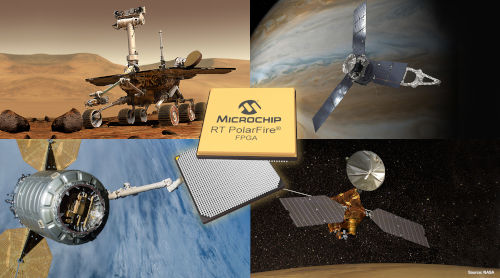
The PolarFire RT FPGA builds upon the success of Microchip's RTG4 FPGA, which has been widely used in space applications requiring its radiation-resistant design, specifically against single event upsets (SEUs), as well as its inherent immunity to single event latch-ups (SELs) and configuration issues. In space applications requiring up to five times the computing power, the PolarFire RT FPGA increases performance by up to 50% and triples the number of logic elements and the serializer/deserializer (SERDES) bandwidth. It also increases the amount of embedded SRAM sixfold to enable greater system complexity than previously possible with FPGAs and withstands exposure to a total ionizing dose (TID) exceeding 100 kRads, a typical value for most Earth-orbiting satellites and many deep-space missions.
The PolarFire RT FPGA reduces power consumption by approximately half compared to SRAM-based FPGAs with equivalent capacity and performance. Its non-volatile (NV) SONOS technology allows configuration switches to be implemented in a more power-efficient architecture, which also lowers development and bill of materials costs thanks to a simpler, less expensive, and lighter power supply system. This minimizes heat dissipation, mitigating thermal management issues. Designs are further simplified compared to SRAM-based FPGAs, as the PolarFire RT FPGA eliminates the cost, complexity, and recovery time associated with configuration-related issues.
The RT FPGA will undergo the standard QML compliance process, including Class V certification for critical applications. Microchip has extensive experience obtaining QML certification for its RTG4 FPGAs and other products, which involves numerous continuous tests, including inspection of each wafer and package.
Microchip’s PolarFire RTPF500T RT FPGA, supplied in hermetically sealed CCGA (ceramic column grid array) packages with integrated decoupling capacitors, will be available and certified for spaceflight in 2021. Customers can begin designing with the commercial PolarFire FPGA using Microchip’s Libero® software toolkit, which optionally supports Triple Mode Redundancy (TMR) synthesis to mitigate the effect of single events when needed, such as in control circuits. Development boards are available for the commercial PolarFire FPGA and will later incorporate the PolarFire RT device in engineering model format. Available radiation data includes TID, SEL, configuration issues, and DFF (D-Flip Flop) and unprotected memory.





- Details
- Category: Integrated Circuits
Microchip PolarFire® FPGA for high-bandwidth space systems
Microchip announces the PolarFire (Radiation-Tolerant) RT FPGA, optimized to meet the most demanding requirements for high-speed data paths in payload space systems with the lowest possible power consumption and heat generation. Space electronics developers are using RT FPGAs (Field Programmable Gate Arrays) to create onboard systems that meet the demanding performance requirements of future space missions, survive the brutal launch process, and continue to operate reliably in the harsh environment of space.




Print Magazine

Annual subscription price:
You will receive all 10 editions that are published each year.
social networks
Popular News Electronics



Spanish electronics magazine. Printed for over 25 years.
Spain - Madrid - All rights reserved © Convertronic Professional Spanish Electronics Magazine.