





As the power component of inverters, this IGBT module converts the DC voltage generated by the solar panels into an AC voltage suitable for the grid. Large players in the inverter industry use proprietary technologies for this power component; however, there is also a market of numerous manufacturers that do not use proprietary topologies. These companies, which rely on standard topologies, often struggled to compete with the larger companies, finding it very difficult to meet market demands for efficiency while maintaining high reliability.
With the first EBVchip Genesis, these companies can now compete much more effectively, as only minimal software changes are required to integrate Genesis into an existing solution. Since EBV Elektronik has prioritized high efficiency and maximum reliability in developing Genesis from the outset, this product employs a conventional Boost topology with a bridge configuration. For the package, EBV and Vishay have opted for the highly reputable ECONO2 (Econopack 2) technology. While there are more economical packages than ECONO2, which are also used in some next-generation inverters, it's important to note that ECONO2 provides exceptionally high reliability. Since end customers anticipate a service life of more than 10, often 15 or even more than 20 years when calculating the payback period for their photovoltaic system, having to replace the inverter after only five or six years is unacceptable to them.
 Genesis: The Creation.
The initial idea behind Genesis is to offer inverter developers a user-friendly solution that can be seamlessly integrated into existing designs as part of a migration path, and that operates with high efficiency and reliability, as well as good electromagnetic compatibility. Genesis meets precisely these requirements, and the more than 50 potential customers in Europe who could use this RoHS-compliant module have already expressed strong interest in the product: from Spain to Turkey; from Italy and Germany to Eastern Europe. EBV Elektronik first defined the design with a major customer, while subsequent refinement took place in close collaboration with several customers and the developers at Vishay.
EBV conceived Genesis for designs that already use Sixpack modules. Many of these customers already had an idea of what they needed, but due to the high NRE costs of a custom design, they had not been able to realize these ideas until now. This is precisely where the strength of EBVchips becomes apparent, as Slobodan Puljarevic, President and CEO of EBV Elektronik, so aptly stated at the EBVchips launch in early 2010: “With EBVchips, we are now building a bridge between thousands of customers and manufacturers.” Thus, Genesis is not designed for just one customer or one national market, but can be used worldwide. Without this focus on vertical markets, the design of EBVchips would not have been possible.
 In January 2010, EBV presented the EBVchips concept, and at electronica 2010, several customers got their hands on the practical Genesis products. In 2011, EBV will supply a large number of Genesis modules to customers.
When EBV began searching for a suitable manufacturer for Genesis after initial discussions with customers, the company first spoke with several partners considered for their EBV product range and ultimately chose Vishay.
Regarding technical feasibility, EBV could theoretically have undertaken the Genesis project with other partners in its product range; however, Vishay demonstrated exceptional flexibility and a willingness to fully support the project from the outset and complete it as quickly as possible. In other cases, the choice of a particular manufacturer may be based solely on the technology.
The current Genesis variant is already the third version of the specification. The various iterations were necessary because new customer requirements were constantly being integrated into the design. Without these additional iterations, EBV would have brought the module to market even sooner. Because EBV experts dealt directly with the factory engineers, thus avoiding typical bureaucratic procedures, this iterative refinement was possible in a very short time.
EBV supplied the first samples without an integrated thermistor for thermal protection because most customers did not require this functionality. However, EBV can also develop variants with an integrated thermistor within two months. Since the engineers responsible for the Vishay and EBV factory use a direct communication channel, design modifications are executed in real time.
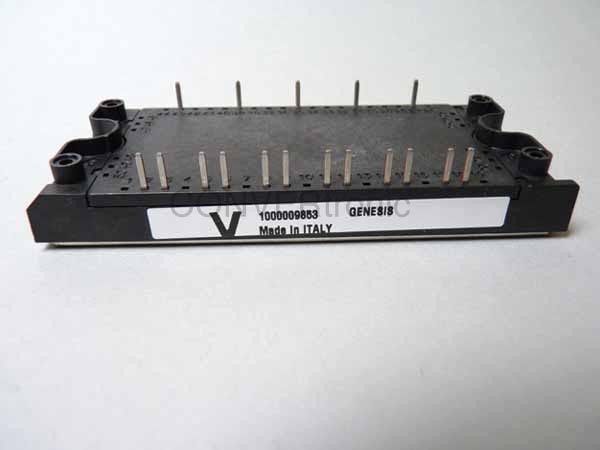
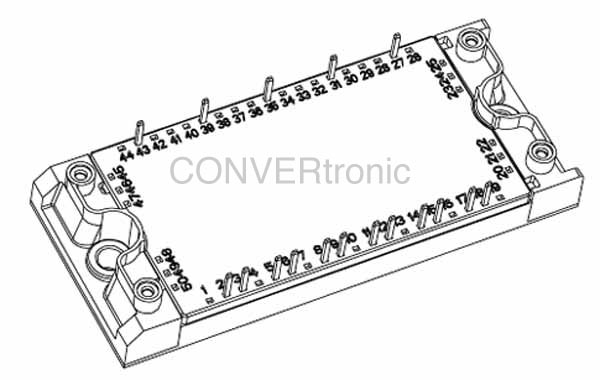 Genesis:
Genesis is a complete power stage integrated into a module for single-phase inverters in photovoltaic applications. With its nominal values of 600 V/50 A (continuous operation) and a conversion frequency of 4 to 30 kHz, Genesis is specifically targeted at residential applications, which mostly have a connection power of between 2.5 and 6 kVA. From the outset, EBV sought an exceptionally high-quality final product when selecting the semiconductor elements integrated into the module. This led to the use of Trench-IGBTs with their low collector-emitter saturation voltage of just 1.65 V to achieve the best balance between conduction and switching losses, while silicon carbide diodes provide particularly low switching losses and a very good EMC ratio. The reverse recovery time of SiC diodes is minimal, so the additional snubbing costs can be significantly reduced compared to conventional solutions.

 FRED silicon diodes bridge the boost converter stage when input voltages are very high, effectively protecting the power stage from polarity reversals in the solar panel connection. Thus, Genesis is ideal for use in single-phase inverters with a boost converter stage to implement the "Maximum Power Point Tracking" concept for photovoltaic modules.
This new component represents an improvement over existing solutions. It adds a unique feature to the product catalog that other manufacturers don't offer in the same way. While there are comparable silicon carbide components in the boost converter, prior to the launch of Genesis, there was nothing similar that also incorporated SiC diodes in the bridge arms.
Furthermore, the modules that most closely resemble Genesis do not come in an Econo2 package, and these other packages can even be more economical in some cases. However, the Econo2 package is superior to other commonly used packages due to its thermal, mechanical, and electrical properties. Furthermore, many customers who now want to use Genesis have historically worked with this package. From a thermal perspective, the Econo2 package with its solid copper baseplate is superior to previously used solutions. Due to the low thermal resistance between the chip and the case, thermal conductivity is improved and further optimized by direct mounting on the heatsink. In addition, mounting a module is much simpler than mounting discrete components, thus increasing reliability while reducing system manufacturing costs by shortening production time.
 In short, EBV's Genesis isn't the cheapest solution on the market, but it offers the best value. Until now, the prevailing opinion in the industry was that a solution like Genesis was too expensive, but now that EBV customers have finally achieved their goals with this solution, they are willing to bear the additional costs associated with these more expensive silicon carbide diodes.
However, compared to the overall cost of the complete inverter, the cost of the IGBT module isn't so high relative to the benefits it provides—ultimately, a more efficient and reliable solution with a better package. By combining increased efficiency, greater reliability, and lower system manufacturing costs, the total cost of ownership for Genesis modules is lower than that of other comparable solutions. If a manufacturer has to replace an inverter during the warranty period due to a failure, the company's profitability is significantly reduced. With Genesis, manufacturers gain a higher degree of efficiency as an added benefit. This isn't a low-cost migration, but rather a migration to higher performance and efficiency.
Genesis is the beginning of everything.
The best thing about EBVchips is that each chip is unique. For this reason, EBV experts are always thinking of new approaches to bring projects to fruition in collaboration with semiconductor manufacturers. At the same time, EBV has increasingly refined processes for defining specifications. Initially, a great deal of persuasion was required, but now we are hearing more and more comments from semiconductor manufacturers such as, "This project would have been very successful with us as a partner." Because manufacturers see EBV as a truly committed company that can deliver initial products so quickly, other manufacturers are also actively participating. This creates a degree of competition among semiconductor manufacturers around a project within the EBVchips ecosystem, depending on the potential product.
A module like Genesis can be implemented much faster than mere semiconductor designs, which typically take up to two years from initial concept to final chip. According to the project, EBV chips are exclusive to EBV for three to five years, or even longer. Genesis, for example, is available only through EBV.
Genesis is "only" the beginning. In early 2010, EBV began an active dialogue with customers, gathering a wealth of valuable information. Like the Bible, Genesis marks the beginning of a long and promising journey, one that always holds new developments, the future of EBV chips, which are still being defined.









