For some years now, various audio devices have been needed to faithfully reproduce information from different sound sources (multimedia files/music), not just high-resolution audio. However, supporting a wide variety of audio sources requires various multimedia decoders (such as CD, USB, Bluetooth), as well as other peripheral components, which creates problems related to software complexity and development effort.
For the audio sector, ROHM offers not only general-purpose ICs, such as operational amplifiers, but also audio ICs, ranging from multimedia decoders and speaker amplifiers to sound processors. Now, ROHM has developed an audio SoC that acts as the "brain" of audio devices and a reference design that improves audio quality for the entire system while minimizing development effort.
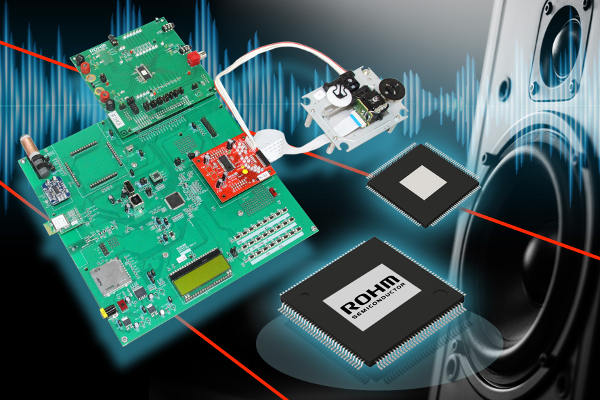
The BM94803AEKU integrates a processor chip with SDRAM featuring an optimized software-based architecture and circuits such as an ASIC (Application Specific IC), a microcontroller, and several multimedia decoders (developed by the ROHM Group) onto a single chip. The multimedia decoder is compatible with a wide range of audio sources, and ROHM's more than 20 years of experience allow them to ensure stable playback of damaged CDs and even non-standard USB drives. Furthermore, it incorporates SDRAM to achieve a higher level of miniaturization.
This SoC has enabled ROHM to achieve the first high-resolution reference audio design on the market. The design maximizes the performance of audio devices and peripheral applications by configuring ROHM's amplifier, CD controller, and other components around the audio SoC. Furthermore, its specialized software allows for the rapid development of audio devices capable of stably reproducing a wide variety of audio sources, significantly shortening development time.
Main features
1. Compatible with a wide variety of audio formats
The BM94803AEKU is multimedia compatible, with conventional formats (CD, USB, SD) and newer ones (smartphones, Bluetooth), as well as various music formats such as FLAC and DSD.
2. Ensures flawless playback.
Over 20 years of experience in developing multimedia decoders ensures flawless, skip-free playback, even from scratched CDs. It can also read non-standard USB drives, widely used in developing countries, while its unparalleled playback stability allows ROHM to meet customer expectations for audio equipment.
3. Complete software package for audio device development.
Providing an audio SoC optimized for audio devices, as well as a reference design that includes special software to significantly maximize performance, reduces the development effort required by audio equipment manufacturers, in addition to accelerating development and considerably shortening the time to market.
4. Integrated CD DSP and SDRAM that Increase Miniaturization:
ROHM's audio SoC integrates a CD DSP (CD Multimedia Decoder) and 16Mb of SDRAM (a LAPIS Semiconductor product), previously implemented separately, into a single package. This not only reduces the mounting footprint but also eliminates the need to account for radiation noise between components.
Reference Design for Audio:
This reference design maximizes the performance of ROHM's audio devices, especially the new audio SoC.
It incorporates audio components, as well as peripherals such as a tuner module, a Bluetooth module, and a CD controller, all of which allow for immediate verification of playback functionality and the rapid development of high-resolution audio equipment.
Applications
◇ Hi-fi audio equipment
◇ High-resolution component systems
◇ Bluetooth speakers
◇ USB D/A converters
Terminology
High-resolution audio source
CD-quality audio sources are generally reproduced at a sampling rate of 44.1kHz and 16 bits, but with high-resolution audio sources, it is common to use sampling rates of 96kHz or higher and 24 bits. In other words, the amount of information contained in high-resolution audio sources is much greater, resulting in higher quality audio.
SoC (System on Chip)
This is generally an integrated circuit (IC) that integrates the functions necessary for the system to operate. In this case, it represents a series of functions that allow audio signals to be extracted from audio sources.
Notes on Licensing and Trademarks
*The sale of iPod/iPhone/iPad compatible products requires an MFi (Made for iPod/iPhone/iPad) license. iPod and iPhone are trademarks of Apple, Inc. in the U.S. and other countries. iPad is a trademark of Apple Inc.
*SD is a trademark of the SD Association.
*Windows Media and Windows are trademarks of Microsoft Corp. in the U.S. and other countries.