In addition to integrating a newly developed fast-response error amplifier circuit and a low-noise architecture, multiple parameters that have been shown to affect audio quality in the development and manufacturing processes have been optimized through real-world listening tests, resulting in industry-leading performance in all key characteristics (voltage stability, noise level, and power supply symmetry) required by power supplies for audio equipment.
In recent years, the rise in popularity of high-resolution audio sources has increased the demand for audio components and devices capable of delivering even more accurate sound reproduction. At the same time, the power supplied to audio equipment has a significant impact on sound quality. Therefore, the power supply integrated circuit plays a crucial role in providing clean power with minimal voltage fluctuations and noise. Clean power supply involves optimizing three key characteristics: voltage stability, noise level, and symmetry between positive and negative power supplies. However, until now, no integrated circuit has been capable of meeting these requirements, hindering the achievement of improved sound quality.
 In response to this situation, ROHM has developed the industry's first integrated audio power supply circuits that deliver outstanding results in all three key areas by combining a patented analog power supply design technology that leverages power processes with expertise in audio quality. The result is a significantly cleaner power supply compared to conventional solutions, enabling higher audio quality, including improved sound imaging (location and distance of the sound source) and resolution (realism and depth).
Key features
1. Offers improved sound quality by providing a clean power supply.
1) Enhanced voltage stabilization:
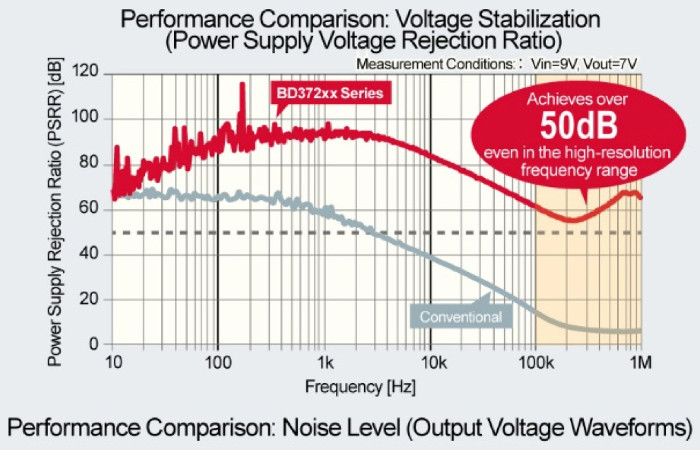
The incorporation of a newly developed error amplifier circuit, capable of high-speed response across a wide bandwidth, minimizes the effects of input voltage/output current fluctuations on the output voltage. The result is more faithful reproduction in the low frequencies (bass).
2) Reduced Noise:
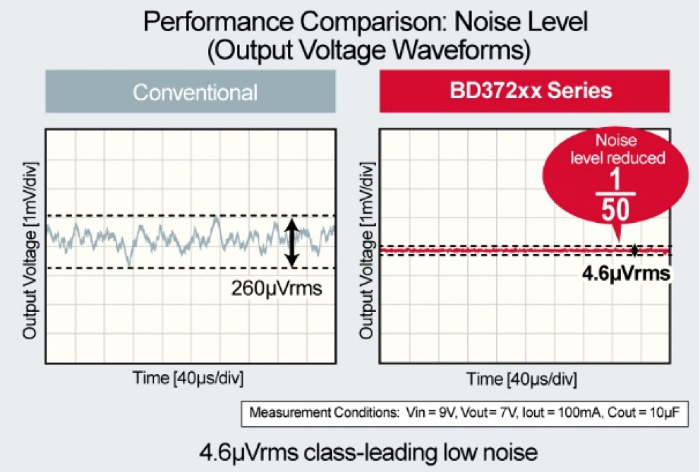
The class-leading low noise level is achieved by adopting a low-noise architecture that suppresses noise generated within the integrated circuit (4.6 µVrms, 50 times lower than conventional designs). This eliminates the influence of noise to deliver clearer sound with superior transparency.
 3) Symmetrization of Power Supplies:
In addition to the positive power supply integrated circuits, a negative type is offered which can be configured to achieve ideal symmetry in characteristics when used together. This allows for improved sound imaging and an expanded sound stage.
2. Program optimized for high-fidelity audio equipment
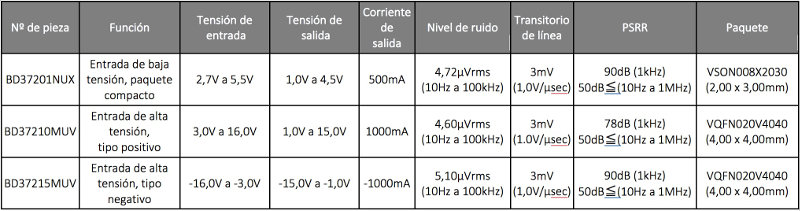
The BD37201NUX is ideal for low-voltage digital devices such as DACs and DSPs, while the BD37210MUV (positive power supply) and BD37215MUV (negative power supply) are optimized for analog devices (i.e., sound processors, current-voltage conversion amplifiers) that operate with positive and negative power supplies.
See table
for program
 Applications
Hi-Fi audio systems, portable equipment, home audio, wireless speakers and other equipment that requires high fidelity playback.
High-resolution audio source
terminology:
Unlike standard CD music, which is played back at a sampling rate of 44.1 kHz and a quantization bit rate of 16 bits, high-resolution audio sources typically require playback at a rate higher than 96 kHz and 24 bits. In other words, the amount of information contained in high-resolution audio sources is much greater than in standard CD-quality sources, resulting in better sound quality.
Hi-Fi (High Fidelity) Audio:
High-quality audio designed to faithfully reproduce the original audio source.
LAPIS Semiconductor (formerly OKI Semiconductor), SiCrystal AG and Kionix are companies of the ROHM Semiconductor Group.