The system is manufactured using a 6nm process, a technology that allows for high processing power while maintaining a focus on energy efficiency. This combination is particularly attractive for compact equipment and devices that need to operate continuously, such as home automation systems, smart appliances, point-of-sale terminals, retail displays, digital signage, and other IoT devices.
On-Device AI and GenAI Processing:
One of the key differentiators of the Genio 420 is its 8th-generation MediaTek Neural Processing Unit (NPU). The NPU delivers up to 6.1 TOPS of AI acceleration, while the system's AI processing capability reaches 7.2 TOPS. This architecture is designed to execute real-time inference tasks, including object detection, image classification, and speech recognition.
The local processing capability also enables the use of GenAI applications and support for large language models (LLMs). In practice, this opens the door to devices capable of processing certain intelligent models and functions directly on-device, without having to continuously send data to a remote server. In addition to reducing latency, edge processing can be particularly useful in applications requiring rapid response times or where reliance on external connectivity is limited.
Eight-core CPU and Graphics Processing:
The platform incorporates an eight-core CPU consisting of two Arm Cortex-A78 cores at 1.8 GHz and six Arm Cortex-A55 cores at 1.6 GHz. This configuration combines cores geared towards higher performance with others optimized for more efficient tasks, allowing resource allocation to be tailored to the needs of each application.
For graphics processing, the Genio 420 integrates an Arm Mali-G57 MC2 GPU compatible with OpenGL, Vulkan, and OpenCL. This GPU complements the capabilities of the CPU and NPU, enabling the platform to be used in applications requiring advanced graphical interfaces, multimedia processing, or interactive display systems.
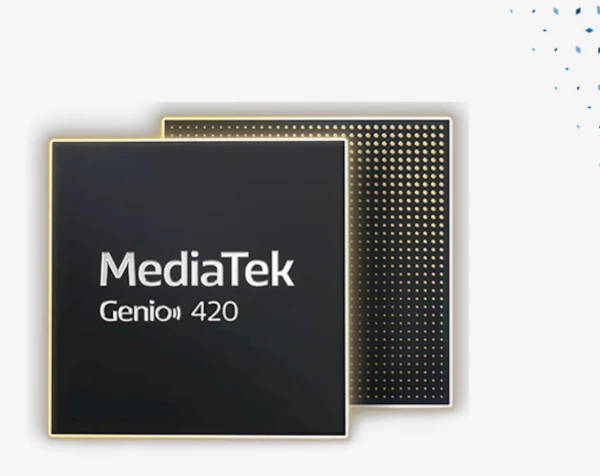
Mouser Electronics, Inc. offers the MediaTek Genio 420 IoT platform, a solution designed for embedded devices that need to combine processing power, connectivity, and artificial intelligence (AI) and generative AI (GenAI) functions directly on the device. The Genio 420 is specifically designed for edge computing applications, where running inference locally reduces latency and decreases reliance on cloud processing services.
The system is manufactured using a 6nm process, a technology that allows for high-performance computing while maintaining a focus on energy efficiency. This combination is particularly appealing for compact devices and those that need to operate continuously, such as home automation systems, smart appliances, point-of-sale terminals, retail displays, digital signage, and other IoT devices.
On-Device AI and GenAI Processing:
One of the key differentiators of the Genio 420 is its 8th-generation MediaTek Neural Processing Unit (NPU). The NPU delivers up to 6.1 TOPS of AI acceleration, while the system's AI processing capacity reaches 7.2 TOPS. This architecture is designed to perform real-time inference tasks, including object detection, image classification, and speech recognition.
Local processing capabilities also enable the use of GenAI applications and support for large language models (LLMs). In practice, this opens the door to devices capable of processing certain intelligent models and functions directly on the device, without having to continuously send data to a remote server. In addition to reducing latency, edge processing can be especially useful in applications requiring a fast response or where reliance on external connectivity is limited.
eight-
core CPU consisting of two Arm Cortex-A78 cores at 1.8 GHz and six Arm Cortex-A55 cores at 1.6 GHz. This configuration combines cores geared towards higher performance with others optimized for more efficient tasks, allowing resource allocation to be tailored to the needs of each application.
For graphics processing, the Genio 420 integrates an Arm Mali-G57 MC2 GPU compatible with OpenGL, Vulkan, and OpenCL. This GPU complements the capabilities of the CPU and NPU, enabling the platform to be used in applications requiring advanced graphical interfaces, multimedia processing, or interactive display systems.
support
is another of the Genio 420's strengths. The platform can manage two simultaneous displays with a resolution of up to 2.5K at 60 Hz, or a single display up to Ultrawide 5K at 60 Hz. These capabilities make it suitable for digital signage, interactive displays, information systems, retail terminals, and other applications that require high-resolution graphics.
It also incorporates 4K video encoding and decoding capabilities. The system supports H.264/H.265 encoding up to 4K30 and H.264/H.265 and VP9 decoding up to 4K60. In the field of machine vision, it features an image signal processor (ISP) and two MIPI-CSI interfaces, supporting cameras up to 16 megapixels at 30 frames per second. These features enable the combination of cameras and AI algorithms for image analysis, monitoring, and recognition applications.
Memory and Storage:
The Genio 420 supports both LPDDR4X and LPDDR5(X) memory. It can support LPDDR4X at speeds up to 4,266 Mbps and capacities up to 8 GB, while LPDDR5(X) achieves speeds up to 6,400 Mbps and capacities up to 16 GB. This flexibility allows manufacturers to tailor the platform to different performance and cost levels.
For storage, the platform supports dual-line UFS 3.1 and eMMC 5.1, offering various options for embedded systems based on capacity, speed, and cost requirements.
Connectivity for IoT Devices
: In terms of wireless communications, the Genio 420 integrates Wi-Fi 6/6E and Bluetooth 5.3. It also offers expansion options for technologies such as Wi-Fi 7, 5G, and 5G RedCap, enabling the development of devices prepared for different connectivity scenarios. It also incorporates Gigabit Ethernet with TSN support and a PCIe 2.0 interface, expanding connection options with peripherals and other components.
RedCap connectivity is particularly interesting for certain IoT devices that need cellular connectivity but do not require all the features of a conventional 5G terminal. In this way, the Genio 420 can serve as a foundation for connected equipment that needs to transmit data, receive information remotely, or integrate into larger-scale IoT infrastructures.
Interfaces and Expansion Options:
The platform provides a wide variety of interfaces to facilitate its integration into embedded products. These include USB 2.0, USB 3.2 Gen 1, PCIe 2.0, Gigabit Ethernet, UART, I²C, SPI, and PWM. It also incorporates various audio interfaces, such as I²S, PCM, and digital microphone inputs. This variety facilitates the connection of sensors, cameras, displays, storage devices, communication modules, and other peripherals.
Integrated Security:
For connected applications and systems that process sensitive information, the Genio 420 incorporates security features based on Arm TrustZone, Secure Boot, and an encryption engine. These technologies provide mechanisms designed to protect the boot process, isolate certain system functions, and contribute to the protection of device data and communications.
Software Compatibility and Lifecycle:
The Genio 420 is compatible with Android and Yocto Linux, and MediaTek also plans to support Ubuntu. This compatibility allows developers to use different software environments depending on the product type and application requirements.
Furthermore, the Genio 420 maintains pin-to-pin hardware compatibility and full software compatibility with the Genio 720 and Genio 520 platforms. This facilitates the migration or upgrade of existing designs within the Genio family and can help reduce redesign effort during new product development.
MediaTek also notes that the Genio 420 was initially announced in the first quarter of 2026 and is designed for extended availability for industrial and embedded applications, with a standard 10-year lifecycle and an expected end-of-life date of 2035. This feature may be relevant for manufacturers of industrial equipment and IoT products that need to maintain a platform for extended periods of production and support.
Applications
: With its processing, connectivity, multimedia, and AI acceleration capabilities, the Genio 420 can be used in a wide variety of devices. Potential applications include:
Home automation and control;
smart appliances and devices;
smart retail systems;
POS terminals and handheld POS terminals;
and commercial and interactive displays.
Digital signage.
Transportation systems and smart cities.
Industrial and business equipment.
Entertainment and education devices.
Camera-based and machine vision applications.
IoT devices incorporating AI and GenAI functions.
In these types of applications, the main advantage is the ability to combine CPU, GPU, NPU, image processing, wireless connectivity, and multimedia capabilities on a single platform. This allows for the development of compact devices capable of performing AI tasks locally, processing images and video, managing high-resolution graphical interfaces, and remaining connected to IoT networks and services.
An AI-Focused Edge Platform
: Overall, the MediaTek Genio 420 represents an evolution of IoT platforms toward devices capable of increasingly performing artificial intelligence functions directly at the point of data generation. Its combination of a 6nm manufacturing process, octa-core CPU, Mali-G57 MC2 GPU, 8th generation NPU, up to 7.2 TOPS of system AI capability, LPDDR5(X) memory support, Wi-Fi 6E and Bluetooth 5.3 connectivity, plus expansion options for Wi-Fi 7, 5G, and RedCap, provides a flexible foundation for developing next-generation IoT products.
The platform's availability through Mouser further facilitates access for manufacturers and developers to this technology for creating AI-oriented embedded systems. The combination of on-device AI processing, GenAI capabilities, advanced multimedia support, and connectivity makes the Genio 420 particularly well-suited for products where real-time response, low power consumption, and local processing capacity are critical factors.
Support for Displays, Cameras, and Video:
Multimedia is another of the Genio 420's strengths. The platform can manage two simultaneous displays with a resolution of up to 2.5K at 60 Hz, or a single display up to Ultrawide 5K at 60 Hz. These capabilities make it suitable for digital signage, interactive displays, information systems, retail terminals, and other applications requiring high-resolution graphics.
It also incorporates 4K video encoding and decoding capabilities. The system supports H.264/H.265 encoding up to 4K30 and H.264/H.265 and VP9 decoding up to 4K60. In the area of machine vision, it features an image signal processor (ISP) and two MIPI-CSI interfaces, supporting a camera of up to 16 megapixels at 30 frames per second. These features allow for combining cameras and AI algorithms for image analysis, monitoring, and recognition applications.
Memory and Storage:
The Genio 420 supports both LPDDR4X and LPDDR5(X) memory. It can support LPDDR4X at speeds up to 4,266 Mbps and capacities up to 8 GB, while with LPDDR5(X) it achieves speeds up to 6,400 Mbps and capacities up to 16 GB. This flexibility allows manufacturers to tailor the platform to different performance and cost levels.
For storage, the platform supports dual-line UFS 3.1 and eMMC 5.1, offering various options for embedded systems based on capacity, speed, and cost requirements.
Connectivity for IoT Devices
: In terms of wireless communications, the Genio 420 integrates Wi-Fi 6/6E and Bluetooth 5.3. It also offers expansion options for technologies such as Wi-Fi 7, 5G, and 5G RedCap, enabling the development of devices prepared for different connectivity scenarios. It also incorporates Gigabit Ethernet with TSN support and a PCIe 2.0 interface, expanding connection options with peripherals and other components.
RedCap connectivity is particularly interesting for certain IoT devices that need cellular connectivity but don't require all the features of a conventional 5G terminal. In this way, the Genio 420 can serve as a foundation for connected equipment that needs to transmit data, receive information remotely, or integrate into larger-scale IoT infrastructures.
Interfaces and Expansion Possibilities:
The platform provides a wide variety of interfaces to facilitate its integration into embedded products. These include USB 2.0, USB 3.2 Gen 1, PCIe 2.0, Gigabit Ethernet, UART, I²C, SPI, and PWM. It also incorporates various audio interfaces, such as I²S, PCM, and digital microphone inputs. This variety facilitates the connection of sensors, cameras, displays, storage devices, communication modules, and other peripherals.
Integrated Security:
For connected applications and systems that process sensitive information, the Genio 420 incorporates security features based on Arm TrustZone, secure boot, and an encryption engine. These technologies provide mechanisms designed to protect the boot process, isolate certain system functions, and help protect device data and communications.
Software Compatibility and Lifecycle:
The Genio 420 is compatible with Android and Yocto Linux, and MediaTek also plans to support Ubuntu. This compatibility allows developers to use different software environments depending on the product type and application requirements.
Furthermore, the Genio 420 maintains pin-to-pin hardware compatibility and full software compatibility with the Genio 720 and Genio 520 platforms. This facilitates the migration or upgrade of existing designs within the Genio family and can help reduce redesign effort during new product development.
MediaTek also notes that the Genio 420 was initially announced in the first quarter of 2026 and is designed for extended availability for industrial and embedded applications, with a standard 10-year lifecycle and a projected end-of-life date of 2035. This feature may be relevant for manufacturers of industrial equipment and IoT products that need to maintain a platform for extended periods of production and support.
Applications
: Thanks to its processing, connectivity, multimedia, and AI acceleration capabilities, the Genio 420 can be used in a wide variety of devices. Potential applications include:
Home automation and control;
smart appliances and devices;
smart retail systems;
POS terminals and handheld POS terminals;
commercial and interactive displays;
digital signage;
transportation systems and smart cities;
industrial and enterprise equipment;
entertainment and educational devices;
and camera-based and machine vision applications.
IoT devices incorporating AI and GenAI functions.
In these types of applications, the main advantage is the ability to combine CPU, GPU, NPU, image processing, wireless connectivity, and multimedia capabilities on a single platform. This allows for the development of compact devices capable of performing AI tasks locally, processing images and video, managing high-resolution graphical interfaces, and remaining connected to IoT networks and services.
An AI-Focused Edge Platform
: Overall, the MediaTek Genio 420 represents an evolution of IoT platforms toward devices capable of increasingly performing artificial intelligence functions directly at the point of data generation. Its combination of a 6nm manufacturing process, octa-core CPU, Mali-G57 MC2 GPU, 8th generation NPU, up to 7.2 TOPS of system AI capability, LPDDR5(X) memory support, Wi-Fi 6E and Bluetooth 5.3 connectivity, plus expansion options for Wi-Fi 7, 5G, and RedCap, provides a flexible foundation for developing next-generation IoT products.
The platform's availability through Mouser further facilitates access for manufacturers and developers to this technology for creating AI-oriented embedded systems. The combination of on-device AI processing, GenAI capabilities, advanced multimedia support, and connectivity makes the Genio 420 particularly well-suited for products where real-time response, low power consumption, and local processing capacity are critical factors.