




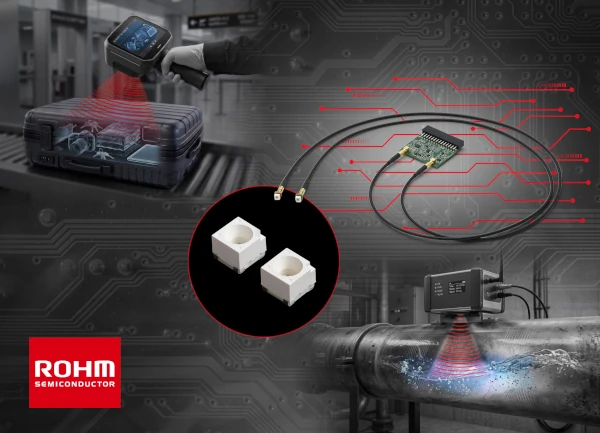
This kit allows companies and research institutions to evaluate THz wave oscillation and detection in a compact development environment.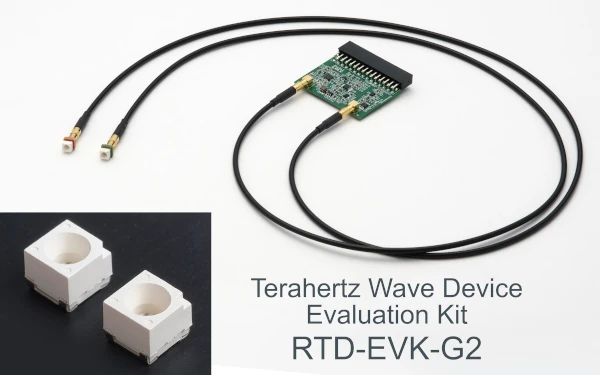
Terahertz waves, which occupy the frequency region between radio waves and light, combine the penetrating properties of radio waves with the straight-line propagation of light. Because they possess unique absorption properties for polymeric materials, moisture, and other substances, they are envisioned for use in non-ionizing radiation-free non-destructive testing, medical and health screening, and high-resolution radar detection systems. However, conventional terahertz systems require large equipment and involve high implementation costs, making it difficult for startups and research institutions to enter or commercialize this field.
Since the late 2000s, ROHM has conducted joint research with the Tokyo Institute of Science, Osaka University, and numerous other universities and research institutions to develop THz wave oscillation and detection devices using RTDs. In 2024, ROHM began offering samples of first-generation products, achieving a significant reduction in size and cost compared to conventional methods.
To meet the demand for improved signal quality in application development, ROHM has developed a second-generation terahertz wave oscillator device. It maintains the same 0.5 × 0.5 mm chip size as the first-generation product while incorporating an internal structure that enables higher output power. As a result, the output power has been approximately four times that of the first-generation product, reaching a maximum of 40 µW. This enhances the detection capability of THz waves after they pass through or are reflected by objects of interest, making the device particularly suitable for applications such as sensing and imaging that require high signal quality.
The device comes in the same 4.0 × 4.3 mm PLCC package, allowing it to remain the smallest* in the industry. This enables the creation of evaluation environments even in confined spaces. Furthermore, compared to other THz generation methods, the RTD approach generates less heat and consumes less power, reducing the application development burden for businesses and research institutions.
* ROHM study of August 4, 2026

Sales of the RTD-EVK-G2 evaluation kit, which includes samples of the 2nd generation wave oscillation device, are scheduled to begin in August 2026. By enabling evaluations at a lower cost than other methods, the kit facilitates the development of a wide range of applications, including non-destructive testing, imaging and detection in the medical and healthcare sectors, materials identification, and moisture detection. ROHM will also continue to market 1st generation devices for applications where low power consumption is a priority. For more information, please contact a sales representative or visit the contact page on the ROHM website. A non-disclosure agreement (NDA) with ROHM is required to purchase the evaluation kit.
Looking ahead, ROHM will continue to expand the development possibilities for THz-based applications and contribute to the rapid commercialization and real-world implementation of terahertz technology, thereby accelerating its adoption across a wide range of industrial sectors.

Professor Safumi Suzuki, Laboratory for Future Interdisciplinary Research in Science and Technology, Institute of Integrated Research, Tokyo Institute of Science:
“Terahertz waves are expected to be applied in a wide range of fields, including non-destructive testing, imaging and sensing, and wireless communications. At the same time, commercialization continues to face significant challenges, such as the need for large-scale equipment and high implementation costs.
The RTD terahertz wave device, developed after many years of joint research with ROHM, is compact, energy-efficient, and requires no cooling. Furthermore, it can be deployed at low cost, helping companies and research institutions to begin their terahertz wave research.
With the launch of the 2nd generation device, which offers significantly improved oscillation power, I expect the development of applications requiring higher signal quality to accelerate.”
Ken Nakahara, General Manager of the ROHM Research and Development Center, ROHM Co., Ltd.:
“With the launch of the RTD-EVK-G2, we expect to take another major step forward in the practical implementation of terahertz technology.
User feedback on the 1st generation device highlighted a strong demand for higher-power devices. With this 2nd generation product, we have succeeded in increasing the oscillation power to approximately four times that of the 1st generation device, while maintaining a compact size, bringing us even closer to meeting those needs.
Terahertz technology is steadily advancing toward real-world implementation. ROHM will continue to collaborate with customers, partners, universities, research institutions, and government agencies to support the development of terahertz wave applications and contribute to the realization of a sustainable society.”
Combining the RTD-EVK-G2 terahertz wave device evaluation kit with measurement tools such as Digilent's Analog Discovery 3™ (along with a computer and the corresponding software) allows users to easily evaluate terahertz wave oscillation and detection. Both the device and the evaluation board are compact, making it possible to create a research and development environment even in confined spaces. For more information, please contact a sales representative or visit the contact page on the ROHM website.
Profile of Professor Safumi Suzuki
, PhD in Engineering, Professor at the Laboratory for Future Interdisciplinary Research in Science and
Technology, Institute of Integrated Research, Tokyo Institute of Science. His research focuses on the development of terahertz wave devices using resonant tunneling diodes (RTDs).
• Career
March 2009: Completed PhD program at the Interdisciplinary Graduate School of Science and Engineering, Tokyo Institute of Technology
April 2009: Assistant Professor, Interdisciplinary Graduate School of Science and Engineering, Tokyo Institute of Technology
April 2014: Associate Professor, Faculty of Engineering, Tokyo Institute of Technology
August 2024: Professor at the Laboratory for Future Interdisciplinary Research in Science and Technology, Institute of Innovative Research, Tokyo Institute of Technology
October 2024: Professor at the Laboratory for Future Interdisciplinary Research in Science and Technology, Institute of Integrated Research, Tokyo Institute of Science
Terminology:
Resonant Tunnel Diode (RTD)
A semiconductor device used as a terahertz wave source that offers advantages such as its compact size, low power consumption, and ability to oscillate at room temperature. After extensive research and development in collaboration with various universities and research institutions, ROHM has successfully manufactured its own RTD devices capable of efficiently generating and detecting terahertz waves.
PLCC
Abbreviation for "Plastic Leaded Chip Carrier", a type of integrated circuit package used for semiconductor integrated circuits.
Other THz Generation Methods
Conventional methods for generating terahertz waves include frequency multiplication, which converts an electrical signal into higher-order harmonic frequencies, and photomixing, in which two laser beams of different wavelengths are combined in a photomixer to generate a terahertz signal at the frequency corresponding to the difference between them. While effective, both methods typically require expensive, medium- to large-scale equipment, limiting their viability for compact applications and those where cost is a critical factor.








