The technology has been successfully implemented in a working prototype. This innovative prototype features multiple 3D magnetometer pixels, utilizing Melexis' industry-proven Triaxis® technology. The sensor is paired with a magnet embedded in an elastomer material. This creates a soft contact interface, mimicking the properties of human skin. The arrangement offers high sensitivity, so that even small amounts of force will trigger a response.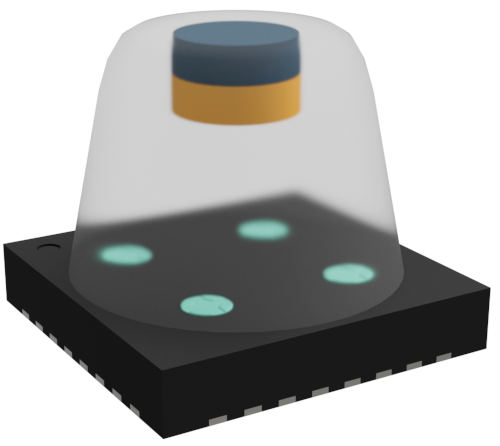
The force resolution achieved is 2.7 mN, sufficient to detect a weight change of a fraction of a gram (~0.3 grams). The Tactaxis prototype is very compact (measuring only 5 mm x 5 mm x 5 mm) and therefore suitable for confined spaces. The gradiometric approach makes the sensor immune to stray magnetic fields, preventing potential measurement errors. Furthermore, it is robust enough to withstand adverse conditions (temperature variations, etc.). Unlike competing optical tactile sensors, Tactaxis is fully integrated, enabling the production of large volumes of factory-calibrated sensors. This semiconductor process offers significant advantages in terms of cost and reliability.
“Robots need the sense of touch to manipulate fragile objects. For these types of applications, we have developed a novel magnetic sensor that allows for precise measurement of contact force while remaining robust against disturbances,” explains Gael Close, Global Director of Innovation at Melexis. “By leveraging the capabilities of our Triaxis® magnetic sensor technology, we have taken a significant step forward in tactile sensors for robots, providing a robust and competitive multi-axis sensing solution.”.
We will now use the Tactaxis prototype as a basis for future development work.” The IEEE (Institute of Electrical and Electronics Engineers) has published a white paper with details on the Melexis 3D magnetic force sensor prototype: T. Le Signor, N. Dupré, and G. Close, “A gradiometric magnetic force sensor immune to stray magnetic fields for robotic hands and grippers,” IEEE Robotics and Automation Letters, Jan. 2022. https://dx.doi.org/10.1109/LRA.2022.3146507