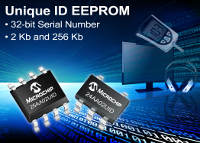
 For applications requiring IDs longer than 32 bits, the length can be extended to 48, 64, 96, 128 bits, and other lengths by increasing the number of bytes read from memory. Because the 32-bit ID is unique on these devices, any longer bit sequence is also unique. These 2 KB serial EEPROM devices are available on standard buses such as I2C™, SPI, and Microwire, and integrate up to 1.5 KB of memory that can be used as standard EEPROM. In addition, Microchip has announced a 256 KB device with a unique I2C ID that, along with the 32-bit serial number, also contains IEEE EUI-48™ and IEEE EUI-64™ MAC addresses. These IDs are located in a write-protected memory area, giving users up to 224 KB of EEPROM for use in their applications. Microchip ensures that this 32-bit identification is unique across the entire family of unique ID EEPROM devices 24AA02UID, 24AA025UID, 11AA02UID, 25AA02UID and 24AA256UID.
Microchip has also added a new family of pre-programmed EUI-64™ MAC addresses to its EUI-48™ address catalog. These 2Kb EEPROM devices are available on I2C, SPI, and UNI/O® buses, providing easy and cost-effective access to MAC addresses and incorporating up to 1.5Kb of EEPROM that can be used to store configuration settings or as a staging area for small amounts of data. The 24AA02E64, 24AA025E64, 11AA02E64, and 25AA02E64 serial EEPROM devices incorporate a 64-bit Extended Unique Identifier (EUI) needed to identify the physical address of network hardware. These embedded MAC addresses allow designers to obtain addresses only when needed and also eliminate the need for serialization and programming.
The EUI-64 network applications for the new EEPROMs are best suited for those that include Ethernet, Wi-Fi®, Bluetooth®, FireWire, ZigBee®, and Microchip's MiWi™ protocol. These devices excel in a wide variety of applications, including consumer applications such as wireless radios and printers, Bluetooth headsets, LCD TVs, and internet-connected home devices, as well as industrial applications such as Ethernet, USB, and industrial automation. Applications for the new unique identification devices include the consumer, medical, industrial, automotive, and networking markets. Examples of ideal end-user applications include printers, wearables, remote sensor modules, audio headsets, medical device authentication and identification, wireless products, and battery-powered products.
Unique ID devices offer customers an easy-to-use, low-cost plug & play solution for adding a serial number or unique ID to an application.
Microchip's uniquely identified EEPROM devices are supported by the MPLAB® Starter Kit for Serial Memory Products (DV243003), priced at $79.98, which is available now.
The 24AA02UID and 24AA025UID devices are already available for sampling in 5/6-pin SOT-23 packages and 8-pin SOIC and PDIP packages, while the 24AA0256UID is available in 8-pin SOIC, TSSOP, and PDIP packages. Volume production of these devices is planned for August.
The 25AA02UID is now available for sampling and volume production in
8-pin SOIC and 6-pin SOT-23 packages. The 11AA02UID is now available for sampling and volume production in 3-pin SOT-23 and 8-pin SOIC packages. The 24AA02E64 and 24AA025E64 are now available for sampling and volume production in 8-pin SOIC and 5/6-pin SOT-23 packages. The 25AA02E64 is now available for sampling and volume production in 8-pin SOIC and 6-pin SOT-23 packages. The 11AA02E64 is now available for sampling and volume production in 8-pin SOIC and 3-pin SOT-23 packages.