
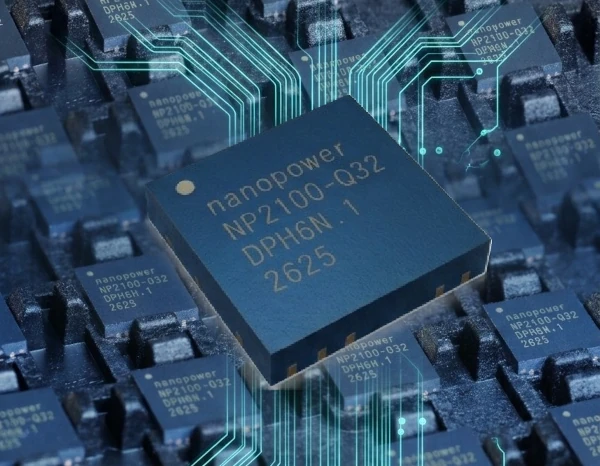
capable of managing sensors and peripherals autonomously, keeping the main MCU off until it is really needed.
With a typical standby current draw of only 200 nA at 3.0 V and a polling current draw of 1 µA, the nPZ2100 can autonomously manage up to six independent peripherals via I²C or SPI, with four integrated 1 mA peripheral power switches and a dedicated 10 mA host power switch. The device operates in an industrial temperature range of −40 °C to +85 °C.
As more and more processing power and artificial intelligence move to the network edge, power management is becoming just as important as processing performance. High-performance microcontrollers, wireless SoCs, and AI accelerators can consume significant amounts of power, but many applications only need this processing power intermittently.
The nPZ2100 provides an ultra-low-power system control layer around these power-hungry devices, monitoring sensors, analog signals, timings, and system events, and activating the host only when necessary. Its 256 bytes of SRAM, 8-bit, three-channel ADC, 32-bit global time counter with alarm, watchdog timer, and general-purpose event counter, along with energy-optimized operation for energy harvesting, give designers the tools to create systems based on a simple principle: detect, decide, activate, and process, rather than keeping the main processor running continuously.
The nPZ2100 can also disable peripherals when they are not needed, helping to eliminate their idle power consumption and reduce host MCU wake-ups. By taking over sensor communication and system monitoring while the host is powered off, the nPZ2100 can significantly reduce host uptime and overall system power consumption.
The nPZ2100 is designed to help extend battery life, reduce maintenance requirements, enable the use of smaller power supplies, and create new opportunities for energy harvesting and smart edge devices. Its power management capabilities can reduce sensor polling frequency and MCU activations, while also maximizing system energy budgets.
Since the EU Battery Regulation requirements regarding the removable and replaceable nature of portable batteries will come into force on 18 February 2027, the nPZ2100 can also help designers extend the life between battery changes, reducing the frequency of battery replacements and at the same time encouraging more energy-efficient product designs.
The device is suitable for a wide range of applications, including wireless IoT sensors, smart home and building devices, asset tracking and monitoring, electronic shelf labels, and wearable devices. It can also be used in remote controls and human interface devices, security and monitoring products, battery-powered industrial sensors, consumer electronics, and energy harvesting systems.
The nPZ2100 represents another step toward Nanopower's vision of making intelligent, ultra-low power management an essential part of the next generation of connected, AI-powered edge systems. "Battery life is a system issue," said Svein-Egil Nielsen, CEO of Nanopower Semiconductor. "Even a processor with excellent idle current can waste a significant amount of power in that state, as well as wake up thousands of times a day to check for unimportant events. With nPZero, our goal is simple: keep the processor off until there's something worth processing."
Availability:
The nPZ2100 data sheet, product information document (PID), and associated initial development resources are available through the Nanopower development portal. Development kits, engineering samples, and nPZero 2100 development stamps are scheduled to be available from September 2026, giving customers and partners the opportunity to begin evaluating the technology and developing applications before the full product launch and mass production, planned for the second quarter of 2027.