

 Internet traffic is available to us in many ways: at home through broadband or wireless internet access, or on mobile devices when we're out and about. At the heart of these systems, you'll typically find an FPGA. FPGAs are commonly found in all aspects of wired and wireless technologies, performing functions as diverse as packet processing and traffic management for processing RF signals for 3G or LTE radio signals. Specifically, optical (wired) communication systems have significantly boosted the functionality and capabilities currently available in high-end and mid-range FPGA families.
Transceivers
: The evolution of transceivers in FPGA technologies has been driven by the need to connect ASSPs and ASICs in wired communication systems. The first FPGAs with transceivers were commercially available in the late 1990s and early 2000s; Altera's Mercury™ devices feature up to 18 transceivers at 1.25 Gbps. These transceivers support 1 Gbit Ethernet, OC-12/STM-4 (622 Mbit/s), and OC-24 (~1.2 Gbps), the main protocols for SONET/SDH and Ethernet. These devices have transformed FPGAs into processing elements for the data path, offering design differentiation by allowing designers to incorporate functions that previously would have required an ASSP. With the development of FPGAs, transceiver speeds have increased to accommodate more advanced protocols. With devices like the Stratix® IV family, a dual approach was implemented: Stratix IV GX devices featured transceivers reaching up to 8.5 Gbps, more than enough to support PCIe® Gen 3 and Gen 2 interfaces, while Stratix IV GT devices reached 11.3 Gbps for OTU2 and 10G Ethernet support. When combined with the appropriate IP block, ten 10.3 Gbps lines can be used for 100G Ethernet, or, together with a frame IP block and Forward Error Correction, an OTU4 link can be created.
Modern FPGAs offer this enormous bandwidth, providing the perfect platform for the frame generation/multiplexing sections of optical systems. These FPGAs are typically found on the communication protocol line card. They need to communicate with other system cards to route data traffic, and this is where a backplane becomes useful. Modern FPGAs have surpassed backplane switches and custom ASICs for low-power backplane communications with high signal integrity.
Given the increasing volume of data delivered by FPGAs to line cards, the backplane bandwidth generally needs to be at least double the line card's transmission speed, as many wired communication systems implement a dual backplane system for redundancy. As data rates increase in communication systems, losses in the link of a given channel also increase. This is due to frequency-dependent losses originating in the dielectric material used (generally the effect of the low-pass filter). To compensate for these losses, the high frequencies of the channel are boosted, either through a process called pre-emphasis (also known as TX equalization) or by equalizing the signal received by the FPGA. Most FPGAs incorporate some type of channel equalization: pre-emphasis, receive equalization, or both.
The Stratix V FPGAs currently support the 10GBASE-KR protocol, an improvement over the 10G Ethernet standard that enables transmission over backplanes. It specifies that channel equalization must be sufficient to compensate for losses across the two connectors and approximately 1 meter of trace. This is expressed as a dB value, and the FPGA uses a combination of linear equalization and Decision Feedback Equalization (DFE), a 5-tap filter that boosts the signal and eliminates intersymbol interference, to recover the signal.
Optical Control.
The advances discussed earlier make the FPGA ideal for the digital section of the signal chain, but what about the optical technology itself? The improvements introduced in FPGAs, which provide such a complete platform for the backplane, also offer the possibility of directly controlling the optical modules. Optical fibers offer numerous advantages: they can carry enormous amounts of data over greater distances and at higher speeds than signals traveling over copper wires on a printed circuit board. Although they suffer from optical dispersion, the result is interference between symbols. Until recently, it was necessary to place an External Dispersion Compensation (EDC) device between the FPGA transceiver and the optical module (usually an SFP+ module for speeds on the order of 10 Gbps) to cancel this effect.
By combining adaptive equalization (an automatic way of equalizing channel losses) and DFE, a Stratix V FPGA can directly control SFP+ modules, thereby greatly reducing the cost, power consumption, and wait time of a given link.
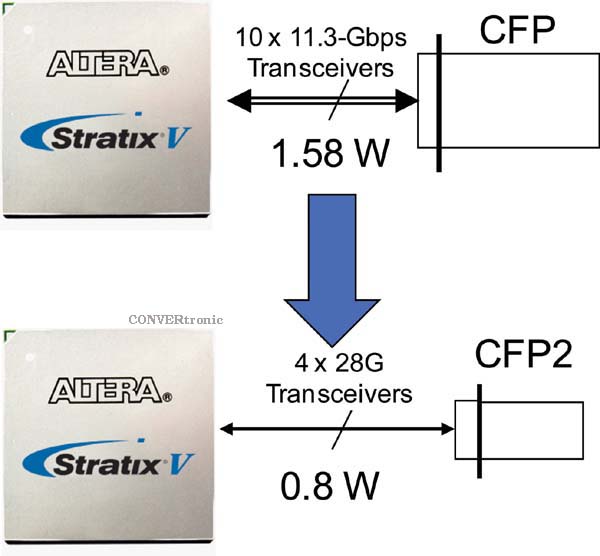
Another technique for reducing cost and energy consumption is to increase the frequency of the transmitted data. Although this seems counterproductive after reading about channel losses, energy can be saved in optical control by increasing the speed. For example, a CFP (C Form-Factor Pluggable) optical module for 100GBASE-LR4 uses a DP-QPSK format generated internally by conversion chips that transform the 10 inputs/outputs of a 10.3Gbps transceiver into 4 channels of approximately 25.6Gbps to modulate a laser. If the FPGA can generate data at 25.6Gbps and supply it to a new optical module (CFP2), it eliminates a signal processing layer, thus reducing energy consumption. Altera's Stratix V GT FPGAs are the first FPGAs capable of delivering the performance of a 25Gbps and 28Gbps transceiver. With four of these transceivers, these new FPGAs in the production phase can be connected to CFP2 modules and greatly reduce power consumption and cost, as shown in Figure 2.
Optical FPGAs:
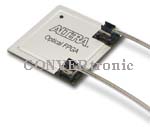
The most advanced step in optical communication technology is an optical FPGA. This new technology from Altera includes optical transceivers in the package. This technology demonstrator (Figure 3) uses pluggable optical cores from Avago Technologies containing 10 controllers in one module and 10 receivers in an array. They can be connected to a low-cost multimode fiber and transmit data at over 100m and 10Gbps. This new technology solves the problem of transmitting signals on printed circuit boards and large systems. Now, signals propagate over a low-loss optical fiber instead of a board. This allows systems to have line cards placed at multiple levels or in distant racks, integrated similarly to a line card on the same backplane.
System Implementation:
Given the anticipated surge in bandwidth demand for communications, there is a growing need to deploy value-added systems as quickly as possible. To maximize product value, engineers require time to innovate in areas where the company excels. In late 2010, Altera acquired Avalon Microelectronics Inc., a leader in IP for Optical Networking (OTN). Now operating as the Newfoundland Technology Centre, this same high-level expertise has been leveraged to create customer-facing IP blocks for OTN and design services that integrate these blocks into customer systems, significantly accelerating system implementation and deployment.
Conclusion:
The growing demand for communication infrastructure products led Altera to initially develop line card products and then, to serve the high-speed market, optical devices. This complementary process drives Altera to develop technologically advanced platforms for optical applications, resulting in devices that can benefit many other high-speed product markets.
Author:
Craig Davis - Director of Product Marketing, Altera Europe