
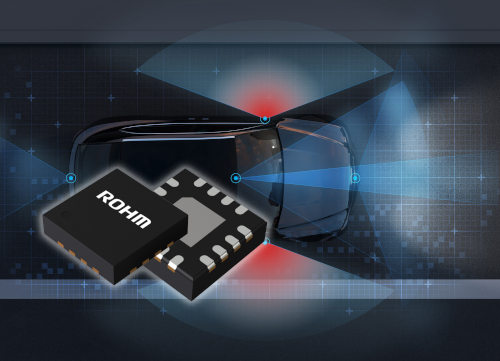
 Rapid advancements in ADAS and automated driving systems in the automotive sector have spurred demand for features such as collision avoidance and lane assist, which reduce the risk of accidents. Consequently, the development of products for mounted semiconductors must consider how to ensure functional safety (fail-safety) in the event of a failure, taking into account self-diagnostics and other functions.
In 2017, ROHM developed an LCD chipset that promoted functional safety and consisted of LCD controllers and power supply integrated circuits that were ahead of the industry standard. In 2018, the company obtained certification of its development process under the international standard for functional safety development, ISO 26262. Currently, considering system safety and redundancy, and incorporating various self-diagnostic and monitoring functions, ROHM has created the industry's first power supply monitoring IC with integrated self-diagnostic functionality, facilitating the integration of functional safety into existing systems.
The BD39040MUF-C is a power monitoring IC that provides the monitoring functions necessary for functional safety in the power supply systems of ADAS sensor modules. In addition to voltage monitoring functions (correct power output, reset) and a watchdog timer for monitoring the ECU (Electronic Control Unit), which is essential for functional safety, ROHM's power monitoring IC is the first in the industry to introduce a self-diagnostic function. Using proprietary technology, this IC allows for the detection of potential faults in the power supply IC itself without affecting existing systems. Integrating these functions into a compact, square 3 mm package makes it ideal for ADAS applications requiring high miniaturization.
ROHM is committed to contributing to technological innovation in the automotive sector by developing products that achieve greater system optimization and greater energy savings.
Availability: immediate (samples), August 2019 (OEM quantities)
 Key Features
The BD39040MUF-C is the industry's first power monitoring IC to include a self-diagnostic function along with additional features that make it ideal for functional safety systems required for ADAS and automated driving.
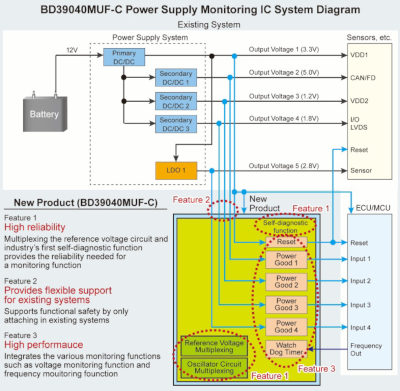
1. The self-diagnostic function provides the necessary reliability for functional safety.
For functional safety reasons, to meet the highest safety level requirement (ASIL), it is necessary to detect potential faults in the power supply monitoring function itself. For example, if a fault occurs when a monitoring function (e.g., overvoltage) cannot detect an anomaly, it becomes a hidden fault that masks the actual problem, creating a dangerous situation. To overcome this, the BD39040MUF-C with self-diagnostic function uses original circuitry technology that allows it to detect potential faults in advance. Both the reference voltage circuit and the oscillator circuit are multiplexed to enable continuous mutual monitoring between systems in order to improve safety during normal operation.
2. Provides Flexible Support for Existing Systems:
The BD39040MUF-C easily enhances functional safety in existing systems without requiring changes to power supply sequences. Furthermore, the monitoring timer for the ECU (Electronic Control Unit) can be adjusted via an external resistor, and the effective timing of the monitoring can be switched on/off as needed. Additionally, the IC is offered in a compact, 3 mm square package, ideal for ADAS applications requiring miniaturization. This addresses the need for more compact and safer driver support modules in ADAS and automated driving systems that demand functional safety.
3. Integrates various monitoring functions required by automotive power supplies and ECUs.
The BD39040MUF-C incorporates a range of monitoring functions, including overvoltage and undervoltage monitoring (correct power output) required for power supplies, as well as the watchdog timer and reset functions required by ECUs (Electronic Control Units). The watchdog timer is a window type and monitors whether the ECU is stuck in a loop within a programmable timeout period.
Application examples
- Radars, cameras and sensors for ADAS/automated driving
- ECUs (Electronic Control Units)
- Electric power steering
- Control panel, LCD panels
- Infotainment
- Lamps
and other power supply systems requiring functional safety measures beyond ASIL-B
Product Overview
- Input Voltage Range: 2.7V to 5.5V
- Self-Diagnostic Function
- Reset Function (Overvoltage and Undervoltage Monitoring)
- 4-Channel Voltage Monitoring Function (Overvoltage/Undervoltage)
- Reference Voltage Self-Monitoring Function
- Swing Frequency Self-Monitoring Function
- Watchdog Timer (WDT)
(Monitoring time can be adjusted via an external resistor; the effective timing of the watchdog timers (WDT) can be enabled/disabled).
Enables air/ground fault detection of the WDT watchdog timer input signal using the WDOUT pin.
- AEC-Q100 (Grade 1) Rated
Functional Safety 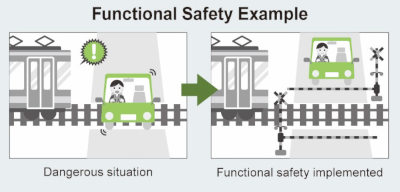 Terminology: Functional safety includes safety measures (concepts to ensure safety) that minimize risks by adding functionalities such as monitoring and protective equipment. In the automotive market, functional safety minimizes risk to an acceptable level in order to prevent physical injury in the event of abnormal operation due to electronic system failure. There is an international standard for functional safety in automotive applications (ISO 26262). At the same time, the protective functions frequently referenced in integrated circuits ensure the safety of the integrated circuit itself by monitoring for internal faults and irreversible damage.
*ROHM study from June 18