

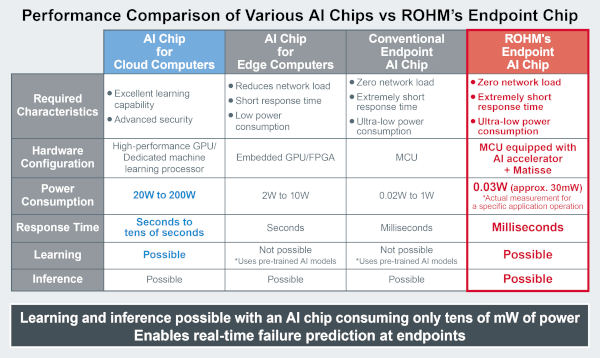
AI chips typically perform learning and inference to achieve artificial intelligence functions. Since learning requires capturing a large amount of data, compiling it into a database, and updating it as needed, the AI chip performing the learning requires considerable computing power, which necessarily consumes a significant amount of energy. Until now, it has been difficult to develop AI chips that can learn on the fly while consuming minimal power, enabling edge computers and endpoints to build an efficient IoT ecosystem.
Based on an "on-device learning algorithm" developed by Professor Matsutani of Keio University, the new AI chip developed by ROHM consists primarily of an AI accelerator (a dedicated AI hardware circuit) and ROHM's highly efficient 8-bit 'tinyMicon MatisseCORE™' CPU. The combination of the ultra-compact 20,000-gate AI accelerator with a high-performance CPU enables learning and inference with ultra-low power consumption, as low as a few tens of mW (1,000 times lower than that of conventional AI chips capable of learning). This allows for real-time fault prediction across a wide range of applications, as "anomaly detection results (anomaly scores)" can be numerically output for unknown input data at the equipment installation site without involving a cloud server.
 In the future, ROHM plans to incorporate the AI accelerator used in this AI chip into various IC products for motors and sensors. Commercialization is expected to begin in 2023, with mass production slated for 2024.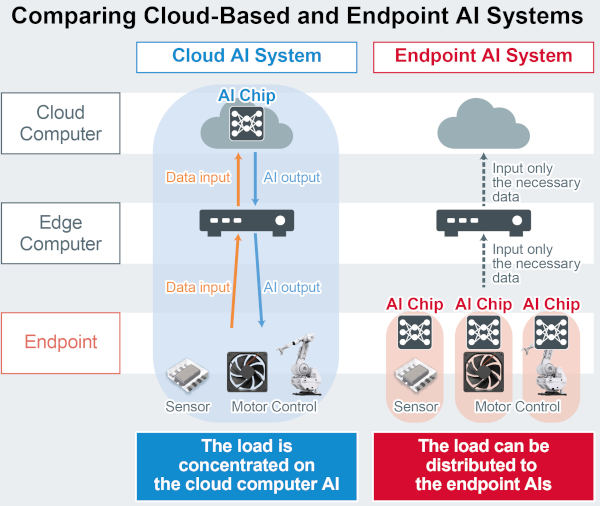
Professor Hiroki Matsutani, Department of Information and Computer Science, Keio University, Japan
: “As IoT technologies such as 5G communication and digital twins advance, cloud computing will need to evolve, but processing all data on cloud servers isn’t always the best solution in terms of load, cost, and power consumption. With the on-device learning we research and the on-device learning algorithms we develop, we aim to achieve more efficient data processing at the edge to build a better IoT ecosystem. Through this collaboration, ROHM has shown us the path to cost-effective commercialization by advancing on-device learning circuit technology. I hope the AI chip prototype will be incorporated into ROHM’s IC products in the near future.”
About tinyMicon MatisseCORE™:
tinyMicon MatisseCORE™ (Matisse: tiny-sized sequencer microarithmetic unit) is ROHM's proprietary 8-bit CPU developed to make analog ICs smarter for the IoT ecosystem. An instruction set optimized for embedded applications, along with the latest compiler technology, delivers fast arithmetic processing in a smaller chip area and program code size. It also supports high-reliability applications, such as those requiring qualification according to the ISO 26262 and ASIL-D vehicle functional safety standards, while the patented onboard "real-time debugging function" prevents the debugging process from interfering with program operation, allowing debugging to be performed while the application is running.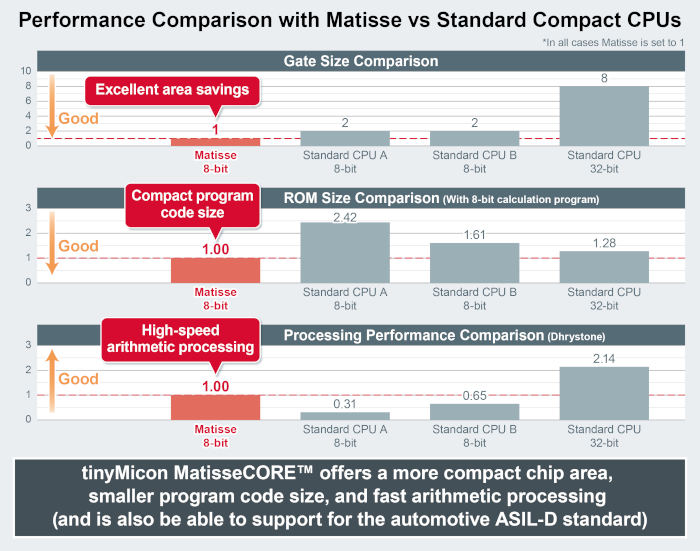
ROHM AI Chip Details (SoC with On-Device Learning AI Accelerator)
The prototype AI chip (prototype part no. BD15035) is based on an on-device learning algorithm (three-layer neural network AI circuit) developed by Professor Matsutani of Keio University. ROHM reduced the AI circuit from 5 million gates to just 20,000 (0.4% of the size) to reconfigure and market it as a proprietary AI accelerator (AxlCORE-ODL) controlled by ROHM's highly efficient 8-bit tinyMicon MatisseCORE™ CPU, enabling AI learning and inference with ultra-low power consumption of only a few tens of mW. This makes it possible to output numerical "anomaly detection results" for unknown input data patterns (i.e., acceleration, current, brightness, voice) at the location where the equipment is installed without involving a cloud server or requiring prior AI learning, enabling real-time fault prediction (predictive fault signal detection) by AI on-site while keeping cloud server and communication costs low.
To evaluate the AI chip, we offer an evaluation board equipped with Arduino-compatible terminals. An expansion sensor board can be attached to this board for connection to an Arduino microcontroller (MCU). The board includes wireless communication modules (Wi-Fi and Bluetooth®) along with a 64kbit EEPROM. By connecting sensors and linking the board to the target device, you can verify the effects of the AI chip on a screen. This evaluation board will be provided by the ROHM sales department. Please contact us for more information.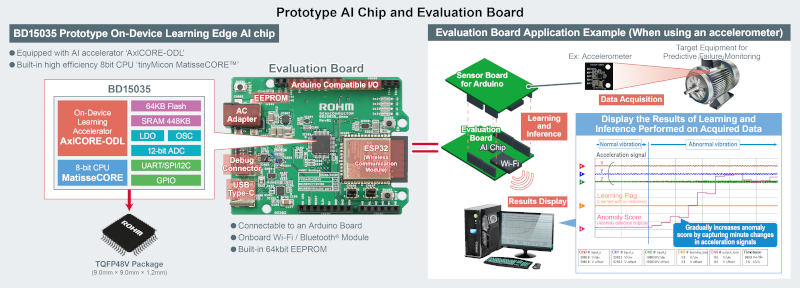
AI Chip Demonstration Video
A demonstration video is available showing this AI chip used with the evaluation board.
*On-device learning: Running learning and inference on the same AI chip.
*TinyMicon MatisseCORE™ is a trademark or registered trademark of ROHM Co.
*Bluetooth® is a trademark or registered trademark of Bluetooth SIG, Inc.