New advances in computerization and the increase in densely packed electrical devices have increased the noise levels in electric vehicles and cars equipped with advanced driver assistance systems (ADAS). However, evaluating the noise characteristics of the various circuit boards and systems, and implementing noise reduction measures, are not feasible in isolation during the development phase. This evaluation and the implementation of measures must be carried out after the entire vehicle has been assembled, making the noise optimization process a very lengthy and costly one that may require several iterations.
In response, ROHM developed operational amplifiers in 2017 using EMARMOUR™, a patented technology that offers superior noise tolerance and helps reduce design resources needed to implement noise mitigation measures. These devices have been well received by automotive manufacturers. To further meet market demands, ROHM is now launching the first ultra-high noise tolerance comparators using the same cutting-edge technology.
This series has achieved superior noise tolerance when used as comparators to determine the threshold value of sensor output signals. This ensures an output voltage fluctuation of ±1% across the entire noise frequency band when tested according to ISO 11452-2. Conventional comparators typically experience output voltage fluctuations of up to ±20% due to noise, which can lead to malfunctions (inverted high/low). In contrast, the new ROHM series is not susceptible to noise, providing greater reliability while reducing system design time by minimizing the time required for noise assessment and the implementation of measures that normally require external filters.
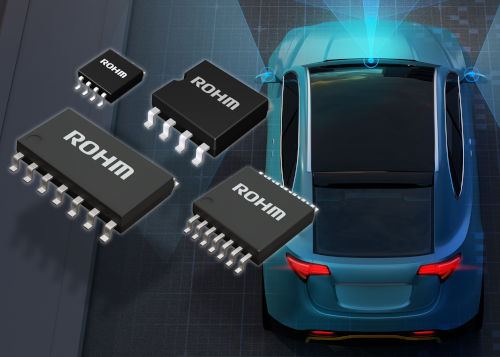
 ROHM will offer these new comparators as part of the EMARMOUR™ series. ROHM is committed to achieving even simpler designs and greater reliability in automotive systems by expanding this high-noise-tolerance technology to other ROHM power supply integrated circuits.
What is EMARMOUR™?
EMARMOUR™ is the name given to ROHM products developed using proprietary technologies encompassing chip layout, processes, and circuit design to achieve ultra-high noise immunity. This limits output voltage fluctuation to ±3% across the entire noise frequency band when tested according to ISO 11452-2. This unprecedented noise immunity reduces design time and resources while improving reliability by addressing noise-related issues in the development of vehicle electrical systems.
Key Features
1. Innovative Noise Tolerance Reduces Design Resources and Time
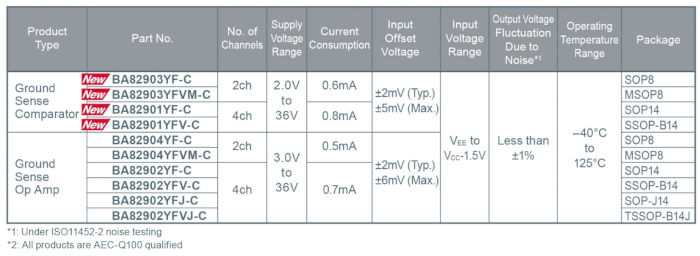
Unlike conventional products, whose output voltage can fluctuate by up to ±20%, the BA8290xYxx-C series utilizes superior noise tolerance to limit output voltage fluctuation to a margin of ±1%, thus preventing malfunctions. This reduces the resources and design time required for noise characterization and the implementation of measures that play a significant role in automotive system design, while simultaneously improving reliability.
2. Reduced number of noise suppression components.
Superior noise tolerance eliminates the need for external components used in noise suppression measures (CR filters for the power supply, input and output pins) found in conventional products. For example, in the case of a 4-channel comparator, the new ROHM products require 28 fewer components than conventional solutions.
3. Compliance with International Automotive Requirements:
The BA8290xYxxx-C series is rated under the AEC-Q100 Automotive Reliability Standard and reduces both current consumption (0.6 mA vs. 0.8 mA) and balance voltage (±5 mV vs. ±7 mV) compared to conventional products. Furthermore, a wide range of products is offered in a variety of common surface-mount packages and with a standard number of channels and comparator pinout, facilitating replacement of existing products in noise-sensitive applications.
The EMARMOUR™ series features very high level noise immunity
Application examples
- Electric vehicle/hybrid electric vehicle inverters - ECUs
- Automatic transmissions - Electric power steering - Automotive lamps - Combination switches - Electric vehicle chargers - Automotive navigation - Vehicle climate control
and other noise-sensitive onboard electrical systems
EMI (Electromagnetic Interference) Tolerance
Terminology
: EMI tolerance is a parameter that indicates the degree of tolerance to ambient noise. Noise generated in the environment can cause malfunctions in systems with low EMI tolerance, requiring protective measures such as the incorporation of filters (i.e., resistors/capacitors) or shielding (metal plates). In contrast, high EMI tolerance ensures stable operation without concern for the effects of noise, providing a significant advantage by eliminating the design burden for noise mitigation measures.
Operational Amplifiers / Comparators:
Operational amplifiers are often used to amplify tiny signals, such as those from sensors, to a voltage level that can be recognized by a microcontroller (MCU).
Comparators are commonly used to determine the threshold value of input signals. They output a High/Low signal after performing a threshold judgment on the sensor's output signal.