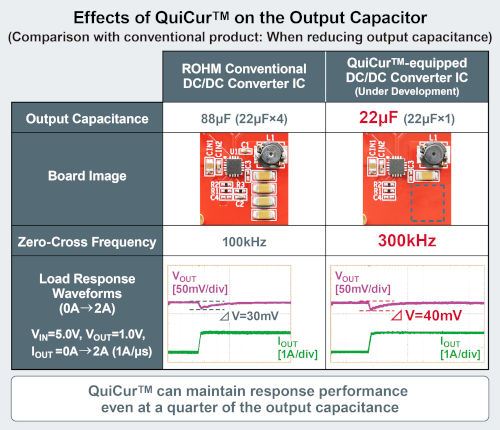
In recent years, the ongoing electrification of applications across all sectors has led to an increase in the number of electronic components and the design resources required. Consequently, there is a growing demand to reduce the number of capacitors used for various purposes, such as stabilizing electronic circuits. Furthermore, to reduce the design burden on power supply circuits when specifications change, high-quality power integrated circuits are needed that offer excellent responsiveness and are capable of providing stable operation.
Typically, the integrated power supply circuit constantly monitors the output voltage to ensure stable power supply operation and includes a feedback circuit that precisely adjusts the output voltage by comparing it to an internal reference voltage. A faster response time allows for the reversal of output voltage changes caused by fluctuations in the input voltage and/or load current in less time. On the other hand, shortening the response time too much can destabilize the circuit's operation and cause the output voltage to oscillate. Since the response speed is also affected by the output capacitance, achieving the desired response performance has been challenging until now.
The integration of the innovative QuiCur™ high-speed load response technology into the power supply ICs enables optimal performance without causing instability in the feedback circuits. This not only reduces the number of external components and the mounting area by minimizing the output capacitor capacitance required by the power supply IC, but also enables linear adjustment of capacitance and output voltage fluctuations (negative constant proportional relationship), ensuring stable operation even when capacitance increases due to changes in specifications. This significantly reduces the resources required for power supply circuit design by providing stable operation with fewer external components.
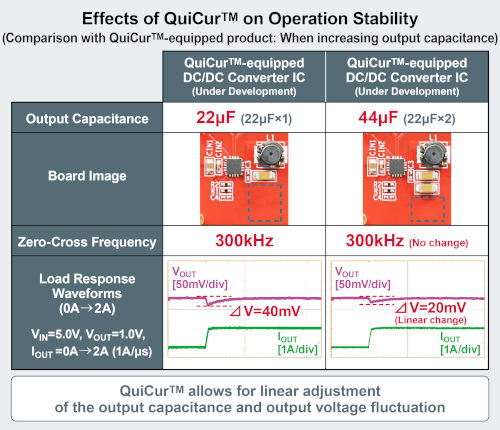 ROHM is currently working on the commercialization of power supply integrated circuits equipped with QuiCur™, and plans to ship samples of DC/DC converter integrated circuits in April and of the LDOs in July of this year.
QuiCur™ Technology in Detail:
QuiCur™ solves the two problems of conventional power supply IC feedback circuits when maximum response performance is desired: (1) the unusable region generated in the frequency range below the unstable area, and (2) variations in the zero-crossing frequency (f0) due to output capacitance. This is achieved by completely separating the signal processing functions for response speed (control system) and voltage stability (compensation system). The first problem is solved by using a dedicated error amplifier that does not generate an unusable region in the feedback circuit.
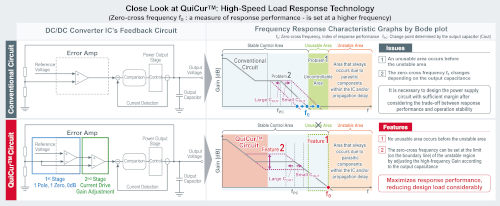 For the second problem, we have adopted a dedicated second-stage error amplifier and introduced a technology that allows the amplification factor (gain) to be adjusted by current generation. Although the zero-crossing frequency can vary depending on the connected output capacitance, by adjusting the amplification factor, the zero-crossing frequency can always be fixed at the boundary (the dividing line) between the unstable and stable control regions. This system, in which the functions of the two error amplifiers are shared, finds wide application in power supply integrated circuits, such as DC/DC converter ICs and LDOs incorporating feedback circuits.
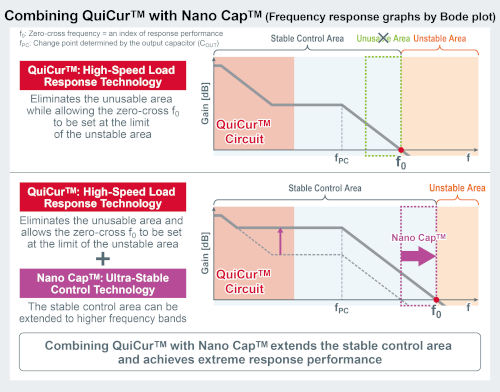 Combined with Nano Cap™ ultra-stable control technology,
Nano Cap™ provides stable control of the linear regulator output, improving response in analog circuits while minimizing parasitic factors related to wiring and amplifiers. This allows the output capacitance to be reduced to less than one-tenth compared to conventional solutions, eliminating the need for a capacitor at the linear regulator output and ensuring stable operation with only a 100 nF capacitor on the MCU side.
While QuiCur™ alone can reduce the output capacitance to the microfarads (µF) range, the combination with Nano Cap™ reduces it to the nanofarads (nF) range.