





Over the past few years, the need to increase energy efficiency to mitigate global warming has become a moral and social imperative across all sectors. As a result, since 2015, the use of smart meters has increased dramatically in Japan, the Wireless M-bus system has emerged in Europe, and smart meters using various systems (e.g., wireless) have been installed in China. Simultaneously, there is a growing trend toward data collection and management via wireless networks, not only to optimize AC power and lighting in offices and buildings and for crime and disaster prevention, but also to improve productivity and performance in primary activities such as agriculture.
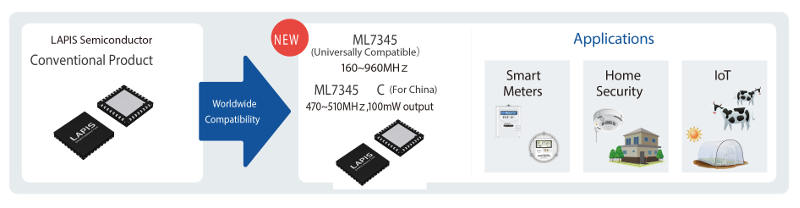
LAPIS Semiconductor's new sub-GHz LSI, offering high-performance, low-power communication, is expected to achieve widespread adoption in smart meters and wireless networks worldwide. The ML7345 covers a broad frequency range below 1 GHz (160 MHz to 960 MHz), thus providing universal compatibility. Improvements to the high-frequency amplifiers enable best-in-class wireless performance and environmental stability (more than tripling the temperature resistance of the transmit power), simplifying the configuration of wireless networks (e.g., smart meters) and improving reliability (e.g., by reducing the number of relays). Furthermore, a high-speed radio wave check function that powers up the receiver in a short period of time, along with a significantly reduced standby current (which accounts for the majority of communication time), decreases the average current by 48% compared to conventional products, thus reducing system power consumption and extending battery life. In the future, LAPIS Semiconductor will continue to simplify the development of wireless devices to contribute to a smarter society.
 Key Features
1. Compatible with various sub-1 GHz frequencies used worldwide
The ML7345 improves upon the performance of the high-frequency amplifier and operates across a wide frequency range, from 160 MHz to 960 MHz. As a result, it is expected to be adopted in various sub-1 GHz applications worldwide, from smart meters and telemetry equipment to sensors and wireless networks.
(1) Compatible with smart meters worldwide.
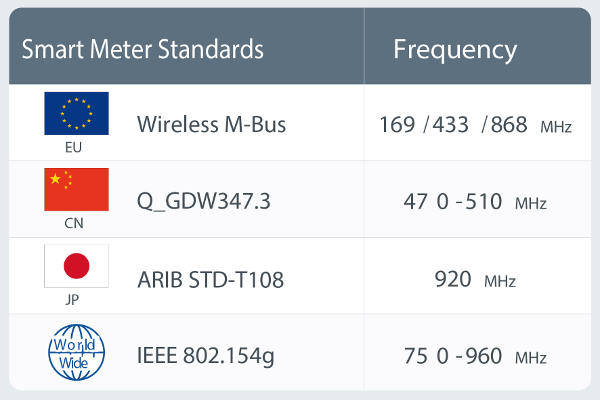
Wide compatibility (160MHz to 960MHz) ensuring compliance with the ARIB STD-T108 standard in Japan and IEEE802.15.4g, thus enabling global support for applications such as smart meters and energy management systems (EMS).
 (2) Compliant with the latest Wireless M-Bus specifications.
The ML7345 complies with the latest (2013) version of the Wireless M-Bus standard. Improvements over the conventional Wireless M-Bus packet manager ensure compatibility with the latest specifications.
(3) High Output Power (100mW) Optimized for the Chinese Market [ML7345C]
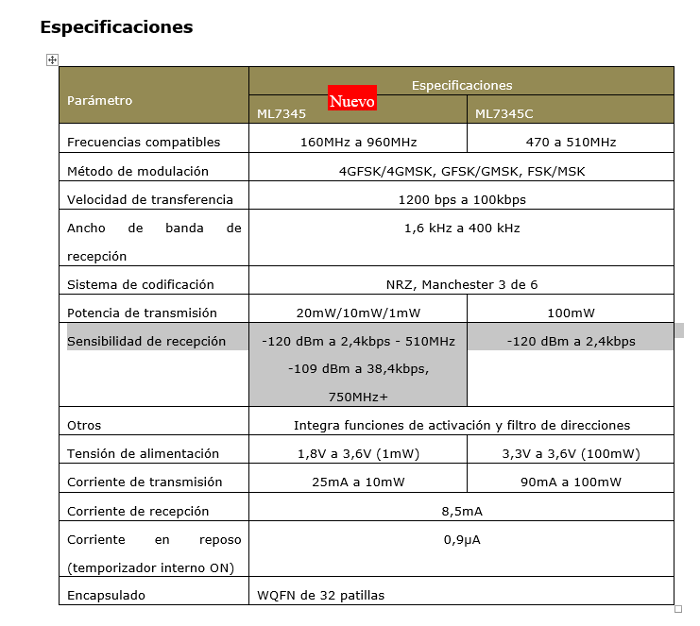
LAPIS Semiconductor offers an LSI specifically targeted to the Chinese market. Along with a 100mW antenna output power, the ML7345C allows for adjustable bandwidth of the programmable receiver for a wide range of applications, from electricity, gas, water, and thermal meters to crime and disaster prevention systems.
2. Best-in-class environmental stability: temperature dependence of less than ±1dB.
In addition to improving the performance of the high-frequency amplifier, a transmission power variation of less than ±1dB is guaranteed across the entire operating temperature range, more than tripling the stability of conventional products. This allows for network design without considering margins for environmental changes in complex wireless networks such as smart meters operating with successive hops, thus reducing costs and simplifying network configuration (e.g., without relays). Furthermore, highly reliable communication can be achieved in relatively simple wireless networks used for disaster and crime prevention, unaffected by changing conditions.
 3. High-speed radio wave checking and lower standby current reduce average current consumption.
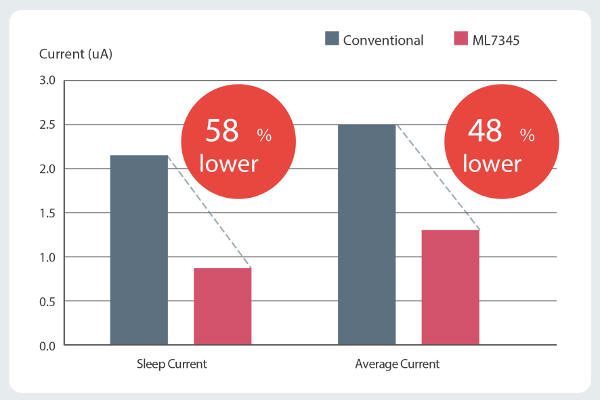
Years of low-current design technology from LAPIS Semiconductor allow them to reduce average current by 48% in standby mode (in 10-second intervals, which comprise most of the communication time).
Furthermore, a unique high-speed radio wave checking function reduces the time required to initiate reception, thus minimizing the total time to detect receiver strength (approximately 1 ms). This further reduces standby current (only when the timer is ON) to 0.9 µA, 58% less than current products. As a result, the power consumption of wireless nodes within a network is reduced, contributing to lower overall system power consumption and extended battery life.
 4. Comprehensive Development Support
An evaluation kit incorporating the ML7345 is also available, along with reference design data for compact modules (e.g., circuit diagram, peripheral component list, recommended printed circuit board layout), hypothetical tests, and sample programs (simple MACs). Other useful materials, such as user manuals and tools, can be downloaded from the LAPIS Semiconductor website (registration required) at:
https://www.lapis-semi.com/cgi-bin/MyLAPIS/regi/login.cgi
Sales Plan
Reference No.: ML7345/7345C
Production Start: December 2015
Production Volume: 500,000 units/month
Packaging: Tape and reel (2,000 units/reel) Note that two cards are required to evaluate the transmission/reception operation
Applications:
Smart meters worldwide, sensor networks, measuring equipment, and other industrial equipment that require wireless communication.
Wireless M-bus
Terminology:
European standard for communication systems aimed at metering and remote reading systems; it specifies an operating frequency of 868 MHz in S, C, and T modes, 433 MHz in F mode, and 169 MHz in N mode.
ARIB STD-T108
: Standard for wireless equipment in Japan for data transmission, telemetry, and remote control, using the 920 MHz band.
IEEE 802.15.4g:
Wireless standard established by the IEEE in the USA for smart grids.








