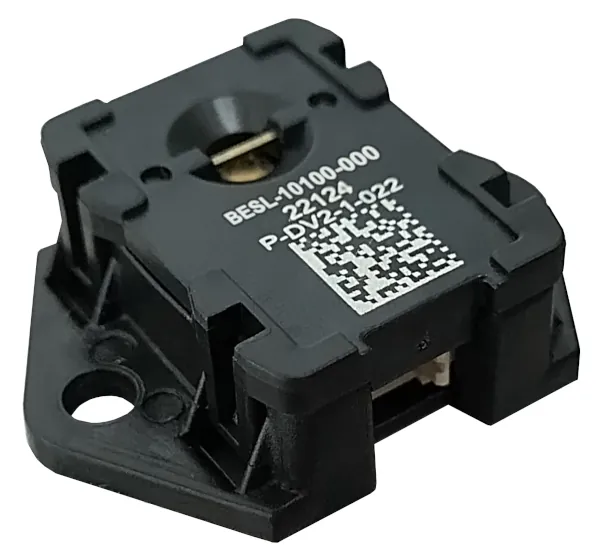
The BES LITE sensor is designed to detect gases released during the initial stages of lithium-ion cell degradation, providing early warning of thermal runaway events and enabling mitigation measures to be activated before the incident escalates.
Thanks to its selective electrolyte vapor detection technology, the device can identify compounds associated with battery failures, significantly reducing the risk of false alarms in complex industrial environments.
Technology and Operating Principle:
The BES LITE utilizes electrochemical gas sensing technology and optimized, low-power electronics, without internal heating elements, which enhances its intrinsic safety and makes it suitable for demanding environments.
The device provides a three-state analog output, enabling easy integration into battery management systems (BMS) and industrial safety architectures.
Key Technical Features:
Selective electrolyte vapor detection;
Early detection of venting events before thermal runaway;
Compact, low-profile, and lightweight design;
Up to 10-year operating lifespan;
Integrated device diagnostics;
Compatible with multiple lithium-ion battery chemistries (NMC, LFP, LTO, etc.);
Resistant to contaminants and siloxane poisoning;
Typical response time less than 2 seconds
Industrial Applications
The sensor is designed for the protection of lithium-ion battery systems in multiple sectors, including:
Battery Energy Storage Systems (BESS),
Light Electric Mobility (micro-mobility),
Medical Devices
, Unmanned Aerial Vehicles (UAV/UAM),
and Light Industrial Equipment
Safety and reliability in critical environments.
The BES LITE is designed to provide deterministic detection of thermal runaway events, contributing to compliance with international battery safety standards and improving the protection of assets and personnel in critical environments.
Its architecture without internal heating elements and its low power consumption make it particularly suitable for applications where efficiency, reliability, and intrinsic safety are key requirements.