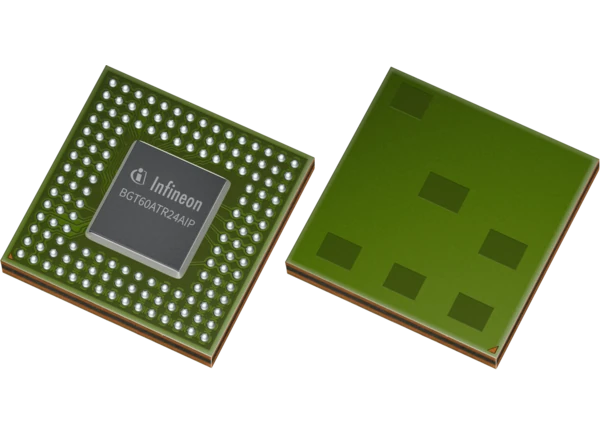
The new sensor combines high detection performance with ultra-low power consumption in a compact and highly integrated device. Its frequency-modulated continuous-wave (FMCW) radar technology accurately detects the presence, position, and movement of occupants, opening up new possibilities for safety and driver assistance systems.
Key applications include detecting children accidentally left in the vehicle, seat occupancy detection to optimize seatbelt reminders, gesture detection for infotainment systems, monitoring vital signs and driver drowsiness, and intrusion and proximity detection.
60 GHz Radar in a Compact Format:
The BGT60ATR24AIP enables ultra-wideband FMCW operation, with a bandwidth of up to 4.7 GHz, and is integrated into a package measuring only 8.0 × 8.0 × 0.86 mm. The device also incorporates the antennas directly into the package (Antenna-in-Package, AIP), simplifying system design and reducing the space required for the radar solution.
The architecture integrates two transmit and four receive antennas, enabling robust spatial detection and detection capabilities in both azimuth and elevation. The sensor also offers micro-motion detection using steep chirps with sub-centimeter resolution, features particularly relevant for occupant and in-vehicle activity monitoring applications.
The device incorporates an integrated crystal oscillator and a digital interface for sensor configuration and data acquisition. An integrated finite state machine (FSM) enables autonomous data acquisition and optimizes operating modes to minimize energy consumption and reduce the necessary intervention of the system's microcontroller.
Designed for automotive applications,
the XENSIV BGT60ATR24AIP has been specifically developed for automotive applications and is AEC-Q100 Grade 2 qualified, facilitating its integration into automotive designs. The device operates in the 57.7 to 62.4 GHz range and is specified for operating temperatures from -40 °C to +105 °C.
Its combination of integration, accuracy, and low power consumption allows a single 60 GHz radar platform to be used to implement various cabin monitoring functions, simplifying design and reducing system costs.
Target applications include:
detection of unattended or accidentally left children in the vehicle;
seat occupancy detection and optimization of seatbelt reminders;
monitoring of driver vital signs, including heart rate and respiration;
driver drowsiness and activity detection;
gesture control for infotainment systems;
and intrusion and proximity detection.