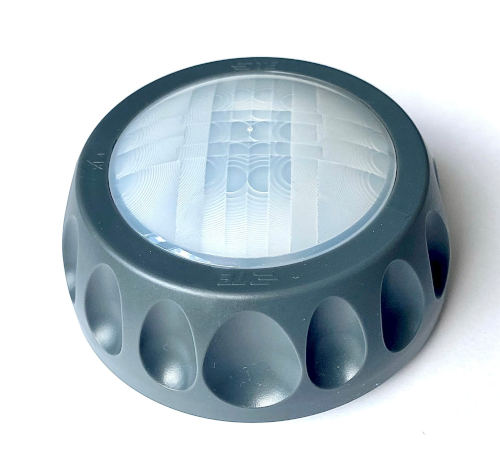
The LUMAWISE programmable motion sensor detects approaching people within the largest detection zone currently available and adjusts the brightness of dimmable luminaires accordingly.
It is used in outdoor environments such as roads, pedestrian and cycle paths, parking lots, train stations, parks, and recreational areas where lighting is needed for pedestrians, wheelchair users, or cyclists. Its compact design complements the aesthetics of modern luminaires in public spaces. The sensor can also be useful for lighting high-bay warehouses, saving energy for the system operator while providing a higher level of safety for workers.
The LUMAWISE Motion Programmable sensor is available with two types of lenses, responding to movement within a 30 m diameter circle or a 30 m x 6 m rectangle with a height of 5 m. If it detects approaching people, it can switch the light fixture to maximum brightness. If there is no movement near the sensor, the light can be dimmed as needed (down to 30% of maximum brightness). The programmable version of the motion sensor allows the user to adjust various parameters, such as individual brightness levels or on/off times based on ambient light.
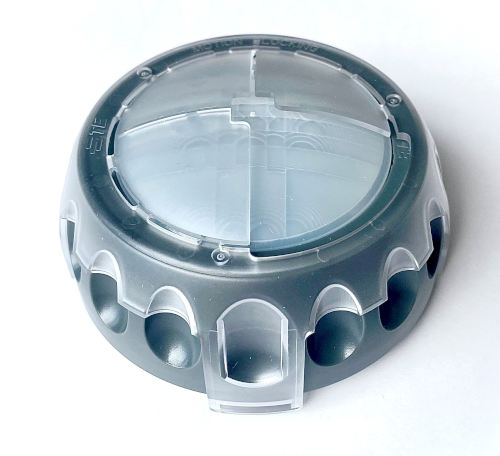
In addition to the switch from incandescent bulbs to LED lamps, cost-effective street lighting also relies on the control system. Using a two-node architecture, the system now supports devices such as the LUMAWISE motion sensor. Specifically, these sensors can be integrated into the luminaire as standalone controllers (Zhaga Type B devices) or in conjunction with a Zhaga-D4i photocell (Zhaga Type A devices, also supplied by TE), representing a significant step forward.
The LUMAWISE programmable motion sensor, certified by Zhaga-D4i, fits seamlessly into the Zhaga-D4i ecosystem. This certification ensures product compatibility according to the standard, enabling plug-and-play integration of sensors and control devices, as well as advanced data transmission capabilities.