This makes menu navigation intuitive and significantly reduces the risk of operational errors, especially for less experienced users or shift workers. As a result, settings can be quickly checked and adjusted even remotely, helping to reduce setup time and machine downtime.
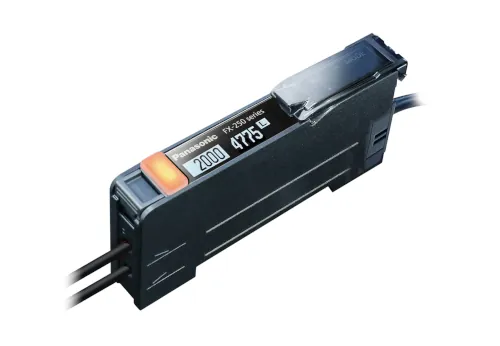
One particularly practical feature is the new two-step teaching function, which eliminates the need for manual adjustment of the emitted light. With just two presses of a button, the sensor reliably learns the switching threshold, even under challenging lighting conditions such as glare or saturation of the incident light. This significantly speeds up machine setup and ensures stable detection of shiny, transparent, or very small components, providing reliable performance even in demanding industrial environments.
The FX 250 also stands out for its extremely compact design. Its newly designed cover requires an opening radius of only 30 millimeters, allowing for installation in very confined spaces and simplifying maintenance without the need to reposition surrounding components. This makes the sensor ideal for modern production machinery, where space is limited and accessibility is crucial.
Energy efficiency has also been a key focus in the development of the FX 250. Three built-in ECO modes automatically reduce power consumption by dimming the display after a short period of inactivity or turning off the display and indicators completely if necessary. This feature is especially useful in 24/7 production environments with numerous sensors, where even small savings contribute to a substantial reduction in overall energy consumption and help companies achieve their sustainability goals.
With a response time of just 35 microseconds, the FX 250 is also ideal for applications requiring fast and accurate detection. Even the smallest or fastest-moving objects are reliably identified, increasing process stability and reducing the risk of errors on high-speed production lines.
“With the FX 250, we are expanding our range of fiber optic sensors with a very user-friendly series that significantly simplifies daily work in industrial automation,” says Angelika Selzle, Director of Product and Business Management for Sensors at Panasonic Industry. “We have designed a very compact yet powerful digital fiber optic sensor. With a response time of 35 µs, it is ideal for applications that demand high performance.”