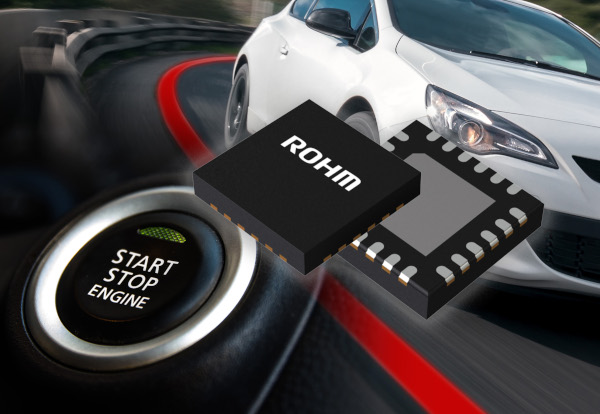
The chipset integrates a buck DC/DC converter with boost functionality (BD8P250MUF-C) and a dedicated boost IC (BD90302NUF-C). The primary chip (BD8P250MUF-C) utilizes ROHM's novel buck-boost control technology, called Quick Buck Booster, which allows for the configuration of a buck-boost power supply without degrading the characteristics of the buck-boost power supply, simply by adding the dedicated BD90302NUF-C boost IC to the next stage.
The result is an industry-leading no-load current draw of 8µA and an output voltage fluctuation of ±100mV using an output capacitance of 44µF (70% less current draw and 50% less output capacitance compared to conventional products). This contributes to improved stability and energy savings in applications where significant input voltage drops occur over a short period, such as in vehicle start-stop systems. Furthermore, Quick Buck Booster technology enables a common-board design that integrates both boost-buck and buck power supply topologies, along with the necessary peripheral components and noise countermeasures. This reduces development time and labor by 50% compared to conventional methods that require separate boost-buck and buck power supply boards.
In recent years, to meet the increased environmental performance demands of the automotive sector, the number of vehicles equipped with start-stop functionality, which shuts off the engine while idling, has grown significantly. These systems require a step-up/step-down power supply to prevent malfunctions due to low battery voltage during idling and battery fluctuations (during starting) immediately after the start-stop operation. However, conventional products present challenges in terms of current consumption and responsiveness, increasing the demand for an improved solution as the number of vehicles with start-stop functionality continues to rise.
In response, ROHM has leveraged analog design technology and power system processes to develop innovative solutions for the automotive market, such as products integrating Nano Pulse Control high-speed pulse control technology. This time, ROHM has developed a boost-buck power supply chipset utilizing proprietary automotive technology focused on Quick Buck Booster control, which overcomes the problems associated with start-stop systems. Looking ahead, ROHM will continue to support vehicle evolution by developing products and technologies that contribute to greater energy savings and system optimization.
Key features
1. Achieves Industry-Best Current Consumption and Responsiveness:
The ROHM chipset's integrated BD8P250MUF-C boost DC/DC converter utilizes Quick Buck Booster control technology developed by leveraging proprietary analog design expertise. This allows for seamless switching to boost-buck operation without degrading buck performance, which offers superior characteristics compared to boost-buck operation.
As a result, it achieves an output voltage fluctuation of ±100mV with a no-load current consumption of 8µA and 44µF output capacitance even in boost-buck configuration. This makes it the industry's best boost-buck power supply (70% lower current consumption and 50% lower output capacitance compared to conventional products), contributing to greater energy savings and stability across a wide range of applications, while also reducing both the size and cost of the output capacitors.
2. It provides the industry's first switchable buck/buck-boost power supply on the same board.
ROHM's chipset with Quick Buck Booster technology enables a common design that combines buck and buck-boost power supply operation on a single board, along with the necessary peripheral components and noise mitigation measures.
This allows for easy switching between buck and buck-boost operation simply by adding a dedicated boost IC, reducing design overhead by up to 50% compared to conventional methods using separate power supplies.
3. Contributes to stable operation with low noise while eliminating AM radio interference.
To meet market demands, the BD8P250MUF-C integrates a spread spectrum function as a countermeasure against electromagnetic interference (EMI), enabling it to comply with the international standard (CISPR 25) for noise in the automotive sector. Simultaneously, ROHM's original Ultra High Speed Pulse Control (Nano Pulse Control) technology is used to enable high-speed operation at 2.2MHz, eliminating the effects on the AM radio band (1.84MHz max.). This allows for a stable 5V output to the ECU from the 36V high-voltage input. This ensures low electromagnetic interference while allowing a low-voltage output from the high-voltage input without AM radio band interference, contributing to stable operation in noise-sensitive automotive systems.
Quick Buck Booster Technology
ROHM's buck-boost control technology has been developed based on proprietary analog design expertise. This allows users to easily switch to buck-boost operation without sacrificing the performance advantage that buck-DC/DC converters provide over buck-boost power supplies. Implementing a buck-boost topology while maintaining the same characteristics as buck-boost power supplies reduces the size of peripheral components and the development burden, contributing to system optimization and stable operation in applications with sudden voltage drops, such as ECUs used in vehicle start-stop systems.
Download the specifications table
Terminology
(buck, boost, buck-boost):
A type of integrated circuit in a power supply that converts one DC voltage into another. Generally, there is a boost type to increase the voltage and a buck type to reduce the voltage. Buck-boost converters can switch between boost and buck operation based on the input voltage, but due to redundant circuitry, they suffer from poor responsiveness and higher current consumption.