The three biggest challenges facing the electronics industry in recent years are increased intelligence, reduced size, and greater efficiency, driven by growing market demand. Furthermore, it is estimated that nearly 50% of global electricity demand is used to power motors, necessitating smarter, more compact, and highly efficient motor drives to protect the environment and improve structural designs.
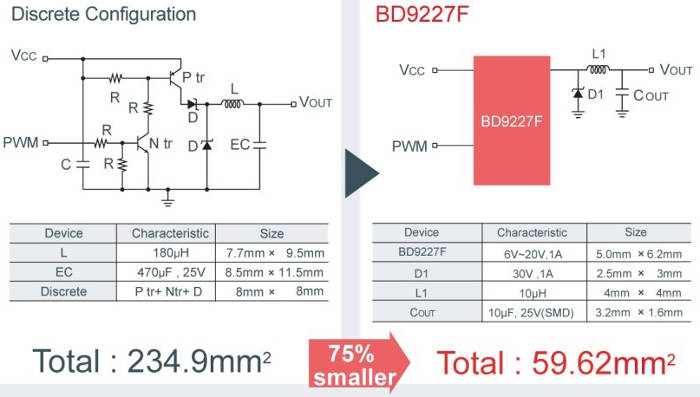
However, until now, power supplies used to control DC fan motors in refrigerators and other equipment have generally been configured with discrete components, making it more difficult to provide high-precision control or achieve high-frequency drive. As a result, larger output coils and capacitors are needed for the peripheral circuitry, significantly increasing the mounting area, which can be problematic.
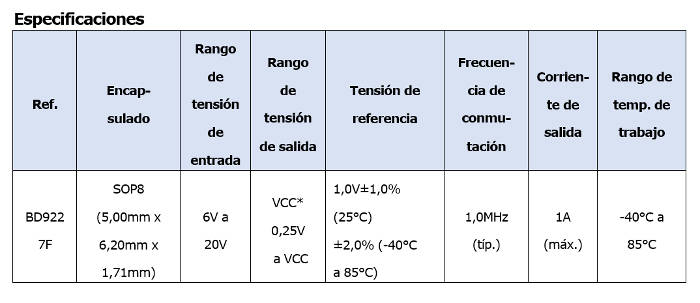
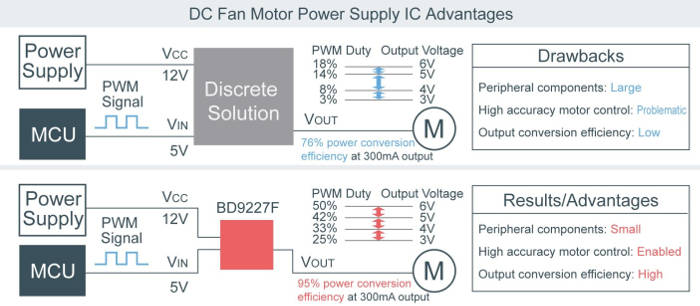 The BD9227F is the first power supply IC on the market capable of precisely controlling the rotational speed of DC fan motors by linearly varying the output voltage based on the duty cycle of the PWM signal generated by the microcontroller. In addition to more precise control than conventional discrete configurations, ROHM leverages its proprietary analog IC design technology to achieve circuit optimization and high-frequency (1 MHz) control. This allows for the use of smaller peripheral components (the inductor and output capacitor), reducing the footprint by 75% and improving power conversion efficiency by 19% (with an output current of 300 mA). All of this contributes to greater precision, miniaturization, and higher power conversion efficiency in DC fan motor applications.
Main features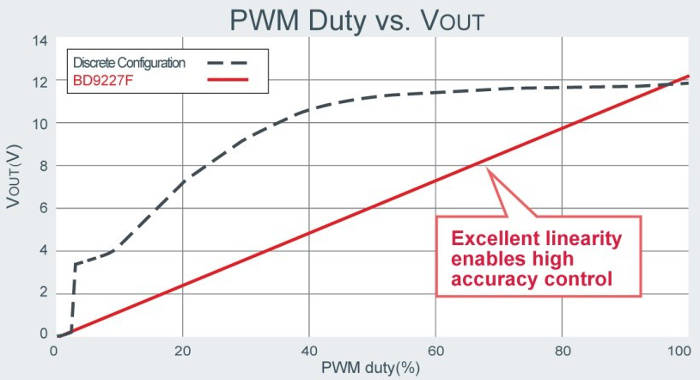 1. Linear control of the output voltage ensures high-precision control of the motor's rotation speed.
With conventional discrete configurations, there is no linearity of the output voltage with respect to the duty cycle of the pulses provided by the PWM terminal, which makes precise control of the motor's rotation speed difficult.
In contrast, the BD922F offers linear control of the output voltage based on the duty cycle of the PWM signal generated by the microcontroller, allowing for very precise control of the rotation speed of DC fan motors.
 2. 75% Reduction in Mounting Area:
Discrete solutions do not support higher frequency PWM signal input from the microcontroller. As a result, larger inductors and capacitors are required, which can cause problems by significantly increasing the mounting area.
The BD9227F, on the other hand, features internal frequency control that allows frequencies up to 1 MHz, thus reducing the mounting area by approximately 75% compared to conventional systems by enabling the use of smaller peripheral components, such as inductors and capacitors.
 3. High efficiency across the entire load range
. The BD9227F improves efficiency across the entire load range. For example, for a 300mA load, the power conversion efficiency is increased by 19%, and the difference is even more pronounced for higher loads.
4. Supports a 100% duty cycle.
The integration of a high-side PMOS allows for the generation of an output voltage with a 100% duty cycle, something exceptional in an IC.
Terminology
/ PWM Duty Cycle:
PWM is a method for controlling output voltage by varying the ON/OFF times in each cycle through repeated switching. The duty cycle refers to the proportion of ON time in each PWM period, so a higher proportion corresponds to a higher output voltage.