 Analog processing capabilities integrated into a small, low-cost, instant-programmable logic device. MAX 10 FPGAs support a comprehensive collection of design solutions that accelerate system development, including Quartus® II software, evaluation kits, design examples, documentation, training, and design services.
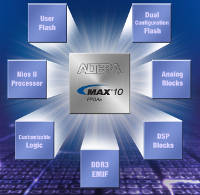
The MAX 10 FPGAs provide greater system value for users by reducing overall bill of materials costs while increasing board reliability. These highly integrated, non-volatile FPGAs offer up to 50 percent PCB space savings compared to other low-cost FPGAs by integrating the following key features onto a single chip:
• Up to 50k logic elements
• Flash memory blocks (user flash and dual flash configuration)
• Analog-to-digital converters
• Integrated memory and DSP blocks
• External DDR3 memory interfaces
• Integrated processing with Nios® II soft-core processors
• Up to 500 user I/O
• Integrated power regulator.
These key features provide greater system-level value for customers by enabling the MAX 10 FPGAs to perform several important system functions, such as instant configuration, fail-safe upgrades, system monitoring, and system control.
Instant-on Architecture for Instant Power-On:
MAX 10 FPGAs are configured in less than 10 ms (milliseconds) using on-chip flash memory. For system management applications, instant power-on allows MAX 10 FPGAs to be the first usable device on a system board and control the power-up of other board components. In data routing applications, instant-on enables MAX 10 FPGAs to provide user interaction upon power-up.
Dual Configuration for Fail-Safe Upgrades:
The on-chip flash storage integrated into MAX 10 FPGAs supports dual configuration, allowing two FPGA designs on a single chip. This dual configuration capability enables fail-safe upgrades, with one flash block designated for upgrade images and the other reserved for a factory-safe image. This capability allows for faster system deployment, reduces maintenance costs, and provides a longer lifespan.
Analog Blocks for System Monitoring:
The analog blocks integrated with the MAX 10 FPGAs include ADCs and temperature-sensing diodes. This integrated analog functionality allows the MAX 10 FPGAs to be used in applications requiring system monitoring, such as temperature control and touchscreen human-machine interface control. Integrated analog blocks reduce board complexity, lower latency, and offer more flexible sample sequencing, including simultaneous 2-channel sampling.
Integrated Processing for System Control:
The MAX 10 FPGAs support the integration of Altera Nios II soft-core embedded processors, providing developers with a fully configurable, instant-on, single-chip subsystem. The Nios II embedded processors in a MAX 10 FPGA enable the device to be used to efficiently manage complex control systems.
Targeting a Wide Range of Applications:
MAX 10 FPGAs deliver system-level value for many end markets. The device's integrated functions, combined with small package options (as small as 3 mm x 3 mm), make MAX 10 FPGAs an effective solution for space-constrained systems, such as industrial and automotive applications. In advanced communications, computing, and storage applications, MAX 10 FPGAs can efficiently manage complex control functions while handling system configuration, bridging, power sequencing, and I/O expansion.