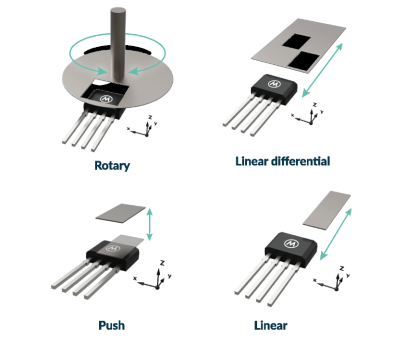
For traditional automotive latches and safety switches, ranging from door and trunk handles to seat belts and brake light switches, the standard design uses a mechanical contact or magnetic switch, such as a push button, reed switch, or Hall effect sensor. But for such a solution to work, the design of the safety target must be modified, either to include a magnet plus a bracket or a physical protrusion to actuate a button.
With Melexis' revolutionary induction solution, this is no longer the case. Its technology actively detects the actual safety target, such as a seatbelt buckle or door lock, directly without a magnet or push button, provided it is a conductive element.
This change in position sensing technology offers several advantages. With no moving mechanisms or additional parts, reliability and safety are increased, as the direct sensing operation is not tied to parts fixed to the safety element that could be damaged or displaced. Furthermore, the solution helps reduce the bill of materials (BOM), and the contactless inductive operation is inherently more reliable than mechanical solutions that wear out over time, as well as being immune to magnetic interference.
The core element of the MLX92442 is its miniaturized, highly integrated standard enclosure. Compared to other inductive solutions, Melexis' design innovates by fully integrating the coils and interface within the chip, eliminating the need for engineers to develop bulky PCB and coil solutions for their application.
The solution is available in a through-hole VK package or a surface-mount SOIC package. In both cases, the supporting materials list is reduced from 3 to 2 items (target + IC/coils) compared to existing solutions, and this, combined with the magnets mentioned above, helps to produce a more sustainable and safer design than existing sensors on the market.
To ensure continuous and reliable operation, the MLX92442 also includes protection against reverse supply voltage, undervoltage and thermal protection, as well as an advanced built-in self-diagnostic function with a dedicated safe mode.
In addition to reducing the number of components in the bill of materials, Melexis' inductive solution helps streamline development time. It allows for both factory and end-of-line programming, and the operation of the smart switch/closer is established simply by defining the application's shape and movement. Unlike Hall effect solutions, magnetic simulation is not required, resulting in development time savings (in addition to the savings in the bill of materials).
Regarding the assembly design, the standard housing and the absence of magnets and brackets allow for simpler system integration. This streamlines the supply chain, with fewer components that help reduce both prototyping and production assembly times. This factor also helps maintain mechanical tolerances in assemblies, as only the inductive sensor and the conductive safety element need to be considered within air gaps of up to 1.5 mm.
With industry-standard two- or three-wire interfaces, a wide operating voltage range of 3.5 V to 18 V, a working temperature range of -40 °C to 150 °C, and compliance with ISO 26262 ASIL A, the MLX92442 requires minimal design considerations. Furthermore, for safety-critical applications requiring heterogeneous redundancy, inductive technology offers a highly reliable option with minimal design requirements that can operate alongside Hall effect and mechanical solutions.
Ready for evaluation
“With this new technology, our engineering teams have redefined end-position detection, delivering a wide range of advantages,” says Minko Daskalov, product manager at Melexis. “Induxis is here to enable the next step in electrification and safety, with battery and hydrogen technologies for both the grid and electric vehicles. The MLX92442 meets all the requirements.”.
The MLX92442 is currently in pre-production, with engineering B samples and evaluation kits available.