In addition to providing faster turn-off times (up to 4X), designs can be simplified by reducing the number of bills of materials.
MOSFET-based power schemes for controlling solenoids and actuators in automotive powertrains are typically built around impulse, free-wheel, or active clamp topologies. A fourth option is a repetitive avalanche design that dissipates the inductive load's energy by utilizing the MOSFET's ability to repeatedly handle the inductive load current during turn-off. Offering efficiencies comparable to active clamp alternatives, these designs eliminate the need for diodes and other devices, minimizing the number of components and circuit complexity. They also support faster turn-off times, a factor that can extend the reliability of electromechanical components such as solenoids and relays. Until now, this has only been possible using an outdated planar technology. Nexperia Automotive's ASFET product family for repetitive avalanches has been specifically developed to address this issue, guaranteeing the functionality of tested repetitive avalanches for up to one billion cycles. Furthermore, when compared to boost topologies, they can simplify designs by providing up to 30% efficiency in component footprint due to a potential reduction of up to 15 board components.
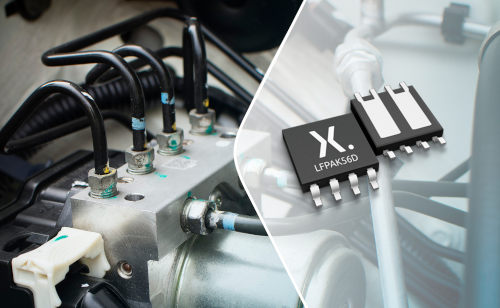
Fully AEC-Q101 approved at 175°C, the new MOSFETs are available in 40V and 60V options with typical RDS(ON) ratings from 12.5 mΩ to 55 mΩ. All devices are supplied with the company's space-saving LFPAK56D (Dual Power-SO8) copper clip package technology. The highly robust enclosure includes gull-wing leads for increased board-level reliability and improved manufacturability, including automated optical inspection (AOI).
According to Nexperia's Product Manager, Richard Ogden, "Typically, engineers looking to implement repetitive avalanche topologies have had to rely on devices using older planar semiconductor technology. Offering automotive-qualified devices with guaranteed repetitive avalanche capabilities based on higher-performance silicon structures will increase the number of powertrain designs that can take advantage of repetitive avalanche functionality."
Learn more, including quick-learn videos.





- Details
- Category: Integrated Circuits
AEC-Q101 rated MOSFETs for automotive applications
Nexperia has launched a new portfolio of AEC-Q101 rated repetitive avalanche effect transformers (ASFETs) for powertrain applications. The technology has been tested to one billion avalanche cycles and can be used to control inductive automotive loads such as solenoids and actuators.




Print Magazine

Annual subscription price:
You will receive all 10 editions that are published each year.
social networks
Popular News Electronics



Spanish electronics magazine. Printed for over 25 years.
Spain - Madrid - All rights reserved © Convertronic Professional Spanish Electronics Magazine.