




From building technology to passenger and freight transport, we are facing substantial changes in all aspects of daily life. A new concept is emerging in this context: electromobility. Automakers, industrial companies, and research institutes are working hand in hand to develop fully electric vehicles and the necessary infrastructure. Expectations for electric vehicles have improved significantly over the past year. New traction concepts have been researched and tested by various companies in recent years. The first hybrid and electric vehicle models are already available on the market. New components that were not present in conventional diesel/gasoline vehicles, such as electronic power systems, are now being integrated into cars.
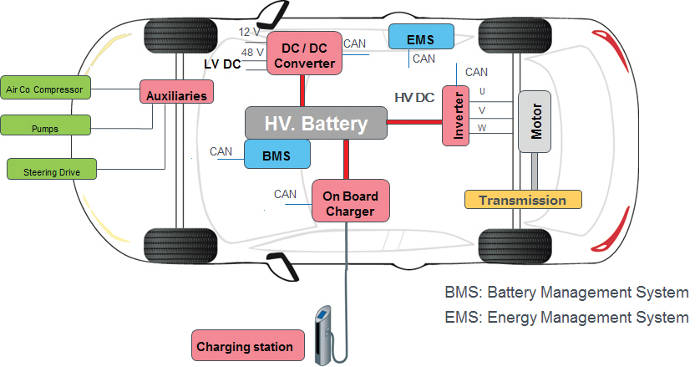 Some examples of this type of system are:
- Inverters for motor control (up to 300 kW)
- Battery chargers (in-vehicle chargers) from 3.6 kW to 22 kW
- Inductive charging (wireless charging) from 3.6 kW to 22 kW
- DC/DC converter up to 5 kW
- Inverter for auxiliary units such as air conditioning systems, power steering, water pumps, etc.
In the systems mentioned above, power electronics plays a decisive role in ensuring the functionality of hybrid and electric vehicles.
SiC, an efficient semiconductor material.
The requirements that OEM manufacturers in the automotive industry place on power electronics systems represent a significant challenge for developers of these systems. Specifically, space, weight, and efficiency are key considerations. Furthermore, the overall system costs and the effort required during the product design phase must be low; at the same time, product quality and safe operation must be guaranteed.
The efficiency of conventional power electronics is based on silicon semiconductor technologies and typically ranges between 85% and 95%. This means that approximately 10% of the electrical current is lost as heat during each energy conversion. Generally speaking, the efficiency of power electronics is largely limited by the performance of the power semiconductors. Due to its physical properties, the semiconductor material SiC has enormous potential to meet the requirements of these market trends.
Compared to silicon semiconductor devices, the electric field strength of SiC is almost ten times greater (2.8 MV/cm vs. 0.3 MV/cm). The higher electric field strength of this highly resistant SiC substrate allows for the application of a thinner layer structure, known as epitaxial layers, to the SiC structure. This is equivalent to one-tenth the thickness of the silicon epitaxial layers. The SiC doping concentration can be two orders of magnitude higher than for silicon at the same blocking voltage. Therefore, the surface resistance (RonA) of the component is reduced, resulting in a considerable decrease in phase losses.
Thermal design plays a crucial role in electronic power systems for designing high power density and, consequently, achieving compact systems. As a semiconductor material, SiC is excellent for these applications because its thermal conductivity is almost three times greater than that of silicon semiconductor devices. SiC is also suitable for higher operating temperatures compared to silicon semiconductors.
Energy Dissipation of Semiconductor Devices:
In the operation of electronic power systems, energy is lost during current flow and the switching of semiconductor components. The total energy loss in electronic power systems consists of static losses and switching losses. Static losses occur primarily when the power component is conducting. Switching losses result from the switching of the semiconductors. The higher the switching frequency during operation, the higher the switching losses.
The switching frequency in electronic power systems is often defined according to its application and specific system limitations. For example, the switching frequency of an electric drive is determined by the output frequency required by the motor. Other factors, such as the resonant behavior of the entire system, electromagnetic compatibility (EMC), and heat management, must also be considered to determine the appropriate switching frequency. In addition to the energy losses in the power semiconductor device, there are also losses in passive components such as transformers, inductors, and capacitors within the circuit. The interaction between power semiconductors and passive components such as inductors and transformers becomes the decisive factor in achieving high power density in the system. Therefore, the physical properties of passive components and semiconductors must be considered when designing electronic power systems.
Static and switching losses, as well as those of passive components, contribute to the total energy losses in the system, which can be converted into heat. The generated heat must be dissipated through a suitable cooling medium to ensure the reliability of the components and the system. In principle, switching losses occur in a single switching process, for example, when semiconductors are switched. An increase in the switching frequency leads to an increase in total switching losses, which in turn significantly impacts total energy losses. In certain vehicle electronic power systems, a high switching frequency is preferable to meet system requirements or specifications. In such a system, switching losses will represent a large portion of the total system energy losses. If silicon semiconductors are used in these types of applications with high switching frequencies, the high power dissipation and resulting heat force system developers to ensure system functionality and reliability. This means, in other words, that a high switching frequency implies lower power consumption. However, if high load currents are essential in these applications, the overall system size must increase accordingly. This measure would be unavoidable at this point, but it doesn't meet end-user expectations. It can be said that silicon semiconductors have almost reached their limits.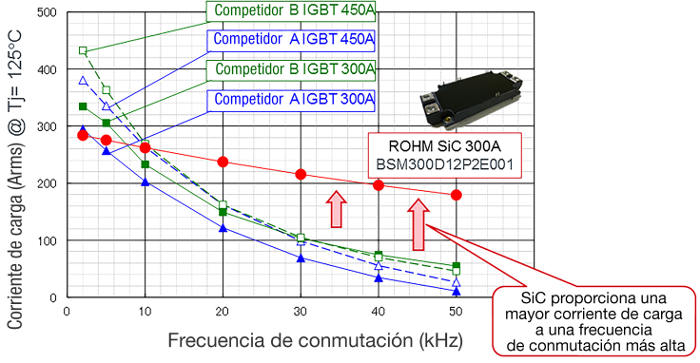 When comparing a SiC MOSFET and a silicon IGBT in applications characterized by high switching frequencies, it can be stated that the output current must be reduced due to the high switching losses of the silicon IGBT and the resulting heat. This is the only way to avoid exceeding the chip's maximum operating temperature and to guarantee the semiconductor's functionality.
Text in the graph: Competitor; Switching frequency (kHz), SiC provides higher load current at higher switching frequencies. Load current (Arms).
Everything looks different when using SiC. The SiC semiconductor offers better switching performance than the silicon IGBT. Therefore, SiC causes lower switching losses at higher switching frequencies. As a result, higher load current can be obtained in the application at high switching frequencies compared to a silicon IGBT.
Figure 2 provides a comparison between a SiC half-bridge module (BSM300D12P2E001) and four different IGBT modules from one manufacturer.
This image clearly indicates that for high switching frequencies, the SiC MOSFET is more efficient than the silicon IGBT. When using a 300A IGBT module and a switching frequency of 40 kHz, a load current of no more than 80 Arms could not be achieved in the application. In contrast, a load current of 200 Arms could be achieved using a 300A Rohm SiC module. This represents a 120% increase in load current compared to the silicon IGBT.
To develop compact power electronics systems, power electronics developers must utilize optimal cooling. Over the past few years, several new cooling concepts have entered the market to overcome these challenges; however, these are generally very expensive concepts that sometimes cause problems in applications. These problems occur not only during the development phase but also during production and operation. Thanks to the use of an efficient semiconductor material like SiC, this complicated cooling process can be eliminated, resulting in reduced cooling costs and easier system operation.
Miniaturization of Power Electronic Systems:
Automakers have imposed various requirements on power electronic systems, taking electric vehicle application scenarios as a reference. These include, for example, resistance to temperature changes, vibration resistance, reliable operation at different temperatures, and a long service life. Furthermore, a requirement such as high power density in integrated systems is now considered essential by automakers. However, all these requirements pose a significant challenge for power electronics.
The range of high-voltage batteries is one of the biggest obstacles to the deployment of hybrid and electric vehicles. To convince the end customer (i.e., the car owner) about electric mobility, some car manufacturers are currently relying on fast-charging systems designed to simplify the use of electric cars. However, from a technical standpoint, fast charging implies the need for higher charging performance in a short period of time to fully charge the battery. Since the available space within a vehicle is always limited, the battery charging system must have a high power density. This is the only way to integrate these systems into the vehicle while meeting market demands.
On-board chargers are complex systems comprised of various components for energy conversion. These systems integrate several components, such as semiconductors (like diodes and MOSFETs), passive components (like inductors and capacitors), and a transformer with a turns ratio adapted to charge the battery to the required voltage. The transformer is also used for galvanic decoupling of the high-voltage battery during charging.
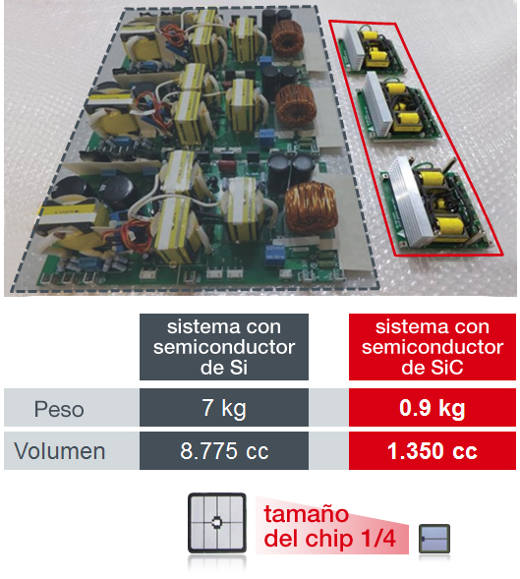
One way to miniaturize power electronics is to make passive components, such as inductors and transformers, more compact. This is generally only possible if the semiconductors used in the circuit can be controlled at a high switching frequency. In the case of silicon semiconductors, the thermal load generated by high switching frequencies will limit this approach. In contrast, the SiC MOSFET is ideal for these applications thanks to its excellent switching characteristics.
Figure 3 illustrates this with an example: for a DC/DC converter using silicon semiconductors, the switching frequency is limited to 25 kHz. By using a SiC MOSFET, a switching frequency of 160 kHz can be achieved. This results in significant miniaturization of the overall system winding quality, as well as high power density and a significant reduction in overall weight.
Weight – silicon semiconductor system – SiC semiconductor system
Volume – chip size
 The advantages of SiC semiconductors have finally been recognized by automakers. The first products, specifically Rohm's SiC diodes, are being used for onboard charging in several mass-produced vehicles worldwide. Rohm will also soon offer the world's first automotive-grade SiC MOSFET. In addition to battery charging systems, SiC semiconductors promise enormous potential in applications such as DC/DC converters and drive inverters. Rohm offers specific solutions for these types of applications. Rohm's
second generation of SiC Schottky Barrier Diodes (SBDs) currently includes products for 650V with 5 to 100A, as well as for 1200V and 1700V with a current capacity of up to 50A. Rohm's SiC MOSFET range is even broader, as the company offers two different technologies: planar and dual-trench. Planar technology already offers discrete products and modules in the 650V, 1200V, and 1700V voltage ranges, with a current capacity of up to 300A.
ROHM is launching mass production of third-generation SiC MOSFETs for discrete components, as well as complete SiC modules incorporating its proprietary dual-trench technology, expanding the existing MOSFET product family and contributing to the development of efficient and reliable power electronics.

Author: Aly Mashaly, Manager Power Systems Department ROHM Semiconductor GmbH








