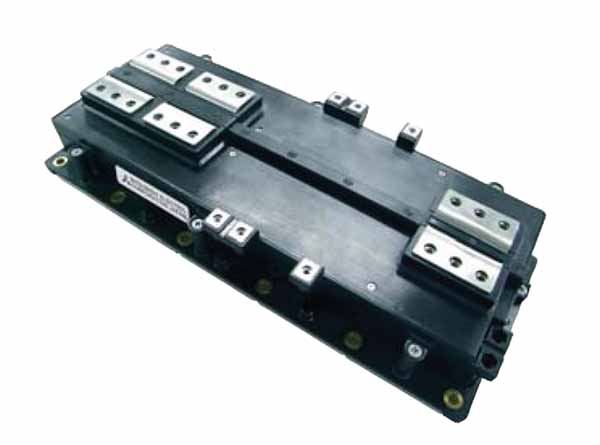
 ROHM has announced the development of 1200V 400A/600A power supply modules made entirely of SiC [BSM400D12P3G002/ BSM600D12P3G001] and optimized for inverters and converters in solar power conditioners, UPS and power supplies for industrial equipment.
The BSM600D12P3G001 achieves a rated current of 600A thanks to a new package featuring an original internal structure and optimized heat dissipation design for higher-power applications, such as large-scale power supplies for industrial equipment. Furthermore, switching losses are reduced by 64% (at a chip temperature of 150°C) compared to IGBT modules of the same rated current, resulting in significant energy savings. The reduced size of peripheral components and the high operating frequency amplify the effects of the reduced switching losses at higher frequencies, thus contributing to miniaturization of cooling and other systems. For example, based on preliminary calculations using cooling system loss simulations, the adoption of SiC modules can reduce the size of water-cooled heat sinks by up to 88%* compared to equivalent IGBT modules.
Over the past few years, SiC has seen increasing adoption in a growing number of markets, such as the automotive and industrial sectors, due to its superior energy-saving performance and the demand for products capable of handling higher currents. However, to maximize SiC's high-speed switching characteristics
—especially in high-current products like power modules—a new package is needed to eliminate transient overvoltages during switching.
In March 2012, ROHM became the world's first company to mass-produce power modules made entirely of SiC by integrating power semiconductors composed entirely of silicon carbide. Since then, we have developed high-power products up to 1200V/300A, which have been adopted in various fields. These new modules utilize a newly designed package that expands our range of SiC modules to cover the important current range of 100A to 600A, thus meeting the growing demand in the IGBT market.
*Product of 1200V/600A, PWM inverter control, 20kHz switching frequency, thermal grease thickness less than 40um, heat sink specifications obtained from products available on the market, other temperature conditions, etc. are the same.
Key Features
1. Reduced switching losses increase energy savings.
Power supply modules made entirely of SiC and equipped with ROHM's Schottky diodes and SiC MOSFETs reduce switching losses by 64% (at a chip temperature of 150°C) compared to IGBTs of the same current. This minimizes power conversion losses in applications and contributes to energy savings.
2. High-frequency control reduces the size of peripheral components.
Simulations of losses performed with PWM inverter control resulted in a 30% reduction at 5kHz and an even more substantial reduction of 55% in total losses with PWM at 20kHz compared to equivalent IGBT modules. At 20kHz, the size of the heatsink can be reduced by up to 88%. High-frequency control also allows the use of smaller passive components.
Technological Challenges for Achieving Higher Currents
1. Reducing Package Inductance
The higher current of power supply modules also increases transient overvoltages during switching, which necessitates minimizing package inductance. However, by optimizing the internal placement of the SiC device, along with the terminal configuration and connection routing, ROHM allows us to reduce internal inductance by 23% compared to conventional products. ROHM's new G-type package eliminates transient overvoltages by 27% for the same level of losses compared to standard packages, thus enabling the development of 400A and 600A modules. Furthermore, this new package reduces switching losses by 24% for the same transient overvoltage control conditions.
2. Improved Heat Dissipation in the Package:
To achieve a rated current of 600A, it is necessary not only to reduce internal inductance but also the heat generated. Thanks to the improved flatness of the base plate section, which significantly contributes to heat dissipation from the module, ROHM has been able to decrease the thermal resistance between the cooling mechanism and the customer's motherboard by 57%.
Along with the SiC modules, ROHM also offers a gate driver board that enables quick and easy evaluation.
Range of SiC power supply modules
Terminology
• Inductance: The amount of electromotive force generated by electromagnetic induction when current flow changes.
• Transient overvoltage: A voltage that fluctuates instantaneously in a circuit where electricity is flowing steadily. In this case, it specifically refers to the voltage generated when the MOSFET switches off.
• IGBT (Insulated Gate Bipolar Transistor): A bipolar transistor that incorporates a MOSFET in the gate.
• MOSFET (Metal Oxide Semiconductor Field Effect Transistor): The most commonly used structure in FETs, often as a switching element.
• Schottky diode: A type of diode that provides rectification characteristics by adopting a Schottky barrier formed by a metal-semiconductor junction. The absence of minority carriers results in higher speed.