System-on-a-chip (SoC) devices for automotive gateways must offer both high performance for deploying new applications, such as cloud services, and low power consumption when not in use. They must also offer fast CAN response to support instant boot times. Furthermore, these SoCs must provide low-power communication technology that enables network functions as a gateway using limited power, along with security technology to ensure secure communication outside the vehicle. To meet these requirements, Renesas has developed (1) an architecture that dynamically adjusts the circuit's operating timing to adapt to vehicle conditions with optimized performance and power consumption, (2) a fast boot technology that partitions and powers only essential programs, (3) a network accelerator that achieves an energy efficiency of 10 gigabits per second/watt (Gbps/W), and (4) a security technology that prevents communication interference by recognizing and protecting vital in-vehicle communications related to vehicle control.
Details of the new technologies include:
1. Architecture that optimizes processing performance and power consumption based on vehicle conditions.
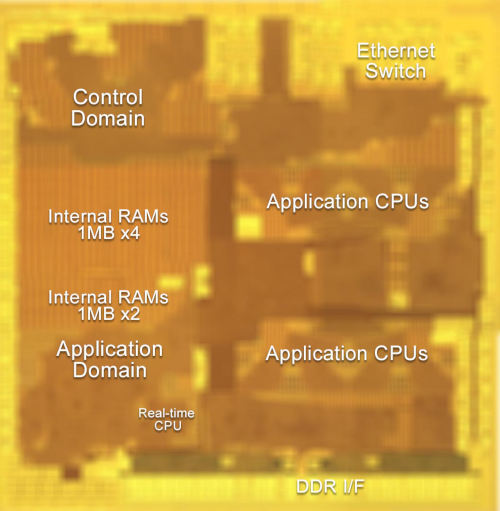
Communication gateway SoCs must deliver processing performance exceeding 30 billion instructions per second (DMIPS) during operation while maintaining standby power consumption of 2 mW or less to conserve battery life. Typically, high-performance SoCs also have high standby power consumption, while low-power SoCs with low standby power consumption suffer performance issues. To address this, Renesas has combined a high-performance application system and an optimized control system for ultra-low standby power consumption onto a single chip. The new architecture manages the power supplies of these two subsystems and adjusts circuit timings to achieve an optimal balance between performance and energy efficiency. The result is higher performance during operation and lower power consumption during standby.
2. Fast boot technology with external flash memory that achieves the same speed as integrated flash memory.
Since communication gateway SoCs manage the processing of critical vehicle control functions, they must be able to respond to CAN in less than 50 milliseconds (ms) from boot time. However, if the SoC uses a process that does not support integrated flash memory, the boot program must be encoded and stored in external flash memory. This means that it takes additional time to load and decrypt the program data. To solve this problem, Renesas has developed a technology that divides the program into sections and initially loads and decrypts only the portion essential for booting, while continuing to load the rest of the program in parallel. This enables a fast response to CAN (50 ms or less), even when using external flash memory.
3. Highly Efficient Network Accelerator with 10 Gbps/W Communication Efficiency.
To enable air cooling and heat dissipation of the electronic control units (ECUs), the communication gateway SoCs must keep power consumption to 7 watts or less. Since compute throughput of 30,000 DMIPS or higher requires approximately 6 watts of power, only about 1 watt can be used for network processing. This presents a challenge, as the total 10 Gbps communication must be achieved using only 1 watt of power, with a processing efficiency of only about 3 Gbps/W when handled by the CPU. To address this issue, Renesas offloaded processing from the CPU to a custom network accelerator, achieving a higher efficiency of 9.4 Gbps/W. Furthermore, Renesas increased the efficiency to 11.5 Gbps/W by changing the routing method from a conventional TCAM to a hash table in SRAM.
4. Security technology to prevent interference in communications that require high reliability
A communications gateway SoC performs a mixed set of tasks, including processing highly reliable vehicle control data and handling large amounts of random data communication with cloud services and others. Since vehicle control is essential for safety, it is important to protect and separate mission-critical data. However, despite the differences in data types, all data is transmitted over the same network within the vehicle, leading to physical intersections and posing security challenges. To address this challenge, Renesas has developed a security technology that analyzes incoming packets at the SoC. It determines whether or not they contain critical data and assigns them to different pathways and control functions within the network accelerator. This prevents interference with highly reliable data and protects in-vehicle data communication from various security threats.
These four technologies have been incorporated into Renesas' R-Car S4 vehicle communications gateway SoC. With the latest R-Car S4, developers can accelerate advancements in E/E architectures, implement a secure connection with cloud services, and ensure safe and reliable vehicle control at the same time.