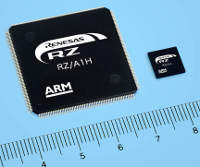
 These are the first products to appear in the new RZ family of embedded MPUs, announced by Renesas in October 2012 under the slogan "the fusion of control and IT."
Key features of the new products include 10 megabytes (MB) of on-chip RAM, the largest capacity in the industry [note 1], and the capabilities needed to implement HMIs, such as camera inputs, hardware-accelerated graphics output, OpenVG 1.1, and audio functions.
Since there is no need for additional external memory (DRAM), developers of new products can implement WXGA (1280 x 768 pixel) graphics display resolutions without worrying about long-term DRAM requirements, while also achieving improved system performance, reduced power consumption, and a lower overall system cost. Furthermore, using an ARM®-designed CPU allows developers to leverage the ARM ecosystem [Note 2], contributing to shorter system development cycles and reduced development costs.
Thanks to advances in information and communication technology (ICT) and semiconductors, all kinds of products and systems we use every day—including household appliances, industrial equipment, building maintenance systems, power grids, automobiles, and transportation infrastructure—are being connected to networks, and a "smart society" is emerging, in which all aspects of our lives are linked to the cloud. Smartphones and tablets are rapidly gaining popularity as interfaces between people and society, and demand is growing rapidly for high-resolution displays and touchscreen interfaces for common household appliances and industrial equipment.
Implementing such sophisticated networks and HMI functionality requires high levels of performance and functionality that have been difficult to achieve with MCUs alone, so traditional embedded MPUs requiring external memory (DRAM) have generally been used for such applications. This approach has several drawbacks, however. DRAM operating frequency requirements complicate system design; frequent generational changes in DRAM interfaces mean that achieving long-term provisioning stability for industrial equipment is difficult, particularly in terms of assembly area and increased electromagnetic noise; and the increasing sophistication of equipment creates a growing software development burden.
Renesas presents the new RZ/A1 series as a solution to these problems.
Details of the new product features:
1) DRAM-free solutions with large on-chip RAM capacity, eliminating concerns related to external DRAM while contributing to improved system performance and reduced costs.
The new products come with the industry's largest on-chip memory: 10 MB. This large on-chip RAM capacity means that the internal memory is sufficient to handle instruction codes during program execution and the large volumes of image data required for HMI applications, such as graphics processing. Therefore, there is no need for external DRAM. This means that, in addition to eliminating concerns regarding DRAM purchases, the overall system cost is lower because a smaller mounting area is sufficient since fewer chips are needed; power consumption and electromagnetic noise generation are reduced; the cost of the printed circuit board is low; and a cheaper power supply can be used because no dedicated power supply is required for the DRAM.
Furthermore, with on-chip RAM, there are no bandwidth limitations imposed by the number of chip pins. Low-latency memory access bandwidth is possible, allowing overall system performance to increase by up to 30 to 50 percent [Note 3].
2) Combination of ARM CPU features and Renesas' exclusive peripherals for excellent scalability.
In the future, the application of increasingly sophisticated networking functions and higher-resolution HMI functions will demand more powerful associated software development environments, in addition to hardware. Therefore, the new RZ/A1 series products employ ARM CPUs, which benefit from a global ecosystem of development tools and software, along with the peripheral functions inherited from the Renesas SH7260 series, which has a proven track record in a wide range of HMI applications. This allows developers adopting the new RZ/A1 series products to fully leverage their experience with previous Renesas products in system development.
Developers will also benefit from a broader range of highly flexible development tools from a variety of tool vendors who have supported Renesas MCUs in the past.
Furthermore, in an industry-first move, Renesas and ARM are jointly developing a version of the Cortex™-M real-time operating system, RTX CMSIS (Cortex Microcontrollers Software Interface Standard) [Note 4]-RTOS, for the Cortex-A, which provides superior processing performance. This will allow easy portability of application resources developed for the Cortex-M to the Cortex-A processor and provide performance scalability in fields that require real-time performance.





- Details
- Category: Integrated Circuits
Renesas Electronics announces the first RZ Family products with high-capacity On-Chip RAM to enable high-performance, low-cost DRAM-free system designs
Renesas Electronics, a provider of advanced semiconductor solutions, has announced a total of 15 new products in the RZ/A1 Group of embedded microprocessor solutions (MPUs) (with subcategories RZ/A1H, RZ/A1M, and RZ/A1L) for the creation of sophisticated human-machine interfaces (HMIs) for the "smart society" of the future.




Print Magazine

Annual subscription price:
You will receive all 10 editions that are published each year.
social networks
Popular News Electronics





Spanish electronics magazine. Printed for over 25 years.
Spain - Madrid - All rights reserved © Convertronic Professional Spanish Electronics Magazine.