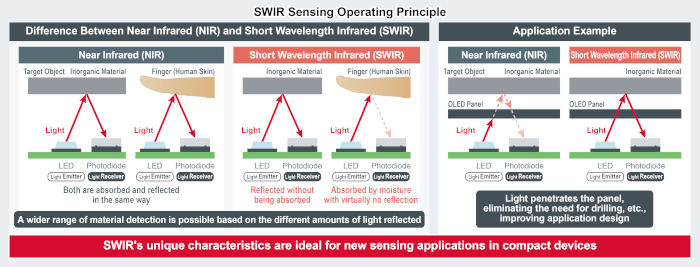
SWIR is characterized by having a longer wavelength than near-infrared (NIR), which provides greater permeability through different materials while being less susceptible to sunlight, smoke, and other particles. The goal is for this technology to expand the range of detectable substances, such as water/gas and glucose. On the other hand, until now, most SWIR devices have been of the through-hole type for relatively large applications, such as communication equipment and industrial analyzers. This means that there are very few surface-mount products available on the market suitable for compact applications.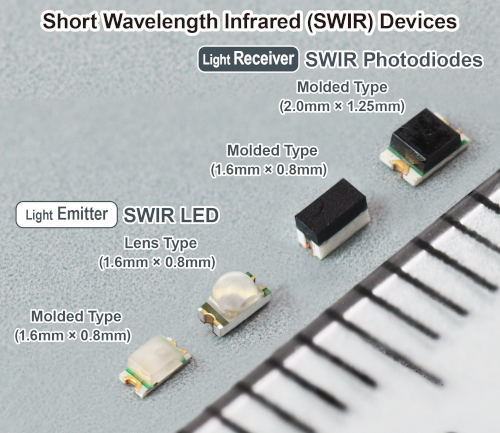
Since SWIR is used to detect the presence of substances and their constituent components by exploiting the properties of water, ice, gases, etc., which absorb specific wavelengths, target applications include light sources for devices measuring blood oxygen saturation and blood glucose in the medical field, and the measurement of water and sugar content in fruits and vegetables in the food industry. Its adoption is also planned for detection applications using OLED panels in portable and wearable devices to add health monitoring and other novel functions to these applications.
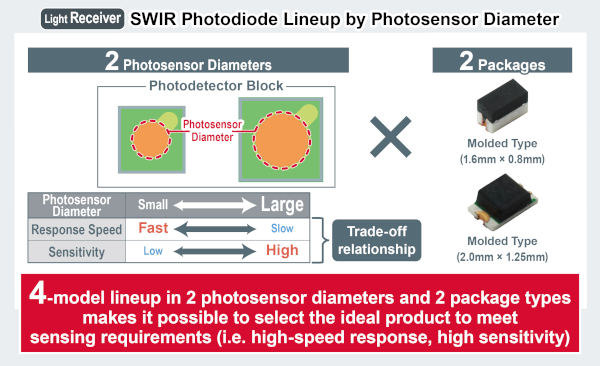
In response, ROHM has developed a mass production technology for compact, surface-mount SWIR products in size 1608 (light emitters/receivers), leveraging manufacturing technology refined during the mass production of compound semiconductors such as visible and near-infrared LEDs. For light emission, a range of 10 LEDs is planned, featuring various package shapes (molded/lensed) and wavelengths (from 1050 nm to 1550 nm). For light reception, four photodiode models will be offered in different packages (size 1608, size 20125 (2.0 mm × 1.25 mm), and photodetector block sizes).
 Samples of SWIR (light emitters/receivers) products based on this technology have been available since March 2023. In the future, ROHM will continue to explore new detection areas by supporting a wider range of material detection in compact applications.
Shortwave infrared (SWIR) devices
SWIR devices (light emitters/receivers) are now available in a best-in-class, compact, surface-mount package. Combining small light-emitting and receiving products not only saves space by reducing the mounting area, but also opens up new detection possibilities in compact applications.
 • SWIR LEDs (light-emitting side):
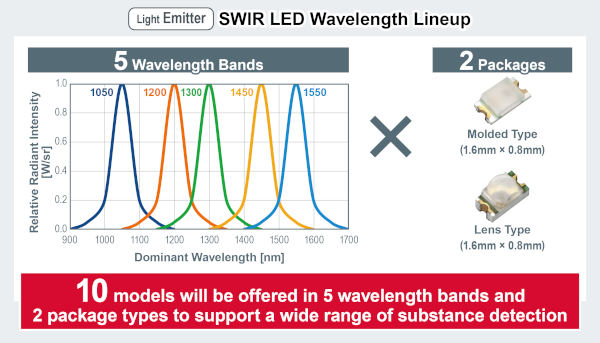
SWIR LEDs will be offered in five wavelengths (1050 nm, 1200 nm, 1300 nm, 1450 nm, and 1550 nm) to suit the characteristics of different materials, and in two surface-mount encapsulation types: a general molded type and a lens variant that features narrower emission directivity along with higher radiation intensity. In total, there will be 10 models in various combinations, contributing to a wide range of material detection, including the analysis of the presence and constituents of substances such as water, gases, and glucose.
• SWIR Photodiode (Light-Receiving Side)
SWIR photodiodes are characterized by a trade-off: the smaller the light-sensing area, the faster the response time. However, a larger area also provides higher sensitivity. For this reason, ROHM plans to offer four models in two light-receiving diameter sizes and two package types. This will allow users to select the ideal product based on application requirements, such as the need for faster response times or detection in low-light environments.
 Target applications
• Detection using OLED panels on wearable devices
• Health monitoring using wearable/audible devices
• Various inspection equipment, such as pharmaceutical analysis and checking the moisture content of food or the human body.