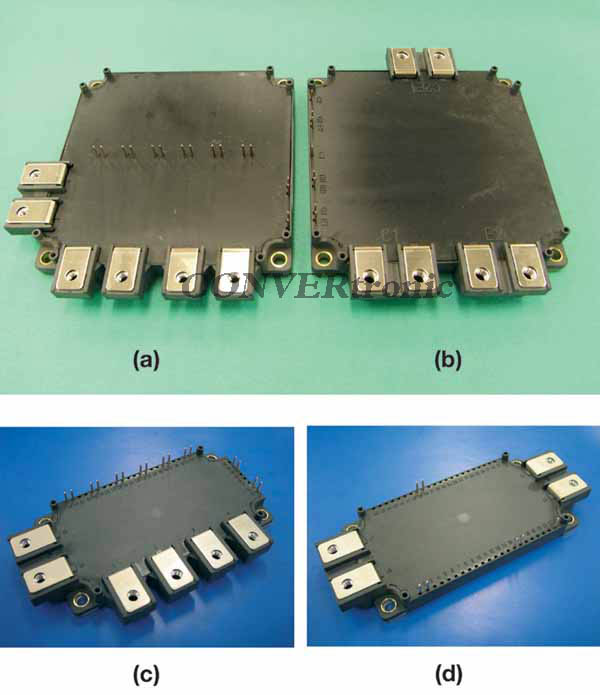
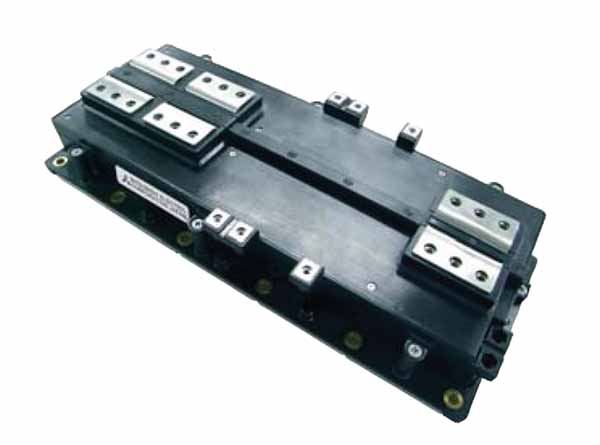
 The goal in designing SolexDrive was to create the best possible integrated circuit for controlling the fuel injectors of diesel and gasoline engines with exceptionally low emissions. In this automotive application, SolexDrive controls external MOSFET amplifiers, which are in turn connected to the injectors. These injectors are essentially actuator coils that operate with the highest level of precision.
It may seem strange at first that this chip, which originated from such a specialized automotive application, is now part of EBV's chip portfolio; however, EBV Elektronik is aware of the strong market demand for switches designed for controlling high-precision actuator coils. This demand exists not only in the automotive sector but also in a variety of industrial applications. After all, the fundamental principle of EBV chips is to open up new markets and previously unexplored opportunities; and that is precisely what EBV Elektronik has achieved once again with SolexDrive.
The field of industrial actuator coils also offers very interesting opportunities for SolexDrive. In this market segment, energy savings are not yet as critical as they are in the automotive sector, meaning that the energy-saving capabilities offered by SolexDrive, combined with its increased precision, provide EBV customers with real added value.
Continuous control: not just on or off.
In many applications, it was often only possible to configure a valve as ON or OFF. Precise dosing is very difficult to achieve with this simple ON/OFF digital controller. Specifically, when ON/OFF digital controllers are off, it is very easy for a small amount of the dosed substance (e.g., water or technical gas) to escape through the valve. This can result in improper dosing or unnecessary wear, leading to additional costs or excessive resource consumption. Continuous controllers, however, allow for more precise regulation.
It used to be the case that coils could often only be controlled with an ON/OFF function; but with SolexDrive, high-precision pulse-width modulation enables precise coil control. Depending on the application, this could mean controlling a linear coil or speed control in brushed DC motors. By combining precise control with low-side or high-side controllers, this solution opens up a wide range of possibilities.
Improved electromagnetic compatibility, more precise dosing.
Except in emergencies, high-speed valve adjustment is not usually necessary; however, it is precisely when such speed is required (as in the case of digital ON/OFF controllers) that the coil is exposed to high currents. These high incoming currents can cause switching problems: not only must the control components (including their protection circuits) be properly sized, but the high currents also produce significant electromagnetic compatibility issues.
What's more, these high inrush currents generate very high (and unnecessary) power consumption, which sometimes even needs to be compensated for. These high currents and the opposing/reversed currents to which the actuator coils are exposed when using an ON/OFF controller subject all these components to enormous fatigue, resulting in the need for frequent replacement during operation.
However, with SolexDrive, these current spikes can be avoided thanks to a PWM (pulse-width modulation) controller. This reduces electromagnetic incompatibility-related fatigue, while also improving accuracy and significantly increasing the lifespan of the actuator coils, as it minimizes problems caused by sparking.
SolexDrive in Industrial Applications
Typical applications for SolexDrive include robots with multiple actuators, as well as a wide variety of applications requiring electronic control of coils, from fuel stations to medical equipment. Wherever controllers are needed for servo motor coils, valves, inductive position actuators, liquid and gas regulators, industrial flow meters, distributed ventilation controllers, linear actuators, professional agricultural sprinkler systems, and more, SolexDrive may be the right integrated circuit for your needs.
Although not all applications require the diversity and complexity of functions that this type of component offers, it is still extremely useful, as it occupies less space on circuit boards and offers great reliability thanks to its protection and diagnostic circuits.
 In addition to the automotive sector, SolexDrive can be integrated into a wide variety of applications where motors require increased efficiency. Clear examples include applications in navigation, hoppers, snowmobiles, commercial vehicles, motorcycles, and agricultural and construction machinery.
It is well known that even relays contain coils that, due to the nature of the system in which they are integrated, only operate in two states: ON and OFF. Thanks to its attractive price, SolexDrive is a suitable module even for control relays requiring feedback or diagnostic signals with their corresponding protection circuitry.
In these types of applications, the EBV chip also significantly reduces not only the electrical stress on the relay but also the inrush current. SolexDrive can be used to simultaneously control up to seven relays in the following configuration: five in a high-side configuration and four in a low-side configuration.
The nerve center. Four SolexDrive microcores
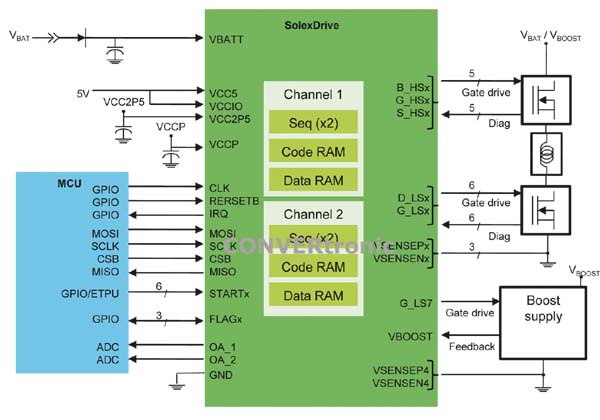
operate with two independent channels, each containing two microcores (meaning the chip includes four microcores in total). These microcores are basic microcontrollers, but they can function completely independently of each other. This would allow, for example, the programming of four entirely different and independent sequences to control the injectors of a four- or six-cylinder engine.
The microcontrollers operate independently and control the pulse-width modulator current with 65,535 distinct values. SolexDrive receives the corresponding 16-bit value via an SPI interface from a standard microcontroller, such as those typically found in motor control units. From this signal, SolexDrive generates the pulse-width modulator sequences to control the MOSFETs.
The chip has two channels, each with two sequencers and two microcores. SolexDrive can activate five controllers in a high-side configuration with five diagnostic cables, and six controllers in a low-side configuration with six diagnostic cables.
Microkernels are only of RAM type, so it is necessary to load the microcode into RAM during initialization, although there is the possibility of changing the parameters dynamically.
The
SolexDrive intelligent solution is remarkably intelligent because its integrated microcores perform all control tasks in real time throughout the entire operating period: from OFF to the acceleration phase, including online adjustment to the peak value and the power drop from the peak. It also dynamically maintains the hold state until the power drop is captured and the system returns to the OFF state. Different maximum and minimum values can be defined for each of these phases. The microcore ensures that these values are maintained by comparing, for example, the actual values with individually pre-programmed peak activation/deactivation values, target activation/deactivation values for the hold function, and various synchronization parameters.
 Therefore, developers need not worry about such complex procedures at all; all they need to do is ensure that the microcontroller supplies the appropriate current and timing specifications to SolexDrive via the SPI interface. The EBV chip takes care of the rest by adjusting the line currents according to the behavior of each actuator coil.
The PWM current pulse sent to the actuator starts on the rising edge of the microcontroller's trigger signal and ends on its falling edge. SolexDrive measures the current flowing through the coils, providing precise feedback from the coil circuit. The chip also includes the necessary protection circuitry and diagnostic functions.
An on-chip mesh switch allows developers to assign each channel to one of the four integrated sequencers, enabling SolexDrive to handle multiple channels with a single sequencer. There are four digital sequencers, each capable of managing a different channel.
The chip also includes a DC/DC converter to enable control of the MOSFETs in a high-side configuration, which, as is well known, require a higher gate voltage than source voltage. Consequently, the MOSFETs can then (with the appropriate suppression diode) be connected directly to the IC output; the necessary protection circuitry is already integrated into SolexDrive.
SolexDrive generates pulse-width modulated output signals up to 100 kHz, so it controls MOSFETs that require a load of 30 nC (50 nC maximum).
Author:
Author: Frank-Steffen Russ, Vertical Director Automotive Segment, EBV Elektronik