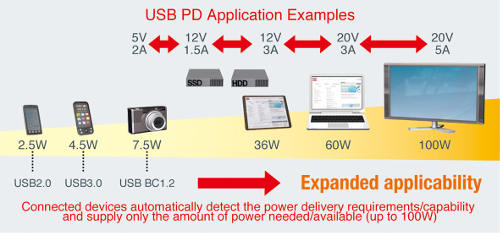
 The BM92TxxMWV series supports not only conventional USB power delivery up to 7.5W, but also the newly expanded power range of up to 100W (20V/5A) for USB Type-C connected devices. This will make it possible to control equipment with higher power requirements, such as TVs and PCs, via USB, while also allowing portable devices equipped with conventional USB (i.e., smartphones, tablets) to charge up to four times faster than the previous standard.
The last few years have seen increased demand to reduce electronic waste in many regions, including Europe, for example, through the use or development of common connectors and chargers for a variety of electronic devices. As such, the latest USB connector and power delivery standards developed by the USB Implementers Forum (USB-IF), which include USB Type-C, USB Power Delivery (along with SuperSpeed USB), and the new DisplayPort Alternate Mode standard for video support, are attracting increasing attention as a true "all-in-one" cable solution. This allows for the simultaneous delivery of high power, high-speed data, and up to 4K video through a single USB cable/port. This will eliminate the need for dedicated cables, providing greater convenience while reducing clutter and waste.
 Combining the new Type-C connector, which features a smaller, reversible cable design robust enough for laptops yet thin enough for mobile phones, with USB PD, which offers scalable power using various power delivery modes, results in a future-proof common interface. ROHM leverages leading BiCDMOS processes and circuit technologies to develop USB PD controller integrated circuits optimized for these latest USB standards.
Characteristics
 1. Supports up to 100W of power using USB Type-C connectors.
With the new power delivery standard, optimal power delivery is enabled in both directions between USB Type-C connected systems via a power contract determined by the provider (Supply) and consumer (Receiver) devices. This achieves maximum efficiency, as the consumer only requests the required amount of power and the provider only supplies the available power. Additional benefits include multiple scalable power delivery modes, from 7.5W (5V@1.5A) up to 100W (20V@5A), making it possible to power larger electronic equipment such as TVs and laptops, while allowing existing USB-equipped battery-powered devices to be charged up to four times faster than the previous standard.
2. DisplayPort Alternate Mode Support Eliminates the Need for Dedicated Video Cables.
Support is also provided for DisplayPort Alternate Mode to carry video signals over USB, eliminating the need for dedicated video cables. The ability to deliver high-speed data, video, and an unprecedented amount of power over a single cable represents a breakthrough expected to improve convenience while significantly reducing clutter and energy waste.
3. Fewer Parts Needed:
Advanced 0.13µm BiCDMOS processes and circuit technology are used to achieve greater compactness and optimization. This makes it possible to eliminate the FET and separate the power supply for the power receiving function. Compared to standard systems, the number of external parts can be reduced by more than 20 (including the external power supply IC), contributing to further miniaturization.
Availability
September 2015 (samples), December 2015 (OEM quantities)
Terminology
What does USB Power Delivery mean? It's
a USB power expansion standard that delivers up to 100W of power via USB. This allows larger devices, such as laptops, to be powered in ways not possible with conventional USB, and significantly speeds up laptop charging times.
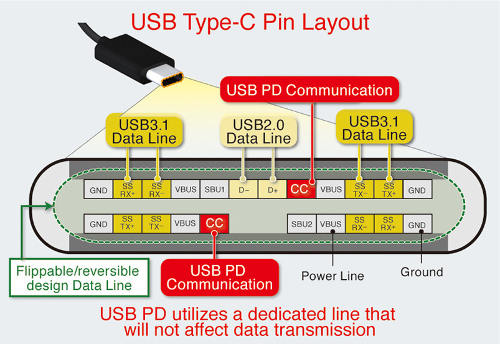
Under the USB PD protocol, connected devices negotiate their power requirements and enter into a contract to determine the optimal voltage and current levels. USB PD communication requires a dedicated DC line that operates independently of conventional USB data transmission.
USB Type-C Standard (Type-C Connector)
Defined under USB 3.1, USB Type-C is a new receptacle (concave connector), connector (convex connector), and cable standard that offers a more compact, reversible design. Unlike the previous standard, which required Type-B connectors for downstream devices and Type-A connectors for upstream devices, both ends of a Type-C cable are the same, and power requirements are negotiated between the connected devices to determine whether the downstream or upstream ports (UFP and DFP) are used, providing greater convenience and usability.
USB Implementers Forum, Inc. (USB-IF)
A standards promotion organization established in 1995 to support the creation, management, and adoption of USB standards; USB-IF currently has over 800 member companies and continues to help bring USB-compatible devices to market.