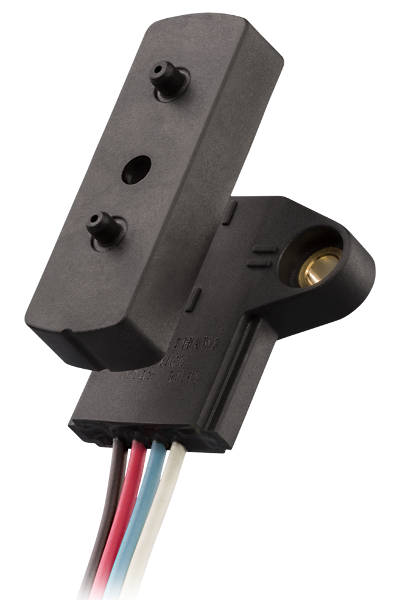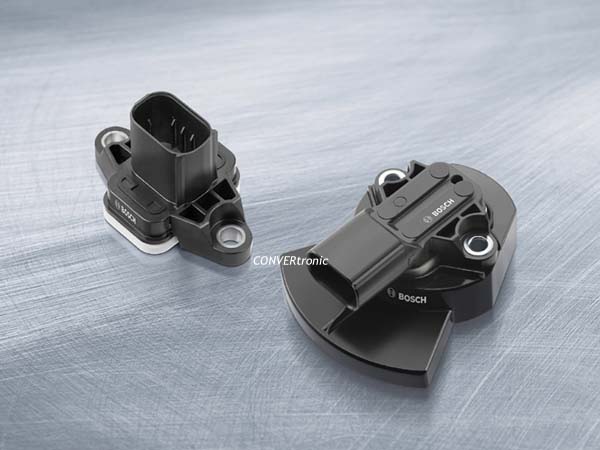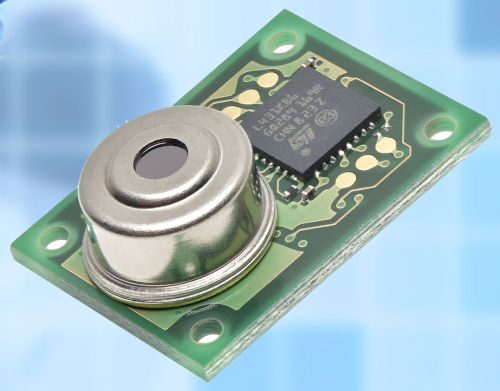


 These so-called “hybrid” vehicles are capable of meeting or exceeding customer expectations in terms of power and responsiveness with lower fuel consumption, thus emitting fewer exhaust gases. The new electrical systems incorporated in these vehicles, such as brake energy recovery systems, start-stop capabilities, and electric motors that control the wheels, all require precise measurement and control of the electricity flowing through the vehicle to optimize performance and prevent catastrophic failure. A fundamental part of these systems is the battery current sensor, which measures the battery's charge and discharge levels, as well as its overall health. Several technologies exist for creating a reliable battery current sensor for automobiles.
The shunt sensor has been the option chosen by some car manufacturers, while others prefer to use the Hall effect or magnetic induction sensors in their designs. As is often the case, each technology has its advantages and disadvantages.
Shunt-based current sensors have been widely used over the past decade to measure battery current, particularly in high-end cars. These cars employ advanced electronics to monitor the battery's charging capacity and overall condition, and sometimes also some form of electric assistance to enhance performance. The shunt is a resistor made of relatively expensive materials such as manganese or nickel-chromium alloys, whose impedance is very low, well-known, and precisely characterized within a range of temperatures and voltages. By measuring the voltage drop across the shunt resistor, the current flow through the resistor can be calculated using Ohm's law. This resistor is placed in the current flow path to and from the car's battery, thus providing accurate, high-resolution information on voltage and current (a temperature sensing function is also added). Furthermore, they can measure a wide range of current amplitudes, from milliamps to over a thousand amps in the short bursts generated when the car starts. Shunts have a problem when measuring very high currents because they must be sized to accept high current flows and dissipate a significant amount of power. These advantages, along with the lack of equivalent performance alternatives over the past decade, have made them the preferred choice for manufacturers of high-end cars, albeit at the expense of a relatively high cost per unit.
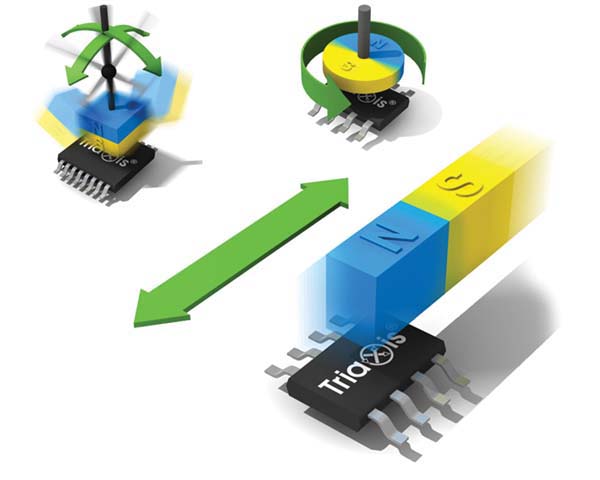
 Hall effect current sensors have been used in industrial applications for several decades and in the automotive industry for many years. Hall effect sensors are sensitive to magnetic fields. By concentrating the magnetic fields generated by currents flowing through the battery cable onto the sensor's Hall cell, for example, the sensor outputs a signal proportional to the current. This signal can then be processed in the analog or digital domain to remove noise and compensate for errors inherent in the technology. An analog output (voltage), or some type of PWM or SENT signal, can be provided to the vehicle's battery management processors, which in turn will be integrated to determine the battery's charge and/or health.
One of the characteristics of Hall effect sensors that has prevented some car manufacturers from using them in their battery management systems, especially in high-end vehicles, is their offset error. Electrical and magnetic offset errors increase the uncertainty of the measured signal. They cannot be fully compensated for, which can affect battery charge level calculations. Offset error is also temperature-dependent, sometimes with significant variations between devices. Shunt-based sensors do not experience these magnetic hysteresis effects. Total errors of 3 to 5 percent were common in Hall cell sensors just a few years ago. Recent technological advances have reduced this error to 1 or 2 percent in many cases. Chip or magnetic core designs of Hall effect sensors are driving this progress to a greater extent. By comparison, shunt sensors have an accuracy of around 1 percent.
Hall effect sensors have several advantages over shunt-based sensors, the main ones being isolation and reliability. Hall effect sensors are galvanically isolated from the primary current because they are located around the wire and capture the magnetic field across the space to provide their reading. They can withstand much higher current and voltage spikes without damage. Furthermore, the placement of Hall effect sensors is not limited to the battery terminal post, as is the case with most shunts, but can be positioned at any point along the wire or conductor whose current needs to be measured. This provides car manufacturers with significant cost advantages, as they can purchase a single standard component for various engine and battery configurations with different wire lengths. Manufacturing Hall effect sensors is generally much less expensive than for equivalent shunts.
Shunts employ large quantities of expensive materials and electronic devices to filter and condition the output signal, whereas Hall effect sensors require only small amounts of ferrous material and an integrated circuit (ASIC). If a shunt is required to provide galvanically isolated output, a considerable cost is added to the product. The compelling cost-benefit ratio of Hall effect technology has led many car manufacturers to choose it for their battery current sensing applications, at the expense of a modest reduction in accuracy compared to shunt-based alternatives.
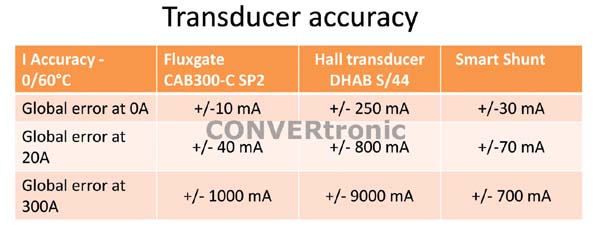
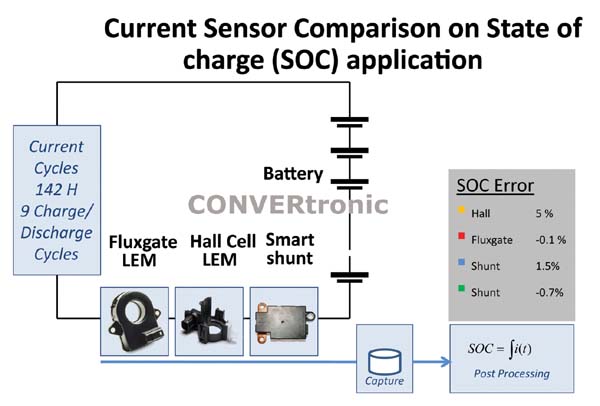
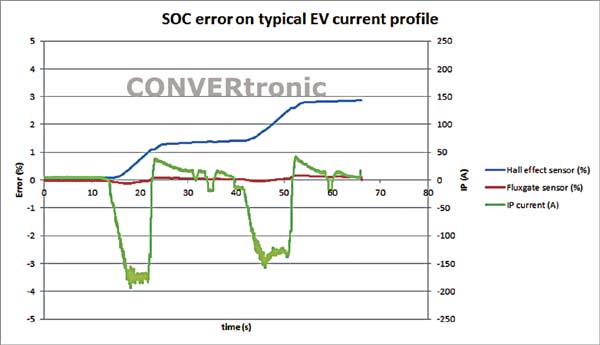
Magnetic induction (fluxgate) technology bridges the gap between Hall effect sensors and shunts by offering the advantages of an isolated sensor with a negligible signal-to-offset ratio. For many years, this technology was used in expensive industrial components, but magnetic induction current sensors are now available in approved automotive solutions at costs comparable to shunts. Much like Hall effect sensors, they are sensitive to the magnetic fields generated around the primary wire. However, their measurement principle is unique: any offset signal is automatically canceled by the alternating currents in the windings of the solid magnetic core. The measurement error of magnetic induction sensors is less than 0.5%, with an overall offset of less than 10 mA in a 400 A range product, giving them an inherent advantage (Fig. 1). By integrating current values over time to calculate the state of charge in a vehicle, for example, the effect of improved accuracy is multiplied, giving magnetic induction sensors a clear advantage over Hall effect sensors and even shunt-based technologies (Fig. 2 and Fig. 3). They can also be positioned anywhere along the conductor, near or far from the battery, thus offering car manufacturers the design flexibility needed to reduce costs. Magnetic induction sensors are ideal for hybrid and electric vehicles, where current measurement is critical and high current amplitudes and sensor isolation pose a challenge for shunt-based alternatives.
 Several technologies exist for measuring battery currents in automobiles, each with its own advantages and disadvantages. High-end car manufacturers have historically favored shunt-based solutions due to their high accuracy and wide measurement range. Magnetic induction technology, initially reserved for very high-level industrial applications, has evolved to be competitively priced for automotive applications, offering better accuracy than shunts while maintaining galvanic isolation. When cost remains the top priority, Hall effect sensors are the ideal solution. Their main historical drawback (offset errors) is being addressed through technological advancements to deliver accuracy in a low-cost product. The growing need for electrical current measurements in cars presents an opportunity for further development of these various technologies, making them a fundamental element in the design and production of future automotive systems.
Author:
By: Ramon Portas and Gauthier Plagne, LEM