

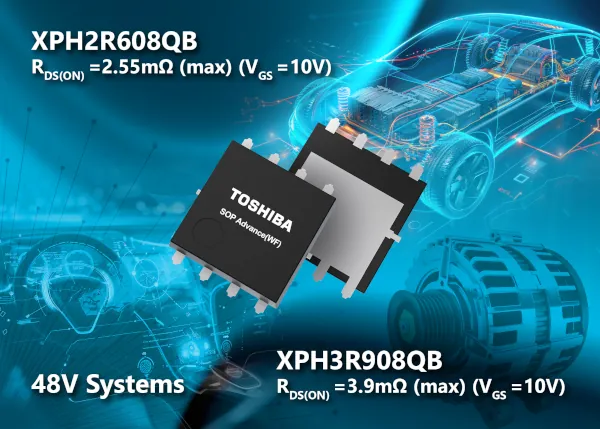
Thanks to Toshiba's U-MOSX-H process, the products achieve low active-state resistance (RDS(ON)), allowing designers to maximize efficiency in their 48V systems, thereby improving performance and extending vehicle battery life. The RDS(ON) of the XPH2R608QB is 2.55 mΩ (max.) with a full gate load (Qg) of 95 nC (typ.), and 3.9 mΩ (max.) and 63 nC (typ.) for the XPH3R908QB; both with a gate-to-source voltage (VGS) of 10 V (max.).
Furthermore, the SOP WF package with a copper connector structure reduces MOSFET package resistance, improving efficiency, enhancing heat dissipation, and increasing system reliability. The package's wettable edge design improves the visibility of solder fillets, facilitating verification of board assembly conditions using automated optical inspection (AOI) equipment, thus improving overall system reliability.
The XPH2R608QB and XPH3R908QB models are suitable for use in N-channel brushless DC (BLDC) motor drive circuits and non-isolated DC-DC buck converters. In addition to 28V automotive systems, other applications include motor drives, switched-mode power supplies, and load switches. The 80V U-MOSX-H series for automotive applications also includes the XPQR8308QB, which features a high-heat-dissipation L-TOGL package. Toshiba will continue to develop automotive MOSFET products suitable for 48V systems to meet diverse customer needs and support various automotive applications.