

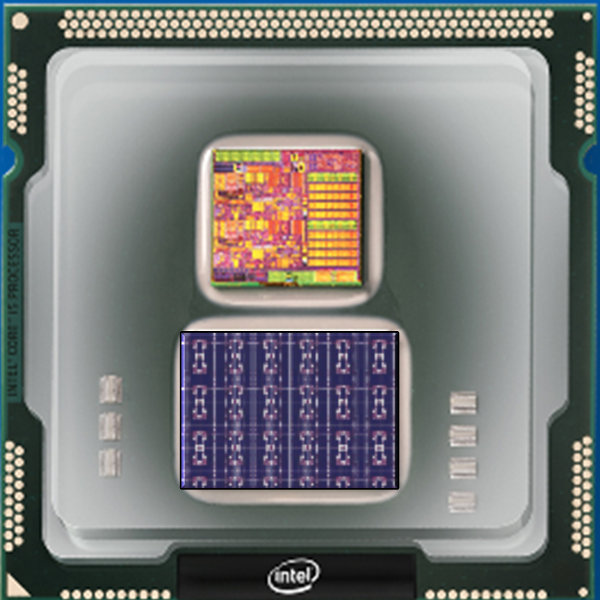
As part of the work done at Intel Labs, Intel has developed the first-of-its-kind neuromorphic self-learning chip—the Loihi test chip—which mimics brain functions, learning to operate based on different response modes to environmental stimuli. This highly energy-efficient chip uses data to learn and make inferences, becomes smarter over time, doesn't require traditional training, and takes a novel approach to computing using asynchronous electrical activity action potentials (spikes).
We believe AI is in its early stages and that more architectures and methods—like the Loihi chip—will continue to emerge to advance AI. Neuromorphic computing draws on current knowledge of brain architecture and its associated computations. The brain's neural networks obtain information through electrical impulses, or action potentials, and modulate synaptic strength, or the weight of interconnections, based on the duration of these action potentials, storing these changes locally within the interconnections. Intelligent behaviors arise from cooperative and competitive interactions between multiple areas within the brain's neural networks and their environment.
Machine learning models—such as deep learning—have made great strides in recent times by using large datasets for training and object and event recognition. However, unless this training data has specifically accounted for an element, situation, or circumstance, these machine learning systems do not generalize well.
The potential benefits of self-learning chips are endless. One example involves reading a person's heart rate in different states—after running, after a meal, or before going to bed—and feeding it to a neuromorphic system that analyzes the data to determine a "normal" heart rate. The system can then continuously monitor data from the heart to identify patterns that deviate from the "normal" pattern. This system can be customized for any user.
This type of logic can be applied to other use cases, such as cybersecurity, where an abnormality or difference in the data could identify unauthorized access, because the system has learned a pattern of "normality" in different contexts.
Introducing the Intel Loihi Test Chip:
The Intel Loihi research test chip incorporates digital circuitry that mimics the brain's basic mechanics, speeding up and increasing the efficiency of artificial intelligence with less computing power. The chip's neuromorphic models are based on the communication and learning patterns of neurons, utilizing electrical activity action potentials and synaptic plasticity that can be modulated based on their duration. This helps computers to self-organize and make decisions based on patterns and associations.
The Intel Loihi test chip offers flexible on-chip learning, combining training and inference on a single chip. This allows machines to be autonomous and adapt in real time, rather than waiting for the next update from the cloud. Researchers have demonstrated learning over a million times faster than other typical electrical activity action potential neural networks, based on the total number of operations required to achieve a given accuracy in solving digit recognition problems using the MNIST database. Compared to technologies such as convolutional neural networks and deep learning neural networks, the Intel Loihi test chip uses far fewer resources for the same task.
The self-learning capabilities prototyped by this test chip have enormous potential for improving applications in the automotive, industrial, and personal robotics sectors—any application that can benefit from autonomous operation and continuous learning in an unstructured environment, such as recognizing the movement of a vehicle or bicycle.
Furthermore, it saves up to 1,000 times more energy than the general-purpose computing required by typical training systems.
In the first half of 2018, the Intel Loihi test chip will be distributed to leading universities and research institutions for the development of AI technology.
Additional Highlights
Among the features of the Loihi test chip, we can highlight:
- A fully asynchronous, multi-core neuromorphic network that supports a wide range of sparse, hierarchical, and recurrent neural network topologies, where each neuron is capable of communicating with thousands of other neurons.
- Each neuromorphic core includes a learning engine that can be programmed to adapt to network parameters during operation, supporting supervised, unsupervised, and reinforcement learning paradigms (among others).
- It was manufactured using Intel's 14nm process technology.
- It has a total of 130,000 neurons and 130 million synapses.
- The development and testing of several algorithms with high algorithmic efficiency for solving problems such as path planning, constraint satisfaction, isolated coding, dictionary learning, and dynamic pattern learning and adaptation.