

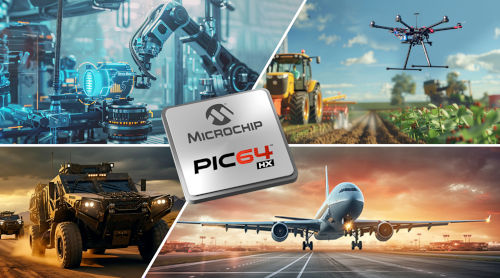
Microchip Technology has announced its PIC64HX family of microprocessors. Unlike traditional microprocessors, the PIC64HX family is specifically designed to meet the unique requirements of intelligent edge designs.
The PIC64HX, the latest addition to Microchip's 64-bit portfolio, is a 64-bit multi-core RISC-V® microprocessor capable of delivering advanced AI and machine learning processing, integrating Time-Sensitive Networking (TSN) connectivity and military-grade post-quantum security. PIC64HX microprocessors are specifically designed to provide fault tolerance, resilience, scalability, and efficient power consumption.
“The PIC64HX microprocessor is truly revolutionary because of the number of advanced features we can offer in a single solution,” said Maher Fahmi, corporate vice president of Microchip’s communications business unit. “Furthermore, the integration of TSN Ethernet switching into the microprocessor helps developers combine standards-based network connectivity and computing to simplify system design, reduce costs, and shorten time to market.”.
The integrated Ethernet switch includes a set of TSN functions compatible with important emerging standards: IEEE P802.1DP TSN for onboard Ethernet communications in the aerospace segment, IEEE P802.1DG TSN profile for in-vehicle Ethernet communications, and IEEE/IEC 60802 TSN profile for industrial automation.
Eight 64-bit SiFive Intelligence™ X280 RISC-V CPU cores with vector extensions help deliver high computing performance in mixed-criticality systems, virtualization, and vector processing to accelerate AI workloads.
The PIC64HX microprocessor allows system developers to utilize the cores in various ways to deliver SMP, AMP, or dual-core coprocessing operations. It also supports the WorldGuard hardware architecture for hardware isolation and partitioning.
“Next-generation aircraft require new processors for mission-critical applications such as flight control, cockpit displays, cockpit networking, and engine control. The OHPERA Consortium considers RISC-V technology a key component for the future of safe and sustainable aviation,” said Christophe Vlacich, OHPERA Technical Lead. The OHPERA Consortium comprises leading aerospace companies with the shared goal of evaluating new technologies for the next generation of aircraft. “We are pleased to see the upcoming availability of commercial products such as Microchip’s PIC64HX microprocessor, which offers the computing performance, partitioning, connectivity, and security needed for the future of aviation.”.
The anticipated arrival of quantum computers poses an existential threat, as they will render current security measures ineffective. As a result, public bodies and companies worldwide are beginning to require the integration of post-quantum cryptography into all critical infrastructure. With an eye toward meeting current and future security needs, the PIC64HX is one of the first microprocessors on the market to offer comprehensive, military-grade security, including the recently NIST-standardized FIPS 203 (ML-KEM) and FIPS 204 (ML-DSA) post-quantum cryptographic algorithms.
The PIC64HX microprocessor is a powerful and versatile solution for smart warehouse applications that meets key requirements for low latency, security, reliability and compliance with industry standards.
Development Tools:
The PIC64HX microprocessor is supported by a powerful suite of tools, libraries, drivers, and boot firmware. It is compatible with a variety of open, commercial, and real-time operating systems, including Linux® and RTEMS, as well as hypervisors such as Xen. PIC64HX microprocessors leverage Microchip's extensive Mi-V ecosystem of design tools and resources in its RISC-V initiatives. To help shorten development cycles and accelerate time to market, Microchip offers the Curiosity Ultra+ PIC64HX evaluation kit and collaborates with single-board computer partners.
“Aries Embedded has long supported the RISC-V ecosystem,” said Andreas Widder, CEO of Aries Embedded. “We are proud to be a leading System-on-Modules partner for PIC64HX and look forward to continuing to help Microchip develop intelligent edge applications for mission-critical applications.”.
+