
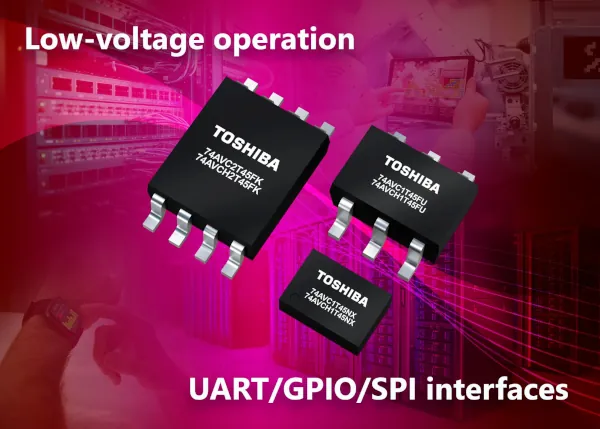
These components can be used for bidirectional level shifting between 0.7 V or 0.8 V and up to 3.6 V without the need for additional components, simplifying communication between low-voltage SoCs and conventional voltage industrial, consumer, and enterprise systems.
The devices employ a push-pull buffer configuration to enable high-speed operation, making them suitable for a wide range of applications, including UART, GPIO, and SPI communication interfaces. In addition to Toshiba's existing 4-bit components housed in TSSOP16B packages, these new, smaller bit configurations are available in smaller package variants, such as the pinless XSON6 and the pinned SOT-363 (US6) and SOT-765 (US8), providing engineers with system design flexibility.
The 74AVC series supports dual power supplies with no restrictions on the power-on and power-off sequence. It utilizes a directional control method using DIR pins and a high-impedance control method using power pins, which avoids conflicts in complex signal lines and improves system reliability. These features simplify power-up sequence design and help reduce the risk of malfunctions.
The 74AVCH series also includes an internal bus hold function that prevents undefined states and enables stable signal retention, reducing the need for external components such as pull-up and pull-down resistors.
Toshiba will continue to expand its range of low-voltage logic integrated circuits to meet the increasingly diverse requirements of system design and contribute to energy savings for a more efficient and sustainable society.
Nordic introduces the nRF54LC10A SoC for compact IoT devices
Nordic Semiconductor today introduced the nRF54LC10A system-on-a-chip (SoC), compatible with Bluetooth® Low Energy (LE), Bluetooth Channel Sounding, Thread, Zigbee, and Matter. The entry-level nRF54LC10A is the smallest and most energy-efficient multiprotocol SoC in the nRF54L series, combining...