

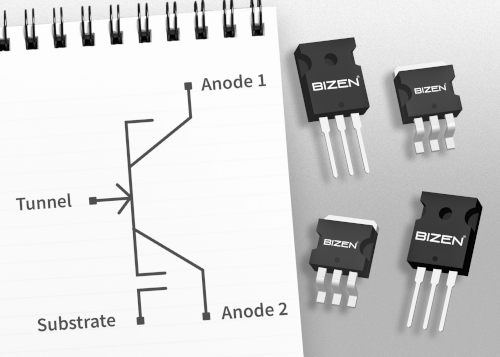
The first devices to use Bizen are members of the QJT (Quantum Junction Transistor) family, which will include three parts rated at 1200V/75A, 900V/75A, and 650V/32A, available in industry-standard TO247 or TO263 power MOSFET packages. Crucially, these devices can be manufactured using standard silicon substrates on conventional, larger-geometry silicon processing lines.
As David Summerland, CEO and founder of Nottingham-based Search For The Next (SFN), who invented Bizen technology, explains: “To achieve this level of performance from traditional silicon-based MOSFETs, the device size needs to be much larger. 1200V/75A can be achieved in a TO247 package using wide-bandgap materials such as silicon carbide, but this approach has other well-known problems. SiC, for example, takes much longer to process and has a significant manufacturing carbon footprint. Furthermore, regardless of roadmaps, SiC does not scale like silicon, and the economic argument that SiC can match silicon fails to account for the advancements that Bizen has made possible. On the contrary, the data we have obtained from physical wafer testing demonstrates that by using Bizen on silicon substrates, our QJTs deliver the same performance as SiC or GaN. However, the production equipment required to manufacture a QJT is exactly the same as that of…” a standard silicon MOSFET, and the Bizen process adds no additional manufacturing complexity.”.
Bizen applies quantum mechanics to a traditional bipolar wafer process. The result is a highly robust and reliable device with the heritage and pedigree of traditional bipolar silicon technology. Bizen also reduces the typical 15-week lead time for MOS integration to create large-scale integrated CMOS to less than two weeks and halves the number of process layers; the new QJTs utilize these same eight layers and wafer process.
Wafer testing also shows that the Bizen process exhibits an effective current gain of over 1 million. This will enable a direct connection between the 1200V/75A QJT power transistor and a low-voltage, low-current CPU output port, such as a PWM. Summerland concludes: “The QJT is the first power device on the Bizen family roadmap. This will soon lead to the PJT (Processor Junction Transistor), a Bizen device integrated with its own processor that can also be produced in an eight-day manufacturing cycle, heralding a new era of smart power devices.”.
SFN has also published other comparative performance metrics for a 1200 V/100 A component, also in a TO247 package, which is on its short-term roadmap. Losses at rated current will be a quarter (<300 mV) of those exhibited by the SiC device, and its input capacitance will also be four to five times lower (<1 pF).