
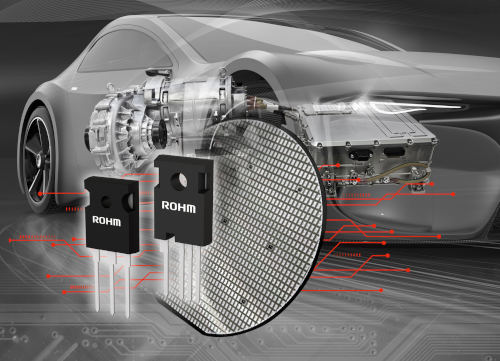
In recent years, the proliferation of next-generation electric vehicles (xEVs) has accelerated the development of smaller, lighter, and more efficient electrical systems. Specifically, improving the efficiency and reducing the size of the main inverter, which plays a central role in the drive system, remains one of the most significant challenges and requires further advancements in power devices.
The capacity of onboard batteries is increasing to improve the cruising range of electric vehicles. And in parallel, the use of high-voltage (800 V) batteries is also progressing to meet the demand for shorter charging times.
To address such diverse challenges, designers urgently need SiC power devices capable of delivering high, non-disruptive voltage with low losses. ROHM, a pioneer in SiC, began mass production of SiC MOSFETs in 2010, placing it at the forefront of the industry. From the outset, ROHM has been strengthening its extensive product range to include AEC-Q101-qualified products, enabling the company to achieve a significant market share in the automotive on-board charger (OBC) sector.
In the case of power semiconductors, there is often a trade-off between lower on-resistance and short-circuit withstand time, which is necessary to achieve a balance and, in turn, lower on-resistance in SiC MOSFETs. ROHM has successfully improved this trade-off, reducing on-resistance per unit area by 40% compared to conventional products, without sacrificing short-circuit withstand time by further refining an original double-trench structure. Furthermore, the significant reduction in parasitic capacitance (a problem that arises during switching) allows for a 50% lower switching loss compared to our previous generation of SiC MOSFETs.
As a result, ROHM's new 4th generation SiC MOSFETs are capable of delivering low on-resistance with high-speed switching performance, contributing to further miniaturization and lower power consumption in a wide range of applications, including automotive inverters and switched-mode power supplies. Unpackaged chip samples have been available since June 2020, with specific packages to be offered in the near future.
As a next step, ROHM is committed to further expanding its range of SiC power devices, combining modularization technologies with peripheral devices such as integrated control circuits designed to maximize performance and contribute to technical innovation in next-generation vehicles. At the same time, ROHM will provide solutions to address customer challenges, including web-based simulation tools that reduce application development time and help avoid evaluation issues.
 Key features
1) The improved trench structure offers the lowest conduction resistance in the industry.
In 2015, ROHM began mass production of the industry's first trench-type SiC MOSFETs, using an original structure. ROHM has now successfully reduced conduction resistance by 40% compared to conventional products without sacrificing short-circuit withstand time, and has further improved its original double-trench structure.
(Fig. 1)
2) Lower switching losses by significantly reducing parasitic capacitance.
Generally, lower on-resistance and higher currents tend to increase the various parasitic capacitances in MOSFETs, which can inhibit the inherent high-speed switching characteristics of SiC.
However, ROHM has been able to achieve 50% lower switching losses compared to conventional products by significantly reducing the gate-drain capacitance (Cgd).
(Fig. 2)
Terminology at a glance: Metal-oxide-semiconductor field-effect transistors (MOSFETs) are the most commonly used structure in FETs. They are often adopted as switching elements.
 Short-circuit withstand time indicates the time it takes for a MOSFET to fail due to a short circuit. Typically, when a short circuit occurs, a large current flows, exceeding the maximum capacity. This can lead to abnormal heat generation, thermal runaway, and ultimately, destruction. A longer short-circuit withstand time is traded off with higher performance characteristics, such as on-resistance.
Double Trench Structure (Trench):
This is ROHM's original trench structure. While adopting a trench structure for SiC MOSFETs has proven effective in reducing on-drive resistance, it was necessary to mitigate the electric field generated in the trench gate section to ensure the device's long-term reliability. In response, ROHM adopted a unique double trench structure that minimizes electric field concentration, enabling it to become the first supplier to mass-produce trench-type SiC MOSFETs in 2015.
Parasitic capacitance is the inherent capacitance that arises due to the physical structure within electronic components. In the case of a MOSFET, there is a gate-source capacitance (Cgs), a gate-drain capacitance (Cgd), and a drain-source capacitance (Cds). Cgs and Cgd are determined by the gate oxide film capacitance, while Cds is the parasitic junction capacitance of the diode.
Trench Structure:
The word "trench" refers to a narrow excavation or groove. This design involves forming a groove in the chip surface and the gate in the MOSFET's sidewall. Unlike a planar MOSFET, JFET resistors are absent, allowing for a thinner structure than planar topologies and resulting in on-resistance close to the original SiC material performance.